
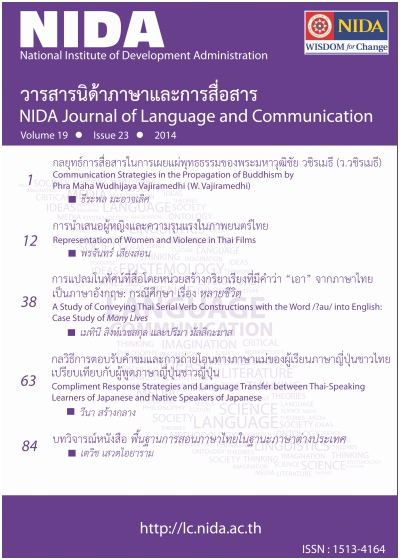
Representation of Women and Violence in Thai Films
Keywords:
violence, victims of violence, patriarchal society, cinematic narrativesAbstract
This research aims to study the cinematic representation of women and violence against/ by them. It examines the ways causes of gendered violence and violent behaviors are constructed in Thai cinema. Based on feminist, psychoanalytic, and constructionism theories, this study employs qualitative textual analysis in deconstructing the narratives of violence against / by female protagonists as shown in 10 Thai films.
The results show that the representation of women and violence against/ by them in the films are consistent with everyday reality. Often portrayed as being individualistic and self-confident, female protagonists in the studied films are shown to be true to themselves, while struggling for social change. Their presence in the films, thus, constitutes a threat challenging patriarchal social memories of women. Consequently, these women are often illustrated as being inferior to men and to an extent falling victims of violence. Particularly, an act of violence performed by a female character is ironically expressed as a way to end conflicts or violence by which the character has been intentionally or unintentionally provoked. Whether it is planned or unplanned, an act of violence can never go unpunished. All characters inflicting violence upon others eventually meet tragic endings. This type of story emphasizes that violence is not the way to solve problems.
Downloads
How to Cite
Issue
Section
License
By submitting a manuscript, the author transfers the copyright for the article to School of Language and Communication, National Institute of Development Administration (NIDA), if and when the manuscript is accepted for publication. Though the journal is an open-access, reproduction of any material published in NIDA Journal of Language and Communication for non-personal and/or commercial purpose requires a written permission from School of Language and Communication, National Institute of Development Administration (NIDA).



