
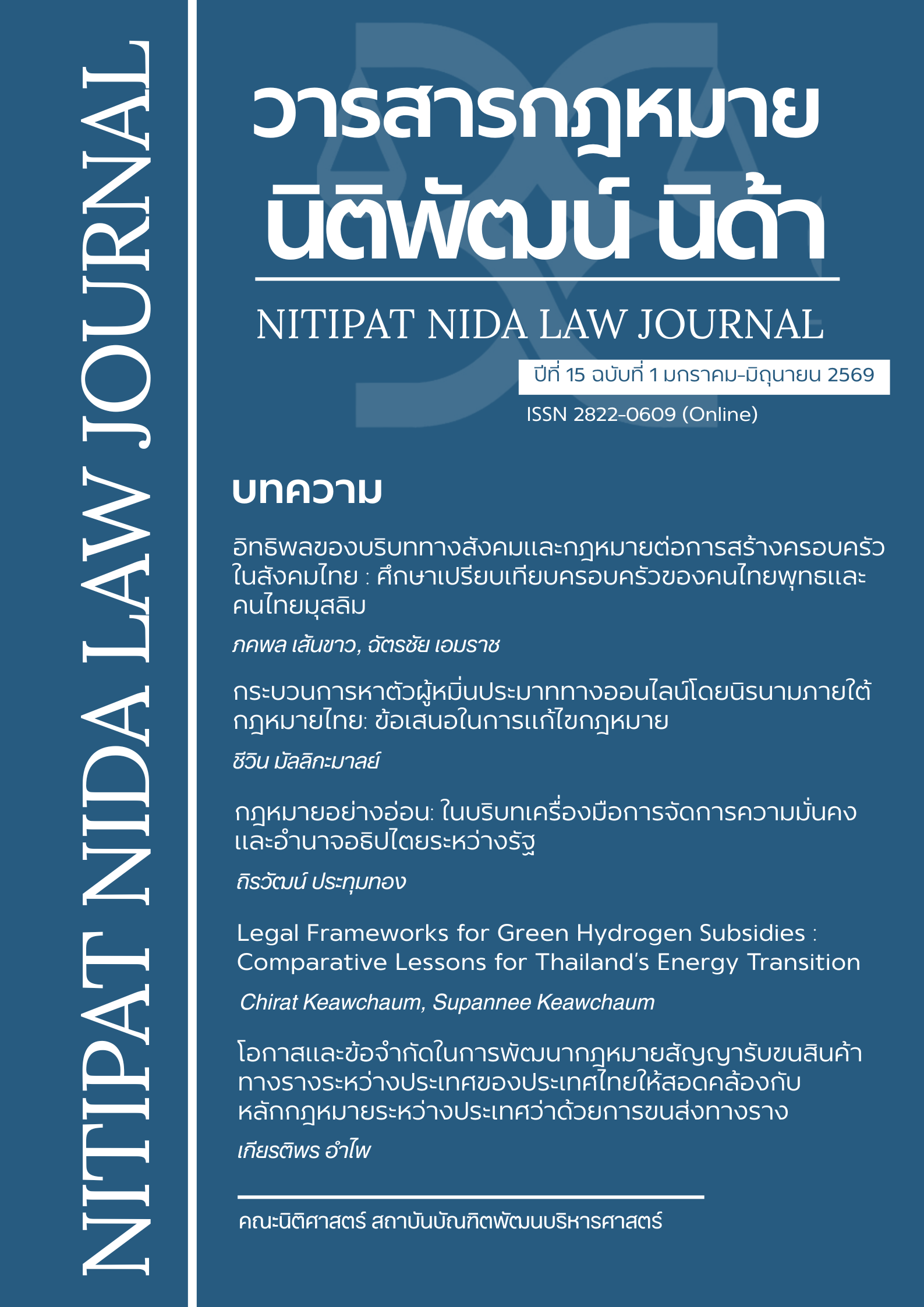
Legal Frameworks for Green Hydrogen Subsidies: Comparative Lessons for Thailand’s Energy Transition
Keywords:
green hydrogen, legal framework, green premium, contract for difference, subsidiesAbstract
To achieve Thailand's net-zero emissions target, the deployment of green hydrogen is essential. However, its implementation is hindered by the significant green premium, a barrier driven by high operational expenditure (OPEX) rather than capital expenditure (CAPEX). This research article argues that Thailand's current legal framework, based on the Board of Investment (BOI)'s investment promotion measures, which focuses on the CAPEX incentive model, is structurally misaligned and incapable of solving this OPEX-driven problem. Therefore, a tax holiday on profit is valueless for an industry if a project cannot become profitable initially. The study applies a comprehensive comparative law analysis of subsidy models in the United States, the United Kingdom, Germany, and Japan to analyze the insufficiency of the BOI's measures and propose operable and bankable alternatives. It recommends that a new legal and financial framework for Thailand should be established with three integrated components: (1) a two-way Contract for Difference (CfD) for long-term risk diversification; (2) a GX Bond mechanism for debt financing, modeled after Japan and guaranteed by a future carbon tax; and (3) a Multi-Criteria Auction (MCA) to ensure project readiness and effective procurement. This paradigm shifts from providing passive incentives to becoming an active state partner is essential for creating a bankable market.
References
Abhinav Jindal, Gireesh Shrimali and Nishant Tiwary, 'At scale adoption of Green Hydrogen in Indian Industry: Costs, subsidies and policies' (2024) 83 Energy for Sustainable Development 101549 <https://doi.org/10.1016/j.esd.2024.101549> accessed 7 November 2025.
Alexander Hoogsteyn and others, 'Interactions and Distortions of Different Support Policies for Green Hydrogen' (2025) 141 Energy Economics 108042 <https://doi.org/10.1016/j.eneco.2024.108042> accessed 7 November 2025.
Ayatte I Atteya and others, 'A Comprehensive Review on The Potential of Green Hydrogen in Empowering the Low-Carbon Economy: Development Status, Ongoing Trends and Key Challenges' (2023) 2(1) Green Energy and Environmental Technology 1 <https://doi.org/10.5772/geet.23> accessed 7 November 2025.
Bijay B Pradhan and others, 'Role of green hydrogen in the decarbonization of the energy system in Thailand' (2024) 51 Energy Strategy Reviews 101311 <https://doi.org/10.1016/j.esr.2024.101311> accessed 7 November 2025.
Donna M Attanasio and Meghan Briggs, ‘Hydrogen Regulation in the United States: Will Government Financial Incentives Outweigh Regulatory Hurdles? ' in Ruven Fleming (ed), The Cambridge Handbook of Hydrogen and the Law (Cambridge University Press 2024) <https://doi.org/10.1017/9781009459259.004> accessed 7 November 2025.
Gabriela Gonçalves Dias Ponzi and others, 'The hydrogen life cycle assessment methodology: an overlooked puzzle piece in harmonizing hydrogen certification and trade' (2024) 26 Clean Technologies and Environmental Policy 2573 <https://doi.org/10.1007/s10098-024-02752-y> accessed 7 November 2025.
Ibrar Ahmad, Jamil Afzal and Siraj Ahmad, ‘Regulatory Analysis of Energy Law and Hydrogen Economy' in Ibrar Ahmad, Jamil Afzal and Siraj Ahmad (eds) Legal Framework of Green Hydrogen Production and Hydrogen Economy for Sustainable Development (SCOPUA Books 2025) <https://doi.org/10.64060/978-627-7898-00-7-4> accessed 7 November 2025.
Ibrar Ahmad, Jamil Afzal and Siraj Ahmad, 'International and Comparative Law Perspectives of Hydrogen Economy' in Legal Framework of Green Hydrogen Production and Hydrogen Economy for Sustainable Development (SCOPUA Books 2025) <https://doi.org/10.64060/978-627-7898-00-7-3> accessed 7 November 2025.
John Chandler and John Paterson, 'Selling sunshine: Emerging challenges in the certification of hydrogen' (2025) 43(1) Journal of Energy & Natural Resources Law 47 <https://doi.org/10.1080/02646811.2024.2344363> accessed 7 November 2025.
Laima Eicke, 'US Hydrogen Policy: Paving the Way for Energy Independence or Fueling the Geopolitical Competition of Subsidies?' in Rainer Quitzow and Yana Zabanova (eds), The Geopolitics of Hydrogen Volume 2: Major Economies and Their Strategies (Springer Nature Switzerland 2025) < https://doi.org/10.1007/978-3-031-84022-7_4> accessed 7 November 2025.
Rainer Quitzow and Yana Zabanova, ‘The Emerging Geopolitics of Hydrogen: Navigating Uncertainty and Industrial Legacies Within the Net-Zero Transition’ in Rainer Quitzow and Yana Zabanova (eds), The Geopolitics of Hydrogen Volume 2: Major Economies and Their Strategies (Springer 2025) <https://doi.org/10.1007/978-3-031-84022-7_9> accessed 7 November 2025.
Shahrouz Nayebossadri, Michael Walsh and Michael Smailes, 'An Overview of the Green Hydrogen Value Chain Technologies and Their Challenges for a Net-Zero Future' (2025) 6(2) Hydrogen 26 <https://doi.org/10.3390/hydrogen6020026> accessed 7 November 2025.
Silvia Weko, ‘The UK Hydrogen Strategy: Industrial Decarbonization and Industrial Policy’ in Rainer Quitzow and Yana Zabanova (eds), The Geopolitics of Hydrogen Volume 2: Major Economies and Their Strategies (Springer Nature Switzerland 2025) <https://doi.org/10.1007/978-3-031-84022-7_6> accessed 7 November 2025.
Thailand Board of Investment, A Guide to Investment Promotion 2025 (2025).
Wenting Cheng and Sora Lee, 'How Green Are the National Hydrogen Strategies?' (2022) 14 Sustainability 1930 <https://doi.org/10.3390/su14031930> accessed 7 November 2025.
Xianyou Pan and others, 'The effects of government subsidies on the economic profits of hydrogen energy enterprises - An analysis based on A-share listed enterprises in China' (2023) 211 Renewable Energy 445 <https://doi.org/10.1016/j.renene.2023.04.093> accessed 7 November 2025.
Yana Zabanova and Rainer Quitzow, ‘Hydrogen Policy in the EU: Navigating the Union’s Internal Dynamics and Geopolitical Challenges’ in Rainer Quitzow and Yana Zabanova (eds), The Geopolitics of Hydrogen Volume 2: Major Economies and Their Strategies (Springer 2025) <https://doi.org/10.1007/978-3-031-84022-7_2> accessed 7 November 2025.
Yuma Osaki and Llewelyn Hughes, 'Japan: Putting Hydrogen at the Core of Its Decarbonisation Strategy' in Rainer Quitzow and Yana Zabanova (eds), The Geopolitics of Hydrogen Volume 2: Major Economies and Their Strategies (Springer Nature Switzerland 2025) 105 <https://doi.org/10.1007/978-3-031-84022-7_5> accessed 7 November 2025.
Downloads
Published
How to Cite
Issue
Section
License
Copyright (c) 2026 Nitipat NIDA Law Journal

This work is licensed under a Creative Commons Attribution-NonCommercial-NoDerivatives 4.0 International License.

