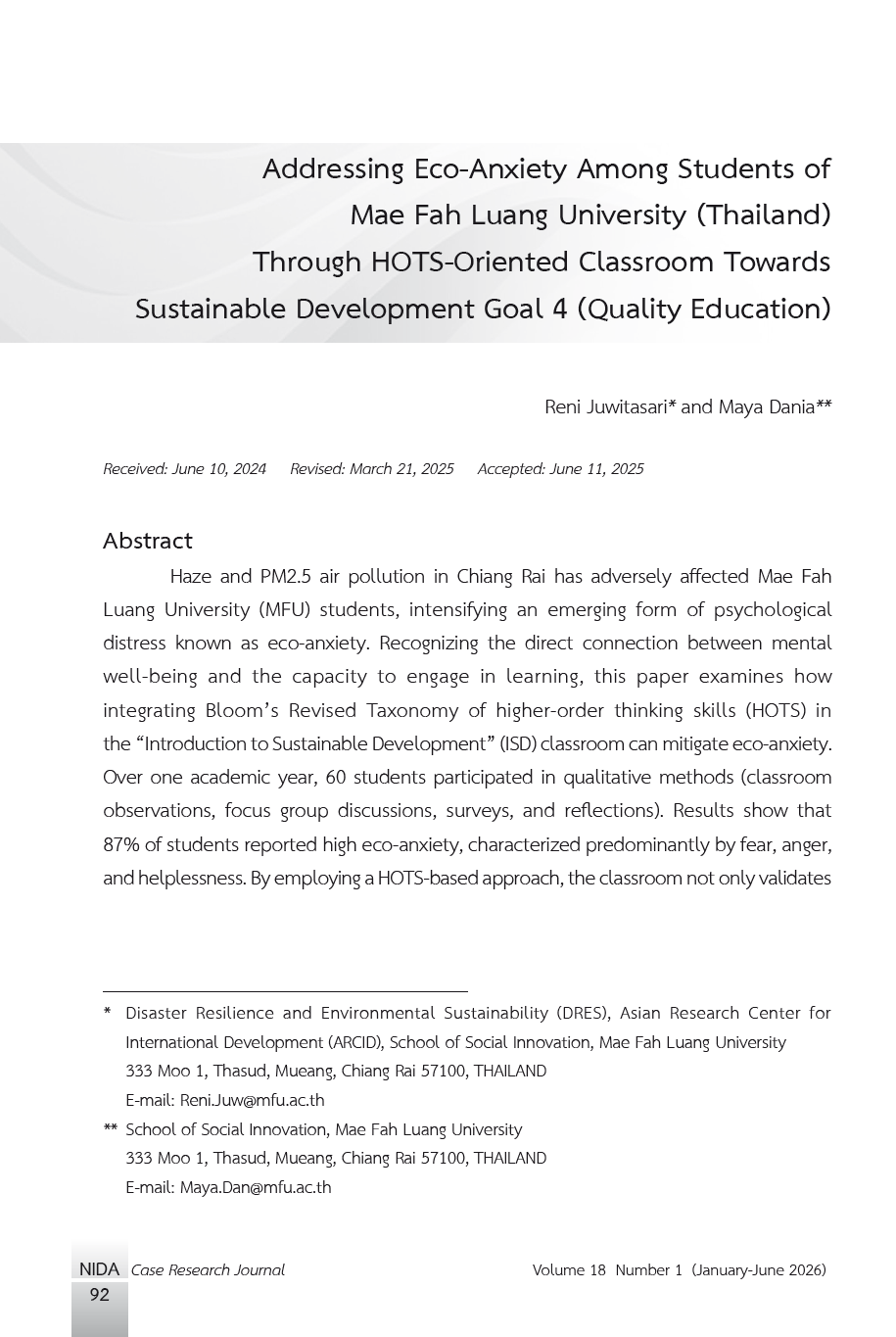
Addressing Eco-Anxiety Among Students of Mae Fah Luang University (Thailand) Through HOTS-Oriented Classroom Towards Sustainable Development Goal 4 (Quality Education)
DOI:
https://doi.org/10.14456/ncrj.2026.4Keywords:
Eco-Anxiety, SDG 4 (Quality Education), HOTS-Oriented Classroom, Air Pollution, Mae Fah Luang UniversityAbstract
Haze and PM2.5 air pollution in Chiang Rai has adversely affected Mae Fah Luang University (MFU) students, intensifying an emerging form of psychological distress known as eco-anxiety. Recognizing the direct connection between mental well-being and the capacity to engage in learning, this paper examines how integrating Bloom’s Revised Taxonomy of higher-order thinking skills (HOTS) in the
“Introduction to Sustainable Development” (ISD) classroom can mitigate eco-anxiety. Over one academic year, 60 students participated in qualitative methods (classroom observations, focus group discussions, surveys, and reflections). Results show that 87% of students reported high eco-anxiety, characterized predominantly by fear, anger, and helplessness. By employing a HOTS-based approach, the classroom not only validates ecological emotions but also helps develop emotional resilience and empowers students to create actionable solutions to environmental challenges. These insights support SDG 4 (Quality Education) by linking cognitive skill development to students’ mental well-being and their capacity to address real-world environmental crises.
References
Albrecht, G. (2011). Chronic environmental change: Emerging ‘psychoterratic’ syndromes. In I. Weissbecker (Ed.), Climate change and human well-being (pp. 43–56). Springer. https://doi.org/10.1007/978-1-4419-9742-5_3
Aprilia, A., & Aminatun, D. (2022). Investigating memory loss: How depression affects students’ memory endurance. Journal of English Language Teaching and Learning, 3(1), 1-11. https://doi.org/10.33365/jeltl.v3i1.1719
Bailey, T. H., & Phillips, L. J. (2016). The influence of motivation and adaptation on students’ subjective well-being, meaning in life and academic performance. Higher Education Research & Development, 35(2), 201-216. https://doi.org/10.1080/07294360.2015.1087474
Berkowitz, A. R., Ford, M. E., & Brewer, C. A. (2005). A framework for integrating ecological literacy, civics literacy, and environmental citizenship in environmental education. In E. A. Johnson & M. J. Mappin (Eds.), Environmental education and advocacy: Changing perspectives of ecology and education (pp.227–266). Cambridge University Press.
Bettis, A. H., Coiro, M. J., England, J., Murphy, L. K., Zelkowitz, R. L., Desjardins, L., ...& Compas, B. E. (2017). Comparison of two approaches to prevention of mental health problems in college students: Enhancing coping and executive function skills. Journal of American College Health, 65(5), 313-322, https://doi.org/10.1080/07448481.2017.1312411
Boeve-de Pauw, J., Gericke, N., Olsson, D., & Berglund, T. (2015). The effectiveness of education for sustainable development. Sustainability, 7(11), 15693-15717. https://doi.org/10.3390/su71115693
Brophy, H., Olson, J., & Paul, P. (2023). Eco-anxiety in youth: An integrative literature review. International Journal of Mental Health Nursing, 32(3), 633-661. https://doi.org/10.1111/inm.13099
Chansilp, K., Chuaybamroong, P., Kerdprasop, K., & Kerdprasop, N. (2020). On modeling smoke-haze incidence with cluster and regression analyses. International Journal of Machine Learning and Computing, 10(6), 880–884. https://doi.org/10.18178/ijmlc.2020.10.6.1004
Clayton, S., Manning, C., Krygsman, K., & Speiser, M. (2017). Mental health and our changing climate: Impacts, implications, and guidance. American Psychological Association and ecoAmerica.
Climate Psychology Alliance. (2022). Eco-anxiety. https://www.climatepsychologyalliance.org/handbook/451-eco-anxiety.
Chinedu, C. C., Olabiyi, O. S., & Kamin, Y. B. (2015). Strategies for improving higher order thinking skills in teaching and learning of design and technology education. Journal of Technical Education and Training, 7(2). 35-43
https://publisher.uthm.edu.my/ojs/index.php/JTET/article/view/1081
Cianconi, P., Betrò, S., & Janiri, L. (2020). The impact of climate change on mental health: A systematic descriptive review. Frontiers in Psychiatry, 11, 74 https://doi.org/10.3389/fpsyt.2020.00074
Doherty, T. J., & Clayton, S. (2011). The psychological impacts of global climate change. American Psychologist, 66(4), 265–276. https://doi.org/10.1037/a0023141
Duggal, D. (2022, April 25). Oxford reveals Word of the Year 2019: Here’s why we should be very, very concerned. The Economic Times. https://economictimes. indiatimes.com/magazines/panache/oxford-reveals-word-of-the-year-2019-heres-why-we-should-be-very-very-concerned/articleshow/72332446.cms
El-Jardali, F., Ataya, N., & Fadlallah, R. (2018). Changing roles of universities in the era of SDGs: Rising up to the global challenge through institutionalising partnerships with governments and communities. Health Research Policy and Systems, 16(1), 38. https://doi.org/10.1186/s12961-018-0318-9
Fang, Y., Naik, V., Horowitz, L. W., & Mauzerall, D. L. (2013). Air pollution and associated human mortality: The role of air pollutant emissions, climate change and methane concentration increases from the preindustrial period to present. Atmospheric Chemistry and Physics, 13(3), 1377-1394. https://doi.org/10.5194/acp-13-1377-2013
Forsyth, T. (2014). Public concerns about transboundary haze: A comparison of Indonesia, Singapore, and Malaysia. Global Environmental Change, 25, 76-86. https://doi.org/10.1016/j.gloenvcha.2014.01.013
González-Pérez, L. I., & Ramírez-Montoya, M. S. (2022). Components of education 4.0 in 21st century skills frameworks: Systematic review. Sustainability, 14(3), 1493. https://doi.org/10.3390/su14031493
Gueldner, B. A., Feuerborn, L. L., & Merrell, K. W. (2020). Social and emotional learning in the classroom: Promoting mental health and academic success. The Guilford Press.
Hartley, M. T. (2011). Examining the relationships between resilience, mental health, and academic persistence in undergraduate college students. Journal of American College Health, 59(7), 596-604. https://doi.org/10.1080/07448481.2010.515632
Heong, Y. M., Yunos, J. M., Othman, W., Hassan, R., Kiong, T. T., & Mohamad, M. M. (2012). The needs analysis of learning higher order thinking skills for generating ideas. Procedia - Social and Behavioral Sciences, 59, 197-203. https://doi.org/10.1016/j.sbspro.2012.09.265
Jaenudin, R., Chotimah, U., Farida, F., & Syarifuddin, S. (2020). Student development zone: Higher order thinking skills (HOTS) in critical thinking orientation. International Journal of Multicultural and Multireligious Understanding, 7(9), 11-19. https://doi.org/10.18415/ijmmu.v7i9.1884
Jodoin, J. J. (2020). Awareness in educational ethics. In Quality education, (pp. 29-40). Springer. https://doi.org/10.1007/978-3-319-95870-5_96
Johnston, H. J., Mueller, W., Steinle, S., Vardoulakis, S., Tantrakarnapa, K., Loh, M., & Cherrie, J. W. (2019). How harmful is particulate matter emitted from biomass burning? A Thailand perspective. Current Pollution Reports, 5, 353-377. https://doi.org/10.1007/s40726-019-00125-4
Kankawale, S., & Niedzwiedz, C. L. (2023). Eco-anxiety among children and young people: Systematic review of social, political, and geographical determinants. medRxiv. https://doi.org/10.1101/2023.12.19.23300198
Krathwohl, D. R., & Anderson, L. W. (2010). Merlin C. Wittrock and the revision of Bloom’s taxonomy. Educational Psychologist, 45(1), 64-65. https://doi.org/10.1080/00461520903433562
Kutsyuruba, B., Klinger, D. A., & Hussain, A. (2015). Relationships among school climate, school safety, and student achievement and well-being: A review of the literature. Review of Education, 3(2), 103-135. https://doi.org/10.1002/rev3.3043
Lawrance, E., Thompson, R., Fontana, G., & Jennings, N. (2021). The impact of climate change on mental health and emotional well-being: Current evidence and implications for policy and practice (Grantham Institute Briefing Paper No. 36). https://doi.org/10.25561/88568
Léger-Goodes, T., Malboeuf-Hurtubise, C., Mastine, T., Généreux, M., Paradis, P. O.,& Camden, C. (2022). Eco-anxiety in children: A scoping review of the mental health impacts of the awareness of climate change. Frontiers in Psychology, 13, 872544. https://doi.org/10.3389/fpsyg.2022.872544
Masek, A., & Yamin, S. (2010). Problem based learning model: A collection from the literature. Asian Social Science, 6(8), 148. https://doi.org/10.5539/ass.v6n8p148
Muhibbuddin, Artika, W., & Nurmaliah, C. (2023). Improving critical thinking skills through higher order thinking skills (HOTS)-based science. International Journal of Instruction, 16(4), 283-296. https://doi.org/10.29333/iji.2023.16417a
McBride, B. B., Brewer, C. A., Berkowitz, A. R., & Borrie, W. T. (2013). Environmental literacy, ecological literacy, ecoliteracy: What do we mean and how did we get here? Ecosphere, 4(5), 1-20. https://doi.org/10.1890/ES13-00075.1
Niampradit, S., Kliengchuay, W., Mingkhwan, R., Worakhunpiset, S., Kiangkoo, N., Sudsandee, S., ... & Tantrakarnapa, K. (2022). The elemental characteristics and human health risk of PM2.5 during haze episode and non-haze episode in Chiang Rai province, Thailand. International Journal of Environmental Research and Public Health, 19(10), 6127. https://doi.org/10.3390/ijerph19106127
Ojala, M., Cunsolo, A., Ogunbode, C. A., & Middleton, J. (2021). Anxiety, worry, and grief in a time of environmental and climate crisis: A narrative review. Annual Review of Environment and Resources, 46, 35-58. https://doi.org/10.1146/annurev-environ-012220-022716
Pietarinen, J., Soini, T., & Pyhältö, K. (2014). Students’ emotional and cognitive engagement as the determinants of well-being and achievement in school. International Journal of Educational Research, 67, 40-51. https://doi.org/10.1016/j.ijer.2014.05.001
Pihkala, P. (2020). Anxiety and the ecological crisis: An analysis of eco-anxiety and climate anxiety. Sustainability, 12(19), 7836. https://doi.org/10.3390/su12197836
Pihkala, P. (2022). The process of eco-anxiety and ecological grief: A narrative review and a new proposal. Sustainability, 14(24), 16628. https://doi.org/10.3390/su142416628
Reijntjes, A., Kamphuis, J. H., Prinzie, P., & Telch, M. J. (2010). Peer victimization and internalizing problems in children: A meta-analysis of longitudinal studies. Child Abuse & Neglect, 34(4), 244-252. https://doi.org/10.1016/j.chiabu.2009.07.009
Saavedra, A. R., & Opfer, V. D. (2012). Teaching and learning 21st century skills: Lessons from the learning sciences. A Global Cities Education Network Report. Asia Society. https://asiasociety.org/files/rand-0512report.pdf
Schwartz, S. E., Benoit, L., Clayton, S., Parnes, M. F., Swenson, L., & Lowe, S. R. (2023). Climate change anxiety and mental health: Environmental activism as buffer. Current Psychology, 42(20), 16708-16721. https://doi.org/10.1007/s12144-022-02735-6
Shulla, K., Leal Filho, W., Sommer, J. H., Salvia, A. L., & Borgemeister, C. (2020). Channels of collaboration for citizen science and the sustainable development goals. Journal of Cleaner Production, 264, 121735. https://doi.org/10.1016/j.jclepro.2020.121735
Sims, L., Rocque, R., & Desmarais, M. É. (2020). Enabling students to face the environmental crisis and climate change with resilience: Inclusive environmental and sustainability education approaches and strategies for coping with eco-anxiety. International Journal of Higher Education and Sustainability, 3(2), 112-131. https://doi.org/10.1504/IJHES.2020.113059
Sugandi, D., & Ruhimat, M. (2021). The urgency of HOTS-oriented learning and assessment towards quality of education in facing Indonesia sustainable development goals (SDGs) 2030. In 5th Asian Education Symposium 2020 (AES 2020) (pp. 237-250). Atlantis Press. https://doi.org/10.2991/assehr.k.210715.052
Usher, K., Durkin, J., & Bhullar, N. (2019). Eco-anxiety: How thinking about climate changerelated environmental decline is affecting our mental health. International Journal of Mental Health Nursing, 28(6), 1233-1234. https://doi.org/10.1111/inm.12673
Verplanken, B., Marks, E., & Dobromir, A. I. (2020). On the nature of eco-anxiety: How constructive or unconstructive is habitual worry about global warming? Journal of Environmental Psychology, 72, 101528. https://doi.org/10.1016/j.jenvp.2020.101528
Wang, J. X., & Liu, X. Q. (2024). Climate change, ambient air pollution, and students’mental health. World Journal of Psychiatry, 14(2), 204. https://doi.org/10.5498/wjp.v14.i2.204
Widana, I. W. (2017). Higher order thinking skills assessment (HOTS). JISAE: Journal of Indonesian Student Assessment and Evaluation, 3(1), 32-44. https://doi.org/10.21009/jisae.v3i1.4859
Zarestky, J., & Collins, J. C. (2017). Supporting the United Nations’ 2030 sustainable development goals: A call for international HRD action. Human Resource Development International, 20(5), 371-381. https://doi.org/10.1080/13678868.2017.1329370
Downloads
Published
How to Cite
Issue
Section
License
Copyright (c) 2026 NIDA Case Research Journal

This work is licensed under a Creative Commons Attribution-NonCommercial-NoDerivatives 4.0 International License.