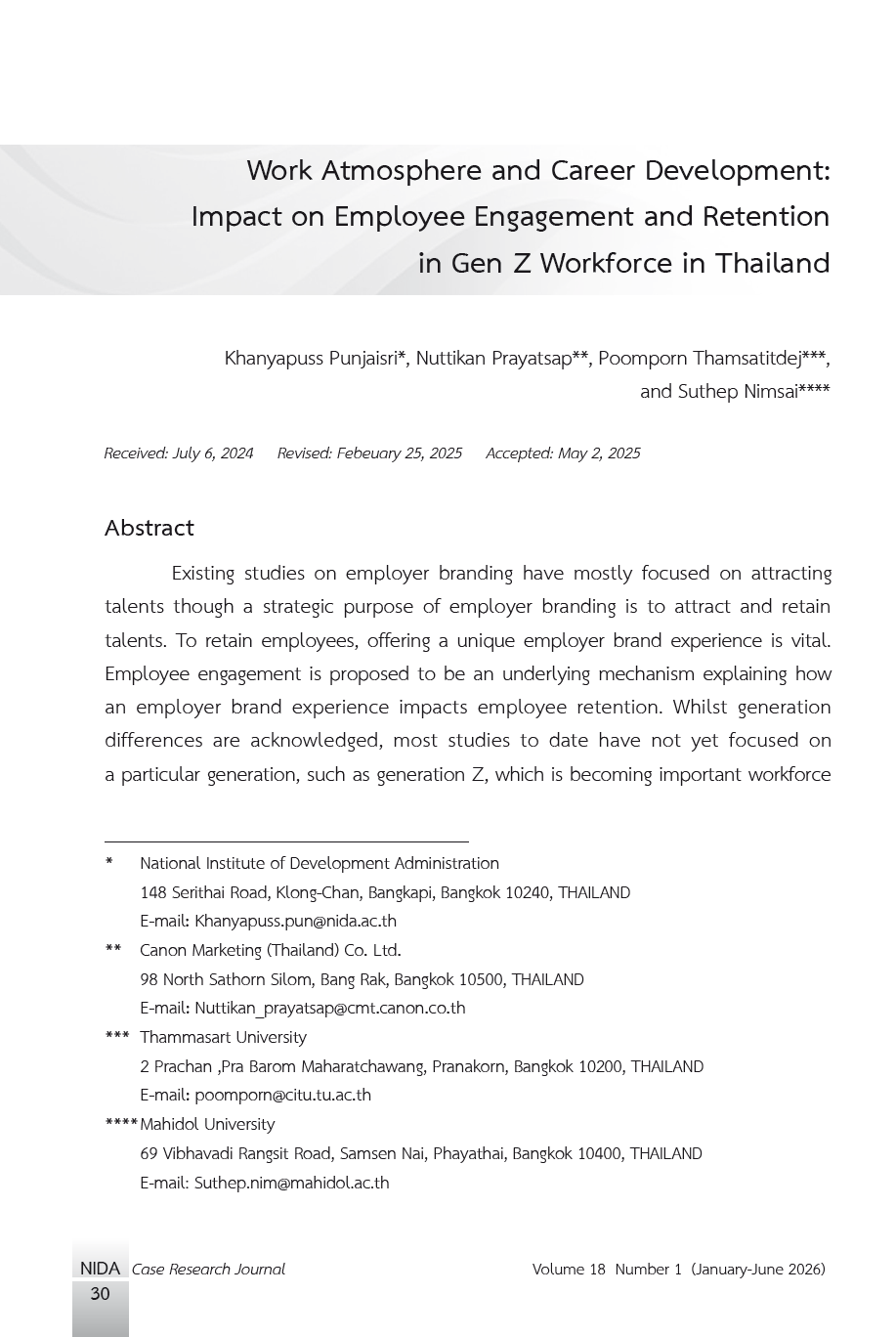
Work Atmosphere and Career Development: Impact on Employee Engagement and Retention in Gen Z Workforce in Thailand
DOI:
https://doi.org/10.14456/ncrj.2026.2Keywords:
Employer brand, Work atmosphere, Career Development, Employee engagement, Employee RetentionAbstract
Existing studies on employer branding have mostly focused on attracting talents though a strategic purpose of employer branding is to attract and retain talents. To retain employees, offering a unique employer brand experience is vital. Employee engagement is proposed to be an underlying mechanism explaining how an employer brand experience impacts employee retention. Whilst generation differences are acknowledged, most studies to date have not yet focused on a particular generation, such as generation Z, which is becoming important workforce in the next five years. Grounded on the social exchange theory, this study aims to identify the mediating effect of employee engagement on the relationship between employer brand experience, particularly work atmosphere and career development, and employee retention from the perspective of Generation Z workforce in Thailand. An online survey was carried out with Gen Z, who are employed and reside in Thailand. In total, 163 questionnaires were returned and deemed usable. The sample size follows the sample-to-item ratio method. This study has identified a full mediation of employee engagement on the link between work atmosphere and employee retention, and a partial mediation on the link between career development and employee retention. For generation Z, career development opportunities attract them to retain with the organization more effectively than work atmosphere. Theoretical and managerial implications are discussed.
References
Adecco. (2023). Welcoming the future of work with Gen Z. Retrieved June 13, 2024, https://adecco.co.th/en/knowledge-center/detail/hr-insight/welcoming-gen-z.
Ahmad, A. (2018). The relationship among job characteristics organizational commitment and employee turnover intentions: A reciprocation perspective. Journal of Work-Applied Management, 10(1), 74-92. https://doi.org/10.1108/JWAM-09-2017-0027
Ahmad, A., Khan, M. N., & Haque, M. A. (2020). Employer branding aids in enhancing employee attraction and retention. Journal of Asia-Pacific Business, 21(1), 27-38. https://doi.org/10.1080/10599231.2020.1708231
Ahmed, I., Khairuzzaman Wan Ismail, W., & Mohamad Amin, S. (2014). Employee’s reciprocation of organizational support and leader–member exchange. Management Research Review, 37(11), 930-943. https://doi.org/10.1108/MRR-05-2013-0102
Ahmed, R. R., Azam, M., Qureshi, J. A., Hashem, E. A. R., Parmar, V., & Salleh, N. Z. M. D. (2022). The relationship between internal employer branding and talent retention: A theoretical investigation for the development of a conceptual framework. Frontiers in Psychology, 13, 1-11. https://doi.org/10.3389/fpsyg.2022.859614
Allen, D., Bryant, P., & Vardaman, J. (2010). Retaining talent: Replacing misconceptions with evidence-based strategies. Academy of Management Perspectives, 24(2), 48-64. https://doi.org/10.5465/AMP.2010.51827775
Ambler, T., & Barrow, S. (1996). The employer brand. Journal of Brand Management, 4(3), 185-206. https://doi.org/10.1057/bm.1996.42
Backhaus, K., & Tikoo, S. (2004). Conceptualizing and researching employer branding. Career Development International, 9(4/5), 501-517. https://doi.org/10.1108/13620430410550754
Bank Finance. (2025, March 8). “Gen Z addicted to screens” uses social media more than 12 hours a day, even though it affects mental health, they can’t stop. Money & Banking Online. https://moneyandbanking.co.th/en/2025/159748/
Berthon, P., Ewing, M., & Hah, L. L. (2005). Captivating company: Dimensions of attractiveness in employer branding. International Journal of Advertising, 24(2), 151-172. https://doi.org/10.1080/02650487.2005.11072912
Bhasin, J., Mushtaq, S., & Gupta, S. (2019). Engaging employees through employer brand: An empirical evidence. Management and Labour Studies, 44(4), 417-432. https://doi.org/10.1177/0258042X19870322
Blau, P. M. (1964). Exchange and power in social life. John Wiley & Sons. https://doi.org/10.4324/9780203792643
Cable, D. M., & Turban, D. B. (2001). Establishing the dimensions, sources and value of job seekers’ employer knowledge during recruitment. Research in Personnel and Human Resources Management, 20, 115-163. https://doi.org/10.1016/S0742-7301(01)20002-4
Cascio, W. F., & Graham, B. Z. (2016). New strategic role for HR: Leading the employer-branding process. Organization Management Journal, 13(4), 182-192. https://doi.org/10.1080/15416518.2016.1244640
Chiaburu, D. S., & Marinova, S. V. (2006). Employee role enlargement: Interactions of trust and organizational fairness. Leadership & Organization Development Journal, 27(3), 168-182. https://doi.org/10.1108/01437730610657695
Chopra, A., Sahoo, C. K., & Patel, G. (2024). Exploring the relationship between employer branding and talent retention: The mediation effect of employee engagement. International Journal of Organizational Analysis, 32(4), 702-720. https://doi.org/10.1108/IJOA-02-2023-3638
Dachmer, A. M., Ellingson, J. E., Noe, R. A., & Saxton, B. M. (2021). The future of employee development. Human Resource Management Review, 31(2), 100732. https://doi.org/10.1016/j.hrmr.2019.100732
Dolot, A. (2018). The characteristics of generation Z. E-Mentor, 74, 44-50. https://doi.org/10.15219/em74.1351
Edwards, M. R. (2010). An integrative review of employer branding and OB theory. Personnel Review, 39(1), 5-23. https://doi.org/10.1108/00483481011012809
Ewing, M. T., Pitt, L. F., de Bussy, N. M., & Berthon, P. (2002). Employment branding in the knowledge economy. International Journal of Advertising, 21(1), 3-22. https://doi.org/10.1080/02650487.2002.11104914
Figurska, I., & Matuska, E. (2013). Employer branding as a human resources management strategy. Human Resources Management & Ergonomics, 7(2), 35-51. https://frcatel.fri.uniza.sk/hrme/files/2013/2013_2_03.pdf
Fletcher, L., Alfes, K., & Robinson, D. (2018). The relationship between perceived training and development and employee retention: The mediating role of work attitudes. The International Journal of Human Resource Management, 29(18), 2701-2728. https://doi.org/10.1080/09585192.2016.1262888
Fredrickson, B. L. (2003). The value of positive emotions: The emerging science of positive psychology is coming to understand why it’s good to feel good. American Scientist, 91(4), 330-335. https://doi.org/10.1511/2003.4.330
Gandasari, D., Tjahjana, D., Dwidienawati, D., & Ischsan, M. (2024). How to attract talents? The role of CSR, employer brand, benefits and career development. Cogent Business & Management, 11(1), 2323774. https://doi.org/10.1080/23311975.2024.2323774
Gupta, S., Bhasin, J., & Mushtaq, S. (2021). Employer brand experience and organizational citizenship behavior: Mediating role of employee engagement. Asia-Pacific Journal of Business Administration, 13(3), 357-382. https://doi.org/10.1108/APJBA-08-2020-0287
Hadi, N.U. & Ahmed, S. (2018). Role of employer branding dimensions on employee retention: Evidence from educational sector. Academic Sciences, 8(3), 44.
Hais, M., & Winograd, M. (2016). A new generation debuts: Plurals. Huffington Post. Retrieved June 12, 2024, from https://www.huffingtonpost.com/michael-hais-and-morley-winograd/pluralsgeneration_b_1492384
Halová, D., & Müller, M. (2023). Being an employer of choice: Attracting Generation Z to work by building brand via social media. Corporate Reputation Review. https://doi.org/10.1057/s41299-023-00175-5
Hanaysha, J. (2016). Testing the effects of employee engagement, work environment, and organizational learning on organizational commitment. Procedia-Social and Behavioral Sciences, 229, 289-297. https://doi.org/10.1016/j.sbspro.2016.07.139
Hatcher, L. (1994). A step-by-step approach to using the SAS system for factor analysis and structural equation modeling. SAS Institute.
Heilmann, P. A. K. (2010). Employer brand image in a health care organization. Management Research Review, 33(2), 134-144. https://doi.org/10.1108/01409171011030421
Heilmann, P., Saarenketo, S., & Liikkanen, K. (2013). Employer branding in power industry. International Journal of Energy Sector Management, 7(2), 283-302. https://doi.org/10.1108/IJESM-03-2012-0005
Huang, I. C., Tsai, C. F., Huang, Y. H., & Chen, C. H. (2003). Appeals of recruiting advertisement contents in e-recruiting: Job seekers’ perspective. Journal of Human Resource Management.
Ibrahim, S. N., & Zayed, A. (2018). The impact of integrated talent management on competitive advantage in multinational corporations. International Journal of Academic Research in Business and Social Sciences, 8(7), 221-237. https://doi.org/10.6007/IJARBSS/v8-i7/4414
Iorgulescu, M. C. (2016). Generation Z and its perception of work. Cross-Cultural Management Journal, 18(1), 47-54.
Itam, U., Misra, S., & Anjum, H. (2020). HRD indicators and branding practices: A viewpoint on the employer brand building process. European Journal of Training and Development, 44(6/7), 675-694. https://doi.org/10.1108/EJTD-02-2020-0029
Kahn, W. A. (1990). Psychological conditions of personal engagement and disengagement at work. Academy of Management Journal, 33(4), 692-724. https://doi.org/10.5465/256287
Kasekende, F. (2017). Psychological contract, engagement and employee discretionary behaviours: Perspectives from Uganda. International Journal of Productivity and Performance Management, 66(7), 896-913. https://doi.org/10.1108/IJPPM-06-2016-0126
Kashyap, V., & Verma, N. (2018). Linking dimensions of employer branding and turnover intentions. International Journal of Organizational Analysis, 26(2), 282-295. https://doi.org/10.1108/IJOA-03-2017-1134
Kelloway, E. K. (1995). Structural equation modelling in perspective. Journal of Organizational Behavior, 16(3), 215-224. https://doi.org/10.1002/job.4030160304
Khanolkar, R. S. (2013). Influence of employer branding on satisfaction and commitment of generation Y employees. In Proceedings of the 7th International Business Research Conference (pp. 13-18). Indian Education Society’s Management College and Research Centre. https://www.iosrjournals.org/iosr-jbm/papers/7th-ibrc-volume-1/3.pdf
Kunerth, B., & Mosley, R. (2011). Applying employer brand management to employee engagement. Strategic HR Review, 10(3), 19-26. https://doi.org/10.1108/14754391111121833
Kurniawan, D. T. (2018). Generation Y trends in choosing an employer: Impact of employer branding toward intention to apply in e-commerce companies in Indonesia. International Journal of Management and Business Research, 8(2), 43-52.
Lavri, O. (2024). Generation Z in the workforce: Challenges, expectations, and strategies for success. HR Forecast. Retrieved March 2, 2025, from https://hrforecast.com/generation-z-workers-and-labor-market/
Lee, C. C., Kao, R. H., & Lin, C. J. (2018). A study on the factors to measure employer brand: The case of undergraduate senior students. Chinese Management Studies, 12(4), 812-832. https://doi.org/10.1108/CMS-04-2017-0103
Lee, E., Kang, M., Kim, Y., & Yang, S. U. (2022). Exploring the interrelationship and roles of employee-organisation relationship outcomes between symmetrical internal communication and employee job engagement. Corporate Communications: An International Journal, 27(2), 264-283. https://doi.org/10.1108/CCIJ-08-2021-0083
Lievens, F., & Slaughter, J. E. (2016). Employer image and employer branding: What we know and what we need to know. Annual Review of Organizational Psychology and Organizational Behavior, 3, 407-440. https://doi.org/10.1146/annurev-orgpsych-041015-062501
Love, L., & Singh, P. (2011). Workplace branding: Leveraging human resources management practices for competitive advantage through “best employer” surveys. Journal of Business and Psychology, 26, 175-181. https://doi.org/10.1007/s10869-011-9226-5
Maclean, M. J., & Panyavaranant, C. (2025). What do Thai workforce of Gen Y and Gen Z think compared to most people in the world? Deloitte. Retrieved March 3, 2025, from https://www2.deloitte.com/th/en/pages/about-deloitte/articles/gen-y-gen-zworkforce-en.html
Mark, P., & Toelken, K. (2009). Poisoned by a toxic brand: A worst case scenario of employer branding: A case study of a Fortune 100 technology firm. Organization Development Journal, 27(4), 21-29.
Markos, S., & Sridevi, M. S. (2010). Employee engagement: The key to improving performance. International Journal of Business and Management, 5(12), 89-96. https://doi.org/10.5539/ijbm.v5n12p89
Matzler, K., & Renzl, B. (2006). The relationship between interpersonal trust, employee satisfaction, and employee loyalty. Total Quality Management & Business Excellence, 17(10), 1261-1271. https://doi.org/10.1080/14783360600753653
May, D. R., Gilson, R. L., & Harter, L. M. (2004). The psychological conditions of meaningfulness, safety, and availability and the engagement of the human spirit at work. Journal of Occupational and Organizational Psychology, 77(1), 11-37. https://doi.org/10.1348/096317904322915892
Menor, J. H. (2010). 10 strategic tips for employee retention. The Recruiters Lounge. Retrieved June 10, 2024, from http://www.therecruiterslounge.com/2010/08/17/10-strategic-tips-foremployee-retention/
Mercer. (2007). Engaging employees to drive business. https://www.mercer.com
Mičík, M., & Mičudová, K. (2018). Employer brand building: Using social media and career websites to attract Generation Y. Economics & Sociology, 11(3), 171-189. https://doi.org/10.14254/2071-789X.2018/11-3/11
Nanjundeswaraswamy, T. S., Bharath, S., & Nagesh, P. (2022). Employer branding: Design and development of a scale. Journal of Economic and Administrative Sciences. https://doi.org/10.1108/JEAS-05-2021-0096
Newton, D. W., & LePine, J. A. (2018). Organizational citizenship behavior and job engagement: “You gotta keep ’em separated!”. In The Oxfor handbook of organizational citizenship behavior (pp. 43-54). Oxford University Press.
Nguyen, H. M., & Nguyen, L. V. (2023). Employee attractiveness, employee engagement and employee performance. International Journal of Productivity and Performance Management, 72(10), 2859-2881. https://doi.org/10.1108/IJPPM-04-2022-0193
Oladipo, K. S., Jamilah, O., Abdul daud S., Jeffrey, L. D. & Salami, D. K. (2013). Review of leadership theories and organizational performances. International Business Management Journal, 7(1), 50-54.
Osteraker, M. C. (1999). Measuring motivation in a learning organization. Journal of Workplace Learning, 11(2), 73-77. https://doi.org/10.1108/13665629910260798
Pandita, D. (2022). Innovation in talent management practices: Creating an innovative employer branding strategy to attract Generation Z. International Journal of Innovation Science, 14(3/4), 556-569. https://doi.org/10.1108/IJIS-10-2020-0217
Parsley, A. (2006). Road map for employee engagement. Management Services, 50(1), 10-11.
Piyachat, B., Chanongkorn, K. & Panisa, M. (2015). The relationships among perceived employer branding, employee engagement, and discretionary effort. Suranaree Journal of Social Science, 9(1), 37-60. https://doi.org/10.14456/sjss.2015.6
Priyadarshi, P. (2011). Employer brand image as predictor of employee satisfaction, affective commitment & turnover. Indian Journal of Industrial Relations, 46(3), 510-522. http://www.jstor.org/stable/41149467
Rich, B. L., Lepine, J. A., & Crawford, E. R. (2010). Job engagement: Antecedents and effects on job performance. Academy of Management Journal, 53(3), 617-635. https://doi.org/10.5465/AMJ.2010.51468988
Richman, A. L., Civian, J. T., Shannon, L. L., Hill, E. J., & Brennan, R. T. (2008). The relationship of perceived flexibility, supportive work-life policies, and use of formal flexible arrangements and occasional flexibility to employee engagement and expected retention. Community, Work & Family, 11(2), 183-197. https://doi.org/10.1080/13668800802050350
Ronda, L., Valor, C., & Abril, C. (2018) Are they willing to work for you? An employeecentric view to employer brand attractiveness. Journal of Product & Brand Management, 27(5), 573-596. https://doi.org/10.1108/JPBM-07-2017-1522
Rosethorn, H. (2009). The employer brand: Keeping faith with the deal. Routledge. https://doi.org/10.4324/9781315616032
Rykun, E. (2025). Millennial employee retention: 5 best strategies to win them over. GoSkills. Retrieved March 3, 2025, from https://www.goskills.com/Leadership-Management/Resources/Millennialemployee-retention
Saini, G. & Jawahar, I. M. (2019). The influence of employer rankings, employment experience, and employee characteristics on employer branding as an employer of choice. Career Development International, 24(7), 636-657. https://doi.org/10.1108/CDI-11-2018-0290
Saks, A. M. (2006). Antecedents and consequences of employee engagement. Journal of Managerial Psychology, 21(7), 600-619. https://doi.org/10.1108/02683940610690169
Samo, A. H., Talreja, S., Bhatti, A. A., Asad, S. A., & Hussain, L. (2020). Branding yields better harvest: explaining the mediating role of employee engagement in employer branding and organizational outcomes. Etikonomi: Jurnal Ekonomi, 19(1), 77-94. https://doi.org/10.15408/etk.v19i1.12320
Santiago, J. (2019). The relationship between brand attractiveness and the intent to apply for a job: A millennials’ perspective. European Journal of Management and Business Economics, 28(2), 142-157. https://doi.org/10.1108/EJMBE-12-2018-0136
Schlager, T., Bodderas, M., Maas, P., & Cachelin, J. L. (2011). The influence of the employer brand on employee attitudes relevant for service branding: An empirical investigation. Journal of Services Marketing, 25(7), 497-508. https://doi.org/10.1108/08876041111173624
Shamaa, R. A., Al-Rabayah, W. F., & Khasawneh, R. T. (2015). The effect of job satisfaction and work engagement on organizational commitment. The IUP Journal of Organizational Behavior, 14(4), 7-27.
Sharma, R., Rana, G., & Agarwal, S. (2021). Techno innovative tools for employer branding in industry 4.0. In Employer branding for competitive advantage (pp. 171-180). CRC Press.
Silva, A. J., & Dias, H. (2023). The relationship between employer branding, corporate reputation and intention to apply to a job offer. International Journal of Organizational Analysis, 31(8), 1-16. https://doi.org/10.1108/IJOA-01-2022-3129
Sokro, E. (2012). Impact of employer branding on employee attraction and retention. European Journal of Business and Management, 4(18), 164-173.
Srivastava, P., & Bhatnagar, J. (2010). Employer brand for talent acquisition: An exploration towards its measurement. Vision: The Journal of Business Perspective, 14(1-2), 25-34. https://doi.org/10.1177/097226291001400103
Sulea, C., Virga, D., Maricutoiu, L. P., Schaufeli, W., Zaborila Dumitru, C., & Sava, F. A. (2012). Work engagement as mediator between job characteristics and positive and negative extra-role behaviors. Career Development International, 17(3), 188-207. https://doi.org/10.1108/13620431211241054
Tanwar, K., & Prasad, A. (2016). Exploring the relationship between employer branding and employee retention. Global Business Review, 17(3), 1865-2065. https://doi.org/10.1177/0972150916631214
Tanwar, K., & Prasad, A. (2017). Employer brand scale development and validation: A second-order factor approach. Personnel Review, 46(2), 389-409. https://doi.org/10.1108/PR-03-2015-0065
Theurer, C. P., Tumasjan, A., Welpe, I. M., & Lievens, F. (2018). Employer branding: A brand equity-based literature review and research agenda. International Journal of Management Reviews, 20(1), 155-179. https://doi.org/10.1111/ijmr.12121Digital Object Identifier (DOI)
Tripathi, V., Rajlaxmi, S. A., & Tripathi, A. (2020). Employer branding: A strategic tool for employee retention in IT industry. Journal of Brand Management, 17(1), 21-35.
van Bogaert, P., Clarke, S., Willems, R., & Mondelaers, M. (2013). Staff engagement as a target for managing work environments in psychiatric hospitals: Implications for workforce stability and quality of care. Journal of Clinical Nursing, 22(11-12), 1717-1728. https://doi.org/10.1111/j.1365-2702.2012.04341.x
Wojtaszyk, K. (2012). Employer branding czyli zarządzanie marką pracodawcy. Wydawnictwo Uniwersytetu Łódzkiego
Xerri, M., & Brunetto, Y. (2013). Fostering innovative behavior: The importance of employee commitment and organizational citizenship behavior. The International Journal of Human Resource Management, 24(16), 3163-3177. https://doi.org/10.1080/09585192.2013.775033
Zhao, X., Lynch, J. G., Jr., & Chen, Q. (2010). Reconsidering Baron and Kenny: Myths and truths about mediation analysis. Journal of Consumer Research, 37(2), 197-206. https://doi.org/10.1086/651257
Downloads
Published
How to Cite
Issue
Section
License
Copyright (c) 2026 NIDA Case Research Journal

This work is licensed under a Creative Commons Attribution-NonCommercial-NoDerivatives 4.0 International License.