
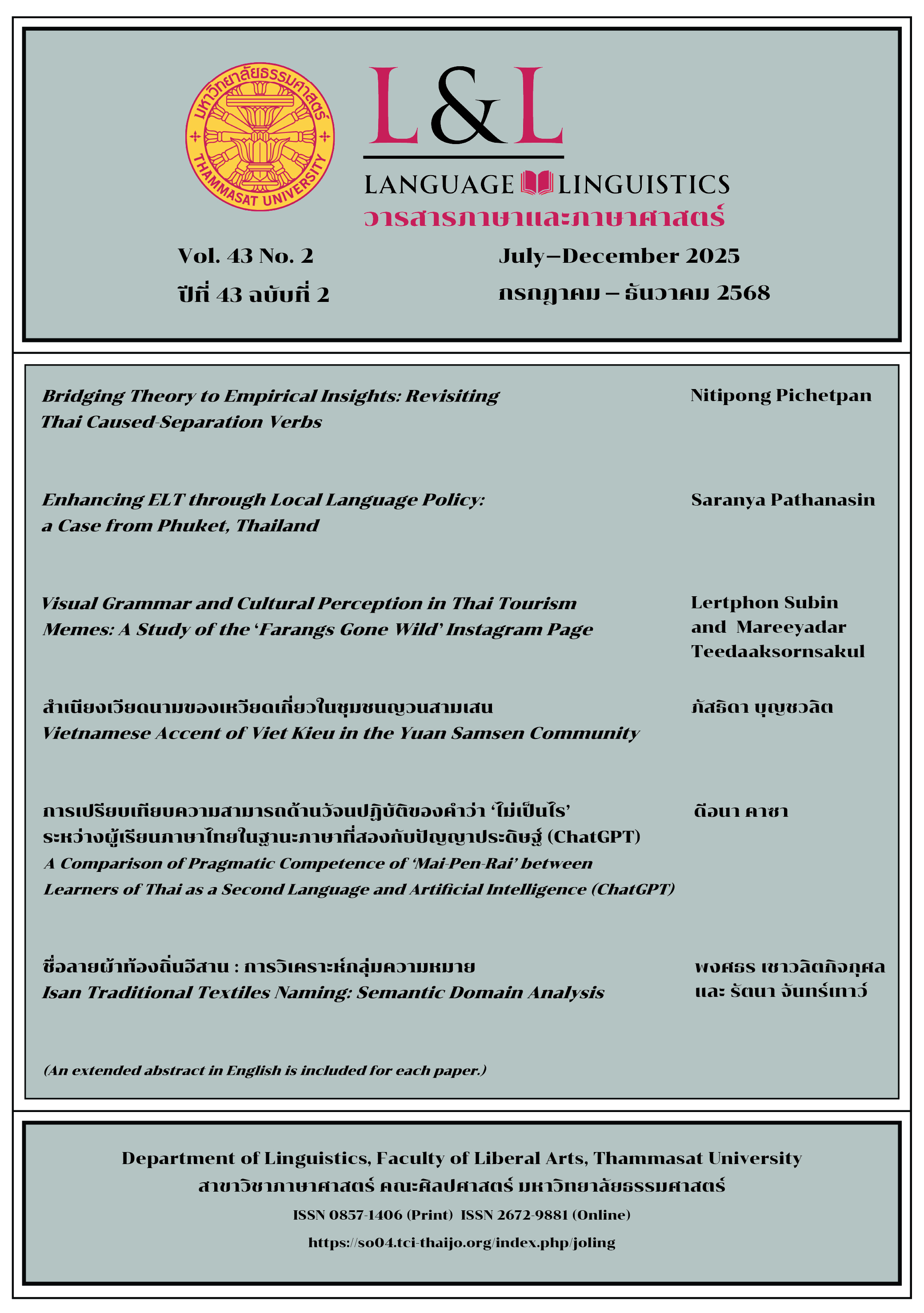
Enhancing ELT through Local Language Policy: a Case from Phuket, Thailand
Article Sidebar
Main Article Content
บทคัดย่อ
For success in English language teaching (ELT), all stakeholders need to work together to achieve the goal. Local government has a crucial role as a policy maker and a supporter. How policy is translated into practice should be analyzed and the voices of practitioners should be heard. This research aims to analyze the ELT policy established by the Phuket Provincial Administrative Organization (PPAO) and how it has been implemented in schools. The participants in the study are school administrators and teachers working under the supervision of PPAO. Data were obtained by a semi-structured interview method and were analyzed using thematic analysis. Results reveal that the school network has been taking the right path collaboratively under a feasible and fruitful policy. Areas in which potential for improvement is perceived are identified. The results benefit local governments in making language policies for local schools in Thailand.
Article Details

อนุญาตภายใต้เงื่อนไข Creative Commons Attribution-NonCommercial-NoDerivatives 4.0 International License.
บทความทุกบทความเป็นลิขสิทธิ์ของภาษาและภาษาศาสตร์
เอกสารอ้างอิง
Assalihee, M., & Boonsuk, Y. (2022). Factors obstructing English teaching effectiveness: Teacher voices from Thailand’s deep south. IAFOR Journal of Education: Language Learning in Education, 10(1), 155-172. https://doi.org/10.22492/ije.10.1.08
Baker, W. & Jarunthawatchai, W. (2017). English language policy in Thailand. European Journal of Language Policy, 91, 27-43.
Baldauf, R. B., & Nguyen, H.T. (2012). Language policy in Asia and the Pacific. In B. Spolsky (Ed.), The Cambridge Handbook of Language Policy (pp. 617-638). Cambridge University Press.
Braun, V., & Clarke, V. (2006). Using thematic analysis in psychology. Qualitative Research in Psychology 3, 77-101.
Boonsuk, Y., Wasoh, F. & Ambele, E.A. (2023). Repositioning English and teaching practices in global Englishes: A critical perspective from Thai higher education. Language Teaching Research, 0(0), 1-20. https://doi.org/10.1177/13621688231178364.
Darasawang, P., & Watson Todd, R. (2012). The effect of policy on English language teaching at secondary schools in Thailand. In E. Low & A. Hashim (Eds.), English in southeast Asia: Features, policy and language in use (pp. 207-220). OpenAIRE: John Benjamins. https://doi:10.1075/veaw.g42.17dar
Education First. (2024). EF English proficiency index. http://www.ef.com/epi.
Gottlieb, N., & Chen, P. (Eds.). (2001). Language planning and language policy east Asian perspectives. Curzon Press.
Jeon, J., & Lee, H. (2017). Secondary teachers’ perception on English education policies in Korea. The Journal of Asia TEFL 14(1), 47-63. https://doi.10.18823/asiatefl.2017.14.1.4.47
Kachru, B. (1988). The sacred cows of English. English Today 4(4), 3-8.
Kaur, A., David. Y, & Kirkpatrick, R. (2016). English education policy in Thailand: Why the poor results?. In R. Kirkpatrick (Ed.), English language education policy in Asia (pp. 345-361). Springer. https://doi 10.1007/978-3-319-22464-0_16
Kwon, Y. (2017). A study of Thai teachers’ perceptions toward the implementation of communicative language teaching of English. HRD Journal 8(1), 114-125.
Ministry of Education Thailand, Basic Education Core Curriculum B.E. 2551 (A.D. 2008). https://academic.obec.go.th/images/document
Nitsaisook, N., Prabjandee, D., & Kewara, P. (2025) Language ideologies and English education policies in Thailand. World Englishes, 1-20. https://doi.org/10.1111/weng.12739
Oakes, L., & Peled, Y. (2018). Normative language policy: Ethics, politics, principles. Cambridge University Press.
Office of the Basic Education Commission. (2002). National education act 1999 and 2nd amendment 2002. https://www.bic.moe.go.th/images/stories
Orosz, A., Monzon. M, & Velasco, P. (2021). Ecuadorian teachers’ perceptions of teaching English: Challenges in the public education sector. International Journal of Learning, Teaching and Educational Research 20(3), 229-249. https://doi.10.26803/ijlter.20.3.14
Pathanasin, S. (2024). Language policy: from international to Thai context. Prince of Songkla University Publishing.
Pathanasin, S. (2025). A Study of the linguistic landscape on Phuket island: Identity, tourism and policy. rEFLections. 32(1), 213-233. https://doi.org/10.61508/refl.v32i1.279617
Savski, K., & Rukthong, A. (2025). ‘Failed’? Under-perfoming learners’ perspectives on Thailand’s English language policies. Current Issues in Language Planning, 1-22. http://doi.org/10.1080/14664208.2025.2493996
Spolsky, B. (2004). Language policy. Cambridge University Press.
Spolsky, B. (2021). Rethinking language policy. Edinburgh University Press.
Su, Y. (2006). EFL teachers’ perceptions of English language policy at the elementary level in Taiwan. Educational Studies 32(3), 265-283. https://doi.org/10.1080/03055690600631218
