
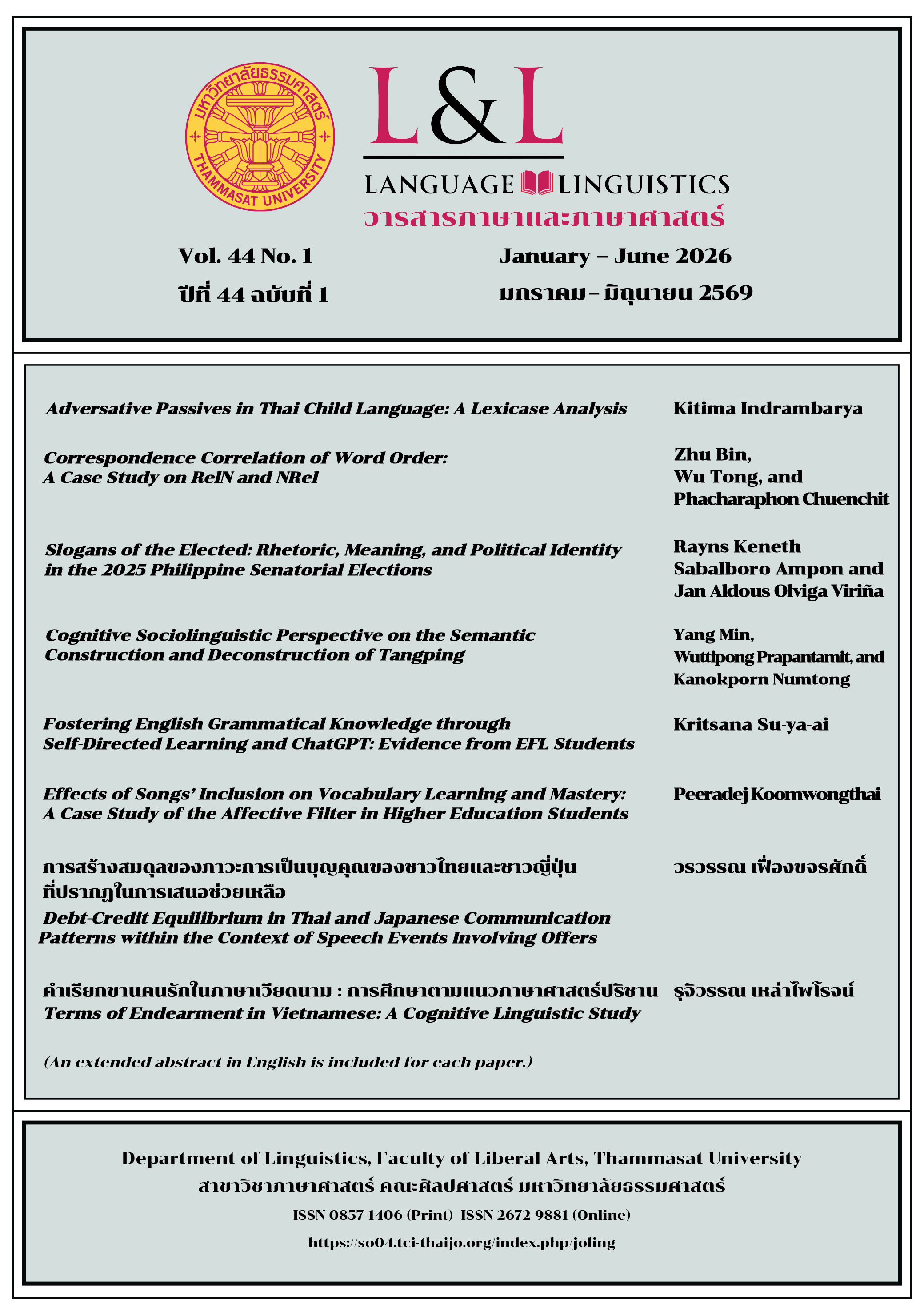
Effects of Song Inclusion on Vocabulary Learning and Mastery: A Case Study of the Affective Filter in Higher Education Students
Article Sidebar
Main Article Content
Abstract
Song inclusion in language pedagogy has mainly been treated as a classical, but also functional approach to listening practice and pronunciation activities. In an effort to address previous research gaps in different learning contexts, this study examines undergraduate EFL learners’ perspectives on song inclusion via vocabulary learning and mastery in a Thai higher education setting. Of great significance is the role of affective filters in vocabulary development and constructive learning motivation. Based on quantitative and qualitative data analyses, 120 Thai undergraduates from a public university were selected as research participants. For data analysis, descriptive statistics were used to reflect the percentages, standard deviations, and mean scores. A semi-structured interview was also designed to bring further viewpoints on in-class and external classroom engagement. During the learning sessions, twelve selected songs were applied in classes, except for the periods of the pretest, posttest, midterm, and final examination. The findings exhibit positive effects of song inclusion on vocabulary learning and improvement, as reflected in the pretest and posttest outcomes. In addition, extensive results highlight beneficial impacts of song inclusion on vocabulary retention, a more relaxing and enthusiastic learning experience, and positive motivation under low affective filter conditions. Specifically in higher education contexts, the recent study provides insights and highlights the roles of English song inclusion in language pedagogy, with further contributions on attentive learning experience, communicative interactions, and resourceful inputs for language and intercultural studies.
Article Details

This work is licensed under a Creative Commons Attribution-NonCommercial-NoDerivatives 4.0 International License.
บทความทุกบทความเป็นลิขสิทธิ์ของภาษาและภาษาศาสตร์
References
Batluk, L. (2015). Does listening to English songs motivate students to expand their extramural English?: A case study of Swedish upper-secondary school students’ perceptions of possible impact of listening to vocal music on their extramural English [Master’s dissertation, Linnaeus University]. DiVA Portal. https://www.diva-portal.org/smash/get/diva2:817139/FULLTEXT01.pdf
Baoan, W. (2008). Application of popular English songs in EFL classroom teaching. Humanising Language Teaching, 10(3). Retrieved December 15, 2025, from https://old.hltmag.co.uk/jun08/less03.htm
Bawawa, M. (2020). Teaching English vocabulary using songs to developing students’ vocabulary mastery. Journal of Linguistics, 8(1), 1-12. http://dx.doi.org/10.35796/kaling.8.1.2020.29099
Bennui, P. (2008). A study of L1 interference in the writing of Thai EFL students. Malaysian Journal of ELT Research, 4(4), 72-102.
Biyaem, S. (1997). Learner training: Changing roles for a changing world, educational innovation for sustainable development. In UNESCO (Ed.), 3rd UNESCOACEID International Conference, Bangkok, Thailand.
Bokiev, D., & Ismail, L. (2021). Malaysian ESL teachers' beliefs and practices regarding the use of music and songs in second language teaching. The Qualitative Report, 26(5), 1497-1521. https://doi.org/10.46743/2160-3715/2021.4350
Boothe, D., & West, J. (2015). English language learning through music and song lyrics: The performance of a lifetime. In Pixel (Ed.), Proceedings of the Future of Education Conference (pp. 248-254). Libreria Universitaria Italia. https://conference.pixel-online.net/files/foe/ed0005/FP/0475-ITL949-FP-FOE5.pdf
Chou, M. (2014). Assessing English vocabulary and enhancing young English as a foreign language (EFL) learners’ motivation through games, songs, and stories. International Journal of Primary, Elementary and Early Years Education, 42(3), 284-297. http://dx.doi.org/10.1080/03004279.2012.680899
Cohen, J. (1988). Statistical power analysis for the behavioral sciences (2nd ed.). Lawrence Erlbaum Associates.
Daly, J. A. (1991). Writing apprehension and writing competency. Journal of Educational Research, 72(1), 10-14. http://dx.doi.org/10.1080/00220671.1978.10885110
Dewaele, J. M. (2019). The effect of classroom emotions, attitudes toward English, and teacher behavior on willingness to communicate among English foreign language learners. Journal of Language and Social Psychology, 38(4), 523-535. https://doi.org/10.1177/0261927X19864996
Domoney, L., & Harris, S. (1993). Justified and ancient: Pop music in EFL classrooms. ELT Journal, 47(3), 234-241. http://dx.doi.org/10.1093/elt/47.3.234
Eken, D. K. (1996). Ideas for using pop songs in the English language classroom. English Teaching Forum, 34, 46-47.
Faisal, F., & Putri, N. N. (2023). English songs in vocabulary learning: Higher-education students’ perceived views. Surakarta English and Literature Journal, 6(1), 46-61. https://doi.org/10.52429/selju.v6i1.119
Faliyanti, E. (2017). The influence of English song toward students’ vocabulary mastery and students’ motivation. Premise Journal of English Education, 6(1), 77-83. https://doi.org/10.24127/pj.v6i1.785
Fithriani, R. (2021). The utilization of mobile-assisted gamification for vocabulary learning: Its efficacy and perceived benefits. Computer Assisted Language Learning Electronic Journal, 22(3), 146-163. http://callej.org/journal/22-3/Fithriani2021.pdf
Fortuna, R. S. (2025). Lowering the filter: The role of attitude in English language acquisition. World Journal of Advanced Research and Reviews, 25(03), 2274-2287. https://doi.org/10.30574/wjarr.2025.25.3.1020
Gan, Z. (2012). Understanding L2 speaking problems: Implications for ESL curriculum development in a teacher training institution in Hong Kong. Australian Journal of Teacher Education, 37(1), 43-59. http://dx.doi.org/10.14221/ajte.2012v37n1.4
Gasuvarn, M., & Jhanphoj, M. (2013). Effectiveness of English song activities on vocabulary learning and speaking ability and retention [in Thai]. Journal of Liberal Arts, 5(2), 18-31. https://so03.tci-thaijo.org/index.php/journal-la/article/view/64228
Gatbonton, E., & Segalowitz, N. (1988). Creative automatization: Principles for promoting fluency within a communicative framework. TESOL Quarterly, 22(3), 473-492. https://doi.org/10.2307/3587290
Getie, A. S. (2020). Factors affecting the attitudes of students towards learning English as a foreign language. Cogent Education, 7(1), 1-37. https://doi.org/10.1080/2331186X.2020.1738184
Gong, X., Zou, X., & Gong, Y. (2023). A study of affective factors affecting college students' autonomous English learning. Advances in Educational Technology and Psychology, 7(18), 6-17. https://doi.org/10.23977/aetp.2023.071802.
Griffee, D. T. (1992). Songs in action. Prentice-Hall.
Hanlan, P.K. (2008). Students’ attitudes toward the use of English songs in the English learning classroom: A case study of students at language institution in Siam Square [Master’s dissertation, Thammasat University]. TU Digital Collections. https://digital.library.tu.ac.th/tu_dc/digital/api/DownloadDigitalFile/download_digi/125505/?path=thesis/lg/0313/01TITLE.pdf
In-Lom, P. S. (2020). Improving students’ pronunciation by using English songs. Journal of Asian Language Teaching and Learning, 1(2), 25-36. https://so10.tcithaijo.org/index.php/jote/article/view/480
Karim, S. A., Sudiro, S., Annisa, D. R., Khairunnisa, H. I., & Rahmawati, D. A. (2022). Enhancing vocabulary mastery through English songs: In the eyes of EFL students. Journal of Language Teaching and Literature, 9(2), 449-458. https://doi.org/10.30605/25409190.439
Khan, T. A. (2024). The impacts of English songs on the pronunciation of ESL learners. Research Journal of Language and Literacy Studies, 3(1), 59-80.
Kim, H. J., Chong, H. J., & Lee, M. (2024). Music listening in foreign language learning: perceptions, attitudes, and its impact on language anxiety. Frontiers in Education, 9, 1-13. https://doi.org/10.3389/feduc.2024.1372786
Kitjaroonchai, T. & Sukman, K. (2025). Effects of English songs on EFL learners’ speaking performance: Lexical complexity, accuracy, and fluency. Arab World English Journal, 16(3), 129-143. https://dx.doi.org/10.24093/awej/vol16no3.7
Krashen, S. D. (1982). Principles and practice in second language acquisition. Pergamon Press.
Krashen, S. D. (1983). Principles and practices in second language acquisition. Pergamon Press.
Kusnierek, A. (2016). The role of music and songs in teaching English vocabulary to students. World Scientific News, 43(1), 1-55.
Laufer, B. (1997). The lexical plight in second language teaching. Cambridge University Press.
Lems, K. (2001). Using music in the adult ESL classroom. Academia. https://www.academia.edu/71884606/UsingMusicintheAdultESLClassroom
Limbong, R. (2012). Enriching students’ vocabulary using English pop songs. Journal of English Teaching, 2(3), 223-237. https://doi.org/10.33541/jet.v2i3.58
Ludke, K. M. (2009). Teaching foreign languages through songs. University of Edinburgh.
Luo, Y., Kong, X., & Ma, Y. (2022). Effects of multimedia assisted song integrated teaching on college students’ English learning interests and learning outcomes. Journal of Frontiers in Psychology, 13(1), 1-6. http://dx.doi.org/10.3389/fpsyg.2022.912789
Malekian, S. (2016). The relationship between English songs and learning vocabulary. International Journal of African and Asian Studies, 20(1), 13-19. https://iiste.org/Journals/index.php/JAAS/article/view/29963/30771
Nety, N. (2022). A study of students’ reluctance to speak English at English Department of Unidayan. English Education Journal, 8(1), 45-51. https://doi.org/10.55340/e2j.v8i1.859
Nurnaningsih, N. (2022). The use of flashcard in teaching English vocabularies by young mothers. Surakarta English and Literature Journal, 4(1), 44-53. https://ejurnal.unsa.ac.id/index.php/selju/article/view/69
Phanarangsan, K. (2000). Effects of English-teaching songs on listeners’ attitudes, information seeking, satisfaction and utilization [Unpublished master’s thesis]. Chulalongkorn University.
Poppleton, C. (2001). Music to our ears. American Language Review, 5(1), 23-26.
Puncharoen, T. (2005). The development of a song instructional package for teaching English to Mattayom-four students at Krabyaiwongkuson-kitpittayakhom school, Rachaburi province [Master’s thesis, Silpakorn University]. SWU EjournalsSystem. http://www.thapra.lib.su.ac.th/objects/thesis/fulltext/snamcn/Tippawan_Puncharoen/Fulltext.pdf
Rattanalert, T., Pataburee, T., Urairat, K., Songkhro, J., Tapnimit, V., Poolsakt, N., Sangvarn, S., & Pannayang, P. (2023). Achievement of using English songs for enhancing English vocabulary knowledge and listening strategies of English as a foreign language second-year students majoring in English for communication at a public university in the lower southern region of Thailand. Pathumthani University Academic Journal, 15(2), 39–53. https://so05.tci-thaijo.org/index.php/ptujournal/article/view/266403
Rasti-Behbahani, A. (2021). Why digital games can be advantageous in vocabulary learning. Theory and Practice in Language Studies, 11(2), 111-118. http://dx.doi.org/10.17507/tpls.1102.01
Richards, J. C., & Ranandya, W. A. (2002). Methodology in language teaching. Cambridge University Press.
Salcedo, C. S. (2002). The effects of songs in the foreign language classroom on text recall and involuntary mental rehearsal [Doctoral dissertation, Louisiana State University]. LSU Scholarly Repository. https://repository.lsu.edu/cgi/viewcontent.cgi?article=2457&context=gradschool_dissertations
Samovar, L. A., & Porter, R. E. (2004). Communication between cultures (5th ed.). Wadsworth publishing.
Schoepp, K. (2001). Reason for using songs in the ESL/EFL classroom. The Internet TESL Journal, 7(2), 1-4. http://iteslj.org/Articles/Schoepp-Songs.html
Selinker, L. (1972). Interlanguage, International Review of Applied Linguistics, 10, 209-231. https://doi.org/10.1515/iral.1972.10.1-4.209
Spada, N., & Lightbown, P. M. (1999). Instruction, first language influence, and developmental readiness in second language acquisition. Modern Language Journal, 83(1), 1-22. https://doi.org/10.1111/0026-7902.00002
Suriyatham, W. (2015). Songs in language teaching and learning in EFL contexts in the 21st century. Thammasat Review, 16(3), 246–251. https://sc01.tci-thaijo.org/index.php/tureview/article/view/40744
Suryanto, B. T., Imron, A. A., & Prasetyo, D. A. R. (2021). The correlation between students’ vocabulary mastery and speaking skill. International Journal of English Education and Linguistics, 3(1), 10-19. https://doi.org/10.33650/ijoeel.v3i1.2042.
Suwanarak, K. (2015). Learning English as Thai adult learners: An insight into experience in using learning strategies. English Language Teaching, 8(12), 144-157. http://dx.doi.org/10.5539/elt.v8n12p144
Tasnim, Z. (2022). Songs for EFL/ESL class: how to teach listening skill through music. MEXTESOL Journal, 46(3), 1-12. https://doi.org/10.61871/mj.v46n3-16
Thadphoothon, J., & Samrit, J. (2025). The use of Artificial Intelligence (AI) applications for vocabulary learning among Thai university students: A case study [in Thai]. Journal of MCU Nakhondhat, 12(1), 112-122. https://so03.tci-thaijo.org/index.php/JMND
Tse, A. Y. H. (2015). Malaysian teachers’ perspectives on using songs in English language teaching. International Journal of Social Science and Humanity, 5(1), 87-89. http://dx.doi.org/10.7763/IJSSH.2015.V5.428
Wiriyachitra, A. (2002). English-language teaching and learning in Thailand in this Decade. Thai TESOL Focus, 15(1), 4-9.
Zhang, Y., Baills, F., & Prieto, P. (2023). Singing songs facilitates L2 pronunciation and vocabulary learning: A study with Chinese adolescent ESL Learners. Languages Journal, 8(3), 1-24. https://doi.org/10.3390/languages8030219
