
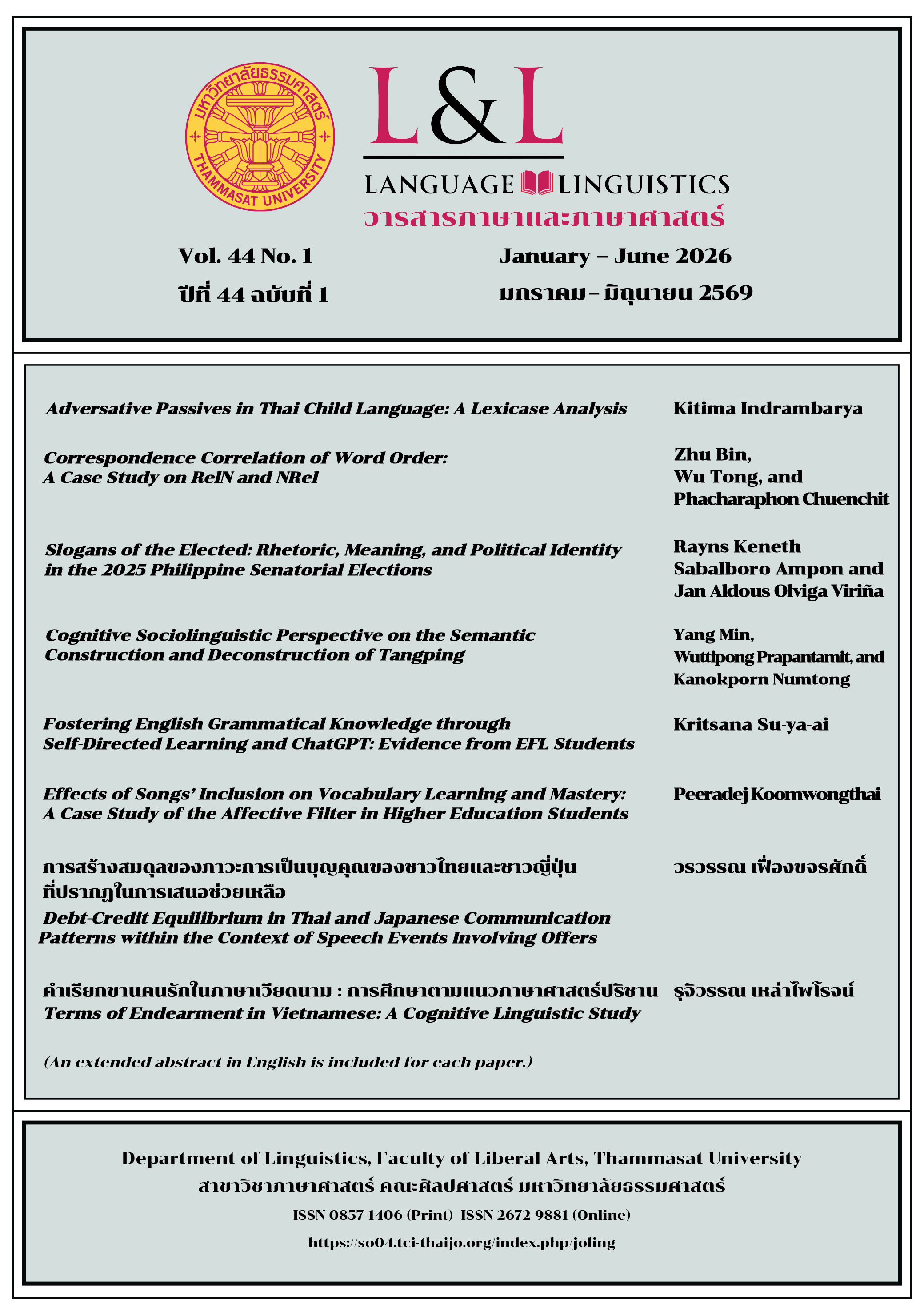
Adversative Passives in Thai Child Language: A Lexicase Analysis
Article Sidebar
Main Article Content
Abstract
This study provides systematic elicited production data on Thai adversative passives in children, contributing to the limited literature on passive acquisition in isolating languages. Using a Lexicase syntactic analysis, the study examines the predominant adversative passive constructions, marked by the passive markers thùuk and doon. The study investigated the production of 138 children aged 2 to 5 years through experimental tasks and semi-structured interviews, compared with an adult baseline production.
Findings revealed that children produced passive constructions early and accurately. In the experiment, the canonical passive pattern (Pattern 4) emerged at age 2, with high target accuracy maintained across the preschool years (86.8%, 95% CI [80.3%, 91.4%]), which confirms robust productive command of the canonical Thai adversative passive pattern. Lexical verbs in passive constructions were predominantly adversative actional verbs, consistent with the adversative nature of the Thai passive markers thùuk and doon. The extended passive pattern with body-part noun phrases (Pattern 5) emerged at ages 2–3, requiring both Patient-to-Patient control and semantic part-whole understanding. Adults produced a more elaborate passive variant not observed in children’s data. This suggests that passive elaboration continues beyond age 5. Grammatical development progressed from basic, canonical passives at age 2 to extended forms at age 3, with more elaborate patterns at age 5, establishing developmental milestones in Thai adversative passive production.
Article Details

This work is licensed under a Creative Commons Attribution-NonCommercial-NoDerivatives 4.0 International License.
บทความทุกบทความเป็นลิขสิทธิ์ของภาษาและภาษาศาสตร์
References
Allen, S. E. M., & Crago, M. B. (1996). Early passive acquisition in Inuktitut. Journal of Child Language, 23(1), 129–155. https://doi.org/10.1017/S0305000900010126
Baldie, B. (1976). The acquisition of the passive voice. Journal of Child Language, 3, 331–348. https://doi.org/10.1017/S0305000900007224
Borer, H., & Wexler, K. (1987). The maturation of syntax. In T. Roeper & E. Williams (Eds.), Parameter setting (pp. 123–172). D. Reidel.
Crain, S., Thornton, R., & Murasugi, K. (2009). Capturing the evasive passive. Language Acquisition, 16(2), 123–133. https://doi.org/10.1080/10489220902769234
Deen, K. U. (2011). The Acquisition of the Passive. In de Villiers, J. & T. Roeper. (eds) Handbook of Generative Approaches to Language Acquisition. John Benjamins Publisher, 155-188.
Demuth, K., Moloi, F., & Machobane, M. (2010). 3-year-olds' comprehension, production, and generalization of Sesotho passives. Cognition, 115, 238–251. https://doi.org/10.1016/j.cognition.2009.12.015
Horgan, D. (1978). The development of full passive. Journal of Child Language, 5, 65–80. https://doi.org/10.1017/S030500090000194X
Huang, C.-T. J. (2013). Variations in non-canonical passives. In A. Alexiadou & F. Schäfer (Eds.), Non-canonical passives (pp. 95–114). John Benjamins. https://doi.org/10.1075/la.205.05hua
Indrambarya, K. (1994). Subcategorization of verbs in Thai: A Lexicase dependency approach [Unpublished doctoral dissertation]. University of Hawai’i. https://doi.org/10.13140/RG.2.2.14104.87047
Indrambarya, K. (2024). The Acquisition of Passives by Thai Preschoolers. Manusya: Journal of Humanities, 27(1), 1-28. https://doi.org/10.1163/26659077-20242716
Indrambarya, K. (In Press). The Acceptability judgment of non-canonical Thai passive constructions in people of different ages. Linguistics of the Tibeto-Burman area.
Indrambarya, K. (Under review). The production of passives with actional and psychological verbs in preschool Thai children. Language, Interaction, and Acquisition.
Prasithrathsint, A. (2001). The establishment of the neutral passive and the persistence of the adversative passive in Thai. MANUSYA: Journal of Humanities, 4(2), 77–88. https://doi.org/10.1163/26659077-00402006
Prasithrathsint, A. (2006). Development of thùuk passive marker in Thai. In W. Abraham & L. Leisio (Eds.), Passivation and typology: Form and function (pp. 115–131). John Benjamins. https://doi.org/10.1075/tsl.68.09pra
Prasithrathsint, A., Indrambarya, K. & Chaicharoen, N. (2011). A pan-dialectal grammar of Thai: Grammar of standard Thai. [in Thai]. Thailand Research Fund.
Savetamalaya, S. (2001). Categorization of /thùuk/ in Thai: Lexicase analysis. In M. R. K. Tingsabadh & A. Abramson (Eds.), Essays in Tai linguistics (pp. 117–127). Chulalongkorn University Press.
Starosta, S. (1988). The case for Lexicase: An outline of Lexicase grammatical theory. Pinter.
Sudmuk, C. (2003). The thùuk construction in Thai. In M. Butt & T. H. King (Eds.), Proceedings of the LFG03 Conference (pp. 402–423). CSLI Publications.
Sugisaki, K. (1999). Japanese passives in acquisition. UCONN Working Papers in Linguistics, 10, 145–156.
