
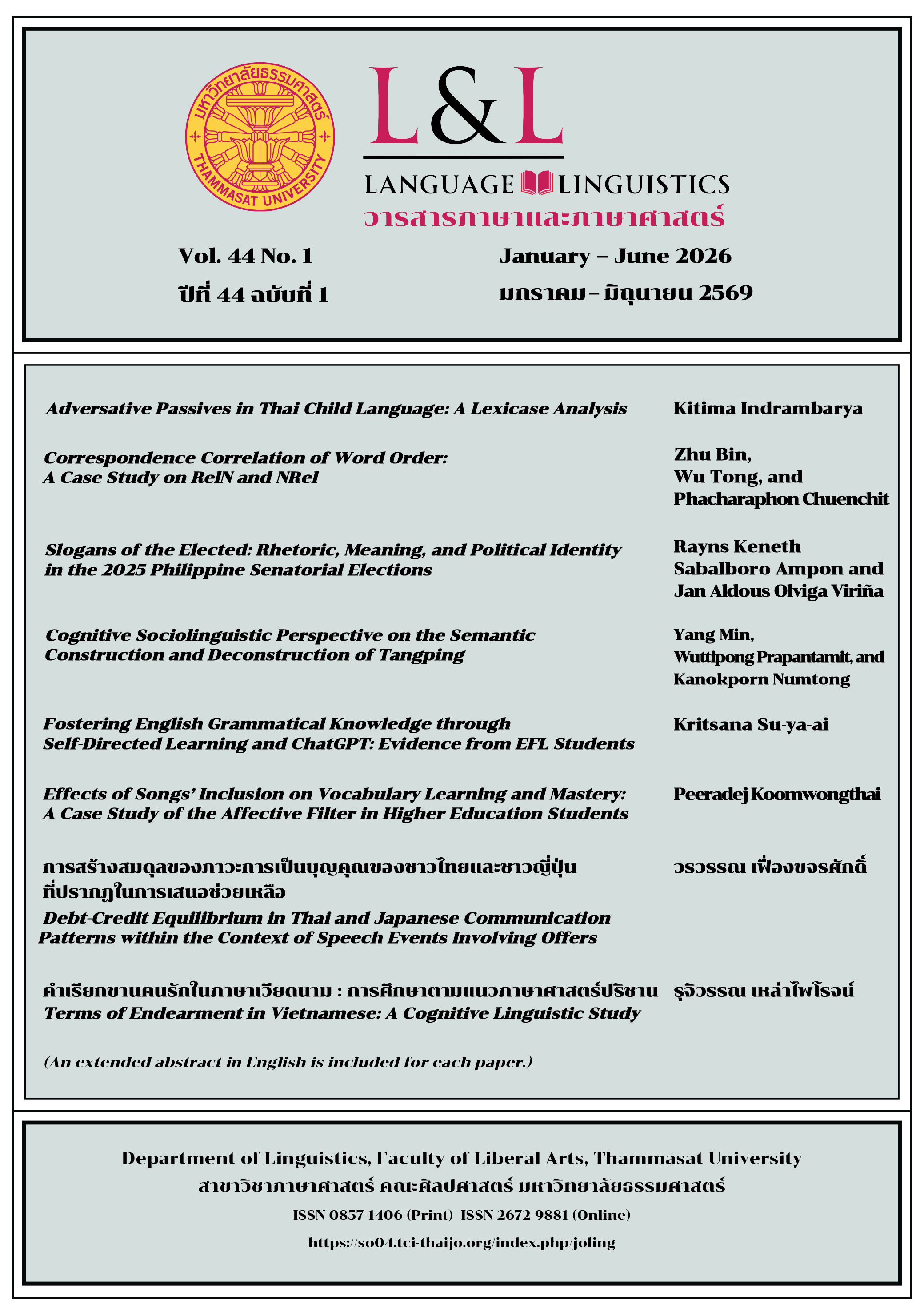
Cognitive Sociolinguistic Perspective on the Semantic Construction and Deconstruction of Tangping
Article Sidebar
Main Article Content
Abstract
Internet buzzwords, on the one hand, embody a new demand for language expression with the change of China’s online media, and on the other hand reflect the history of social transformation in China. Studies on buzzwords can not only trace the changes and development of language itself, but also perceive social life and the representation of the mindsets of large numbers of netizens behind language phenomena. From a cognitive sociolinguistic perspective, the study draws on a corpus-based qualitative approach using online and media discourse from 2021 to 2024, and, by integrating conceptual metaphor theory, frame semantics, and conceptual blending theory in cognitive linguistics, as well as applying ideology and discourse analysis, reveals the dynamic mechanism underlying the semantic formation of Tangping (lying flat; 躺平). The research finds that the semantic meaning of Tangping evolves through a metaphorical change from body posture to social attitude, forming a multi-tiered meaning network in concrete social contexts. Rather than emerging by chance, Tangping developed through the interaction of structural social pressures, pre-existing discursive resources, and accumulated affect, eventually taking shape around a core meaning of cognitive resistance. Under the circumstances of semantic deconstruction by mainstream media and the acceleration of online environments, Tangping ultimately forms a semantic compound with inner tension, and its meaning varies with the speaker’s stance and contextual changes.
Article Details

This work is licensed under a Creative Commons Attribution-NonCommercial-NoDerivatives 4.0 International License.
บทความทุกบทความเป็นลิขสิทธิ์ของภาษาและภาษาศาสตร์
References
Baidu. (2021). Baidu Index data for keyword “Tangping”, nationwide search, March 1 – December 31, 2021 [Data set] [Online]. Retrieved October 11, 2025, from https://index.baidu.com
Baidu Images. (n.d.). Internet memes related to the Tangping phenomenon [Image] [Online]. Retrieved November 16, 2025, from http://images.baidu.com
Chinese Academy of Social Sciences, Institute of Linguistics. (2016). Modern Chinese Dictionary (7th ed.) [in Chinese]. Beijing: The Commercial Press.
Fang, Y., & Li, M. (2023). Semantic construction and Deconstruction of Internet Buzzwords: Taking Neijuan as an Example [in Chinese]. Applied Linguistics, (2), 112–120.
Geeraerts, D., Kristiansen, G., & Peirsman, Y. (2010). Advances in cognitive sociolinguistics. Mouton de Gruyter.
He, W. (2024). “Buddha-like” and “Lying Flat”: The Narrative Logic and Sublation Path of Network Subculture [in Chinese]. Journal of Hubei Minzu University (Philosophy and Social Sciences), (2), 66–79.
Hudson, R. (2007). Language networks: The new word grammar. Oxford University Press.
Kristiansen, G., & Dirven, R. (2008). Cognitive sociolinguistics: Language variation, cultural models, social systems. Mouton de Gruyter.
Li, H. (2014). Reflections on the Rise of Cognitive Sociolinguistics [in Chinese]. Journal of Dialectics of Nature, 5, 114–118, 128.
Li, H. (2022). Generating Logic and Guiding Strategy of “Lying Flat” of Young People [in Chinese]. Journal of Kunming University of Science and Technology (Social Sciences), 22(5), 145–151.
Liang, H., & Chen, H. X. (2016). Multi-perspective studies in cognitive sociolinguistics [in Chinese]. Harbin Engineering University Press.
Lin, Z. (2023). The communication practice and meaning production of the network buzzword “lying down”: On the Basis of Fairclough's Three-dimensional Discourse Analysis [in Chinese] (Master’s thesis, Chongqing University).
Ling, Y. (2022). Research on Network Catchwords from 2010 to 2019 (Doctoral dissertation, Central China Normal University).
Liu, Y., & Fan, X. (2025). A study of the internet buzzword cluster “lying-X” [in Chinese]. Journal of Puyang Vocational and Technical College, 38(5), 79–83.
Mao, X. (2024). Semantic analysis and popularity factors of the internet catchphrase “Tangping” [in Chinese]. Jiaying Literature, (19), 96–98.
Peng, J., & Yu, T. (2023). Multi-dimensional Analysis of the Phenomenon of “Lying Flat” of Contemporary College Students: Based on the Survey and Analysis of College Students in 23 Colleges and Universities in China [in Chinese]. Journal of Beijing University of Aeronautics and Astronautics (Social Sciences Edition), 36(2), 174–181.
Qiu, X. (2019). Group characteristics and causes of Japan’s “desireless generation” [in Chinese]. China Youth Study, (8), 113–119.
Song, D., & Bie, Y. (2022). The nature, risks, and transcendence of “low-desire lying-flatism”: From the perspective of diversified youth needs [in Chinese]. China Youth Study, (2), 22–29.
Sun, R. (2023). The impact and countermeasures of “Sang” culture such as “Tanking” on youth’s values [in Chinese]. Journal of Nanjing University of Posts and Telecommunications (Social Sciences), (1), 76–82.
Wang, S. (2016). Studies on internet buzzwords: Social and media perspectives [in Chinese]. China Social Sciences Press.
Wang, T., & Wang, Y. (2012). Cognitive sociolinguistics [in Chinese]. Foreign Language in China, 2, 44–53.
Wang, X., Xu, J., Zhu, G., Wang, J., Cheng, B., Lü, H., & Tao, D. (2021). “Lying Flat”: Response Posture, Social Mentality and Survival State [in Chinese]. Exploration and Free Views, (12), 4–177.
Wen, X. (2019). Sociocognitive Linguistics Based on Social Cognition [in Chinese]. Modern Foreign Languages, 3, 293–305.
Xiang, Y. (2021). Disenchanting and Reconstructing: The Social Roots and Cultural Reflection of “Lying Flat Culture” [in Chinese]. Social Sciences in Xinjiang, (5), 146–152, 164.
Xu, J. (2024). Ecological discourse shifts of internet catchphrases: A case study of “Neijuan,” “Tangping,” and “Bailan” [in Chinese]. Journal of Yan’an Vocational & Technical College, 38(4), 52–56, 78.
Xu, Z. (2021). Dimensions of Tangping: Discursive representations and reflective dialectics of lying-flat culture [in Chinese]. Social Sciences in Xinjiang, (5), 139–145.
Yang, C. (2022, November 5). Vigorous youth reject Tangping and Neijuan [in Chinese]. People’s Daily Online. http://opinion.people.com.cn/n1/2022/1105/c447715-32559516.html
Ye, F., & Xu, T. (2010). An outline of linguistics (Revised ed.) [in Chinese]. Peking University Press.
Youth.cn. (2022, December 31). What do young people mean when they say Tangping [in Chinese]. https://t.m.youth.cn/transfer/index/url/news.youth.cn/gn/202212/t20221231_14228766.htm
Zhang, D., Pan, Y., & Zhong, M. (2023). New meanings and usages of the internet catchphrases Tangping and Neijuan [in Chinese]. Sinogram Culture, (10), 151–153.
Zhang, H., & Zhou, H. (2010). A New Research Direction in Cognitive Linguistics: Cognitive Sociolinguistics [in Chinese]. Foreign Language Research, 3, 36–42.
Zhang, H., & Shi, L. (2022). Concrete representations, theoretical causes, and guiding approaches of the “lying-flat group” [in Chinese]. Journal of Socialist Theory Guide, (1), 85–92.
Zhang, J. (2023). A Study on the Semantic Cognitive Mechanism of the Internet Slang Term “Tang ping” [in Chinese]. Included in Proceedings of the International Forum on Northeast Asian Linguistics, Literature, and Language Education (Vol. 2, pp. 94–100).
Zhang, W., & Mo, S. (2022). Interpreting youth cultural symptoms: An analysis of the affective structure of the Tangping meme [in Chinese]. Future Communication, 29(4), 26–35.
Zhang, Y. (2025). The mechanisms and mitigation paths of youth Tangping from the perspective of triadic interaction determinism [in Chinese]. New West, (9), 181–187.
Zhu, H., & Liu, Y. (2011). New intersections of cognitive linguistics and sociolinguistics: A review of Cognitive Sociolinguistics: Language Variation, Cultural Models, Social Systems [in Chinese]. Foreign Languages and Literature, 1, 142–144.
Zhu, H., & Wang, M. (2018). Class anxiety syndrome: The spiritual crisis and outlet of contemporary youth [in Chinese]. China Youth Study, (11), 77–82, 97.
