
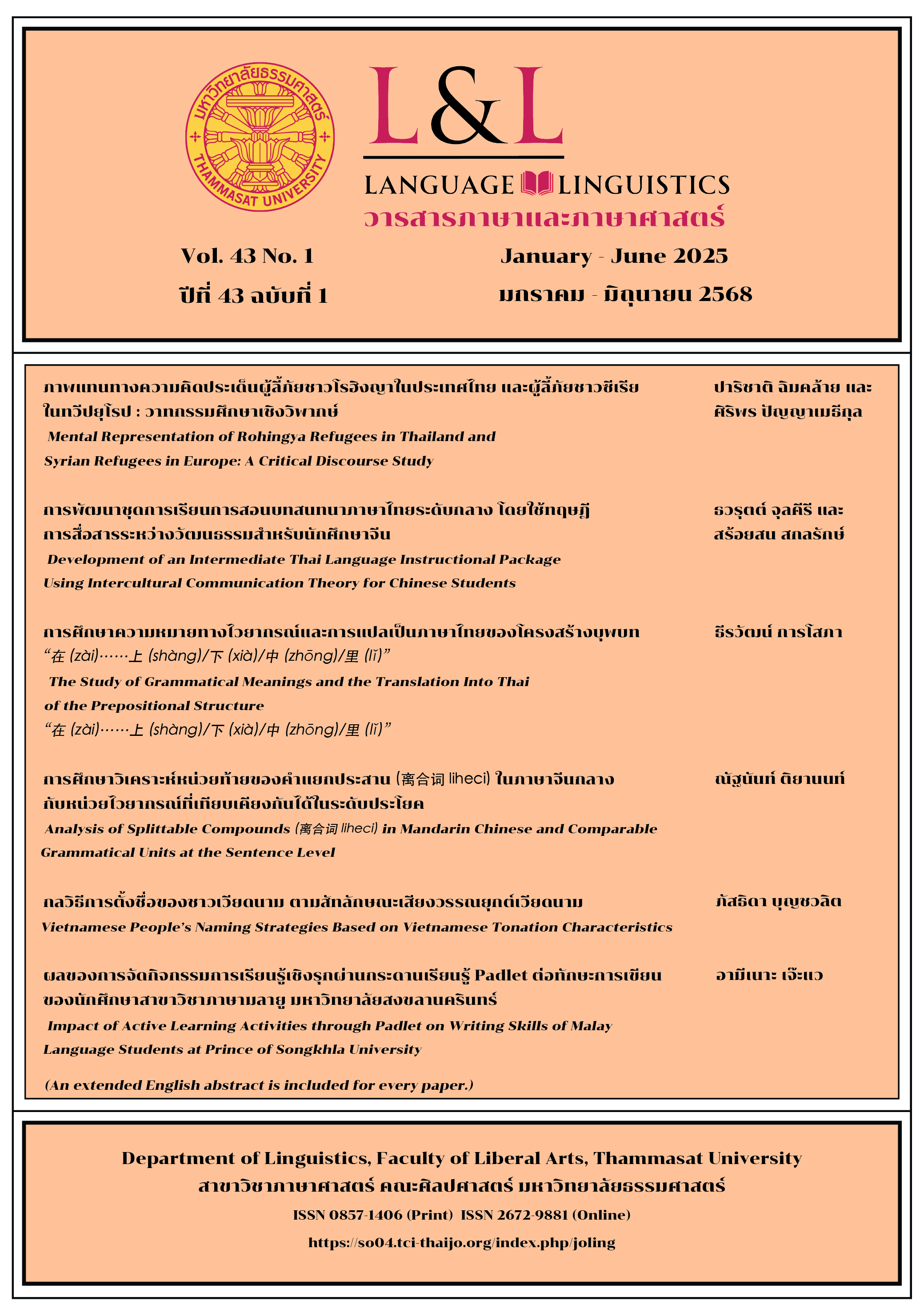
The Study of Grammatical Meanings and the Translation Into Thai of the Prepositional Structure “在 (zài)……上 (shàng)/下 (xià)/中 (zhōng)/里 (lǐ)
Article Sidebar
Main Article Content
Abstract
This research has two main objectives: to analyze the grammatical meaning of the prepositional structure “在 (zài)……上 (shàng)/下 (xià)/中 (zhōng)/里 (lǐ)” and to investigate its translation into Thai. The findings indicate that this structure is not limited to conveying physical meanings related to the position or location, but also extends to five other aspects: 1) indicating perspectives or areas of expertise, 2) indicating boundaries, 3) expressing conditions and factors, 4) describing processes, and 5) denoting statuses, states, or conditions. Regarding its translation, it is observed that this Chinese prepositional structure is highly flexible and can function in multiple ways. It may appear at the beginning of a sentence or before a verb as an adverbial modifier, and it may follow a verb as a complement. Effective translation requires careful adaptation of sentence structures in the target language to align with their linguistic characteristics. For example, in Thai, commonly used equivalents include “ใน”, “บน”, and “ภายใต้”, which differ from Chinese. However, precise contextual analysis is essential to ensure that the translation fully preserves the original meaning while maintaining naturalness and communicative effectiveness in the target language.
Article Details

This work is licensed under a Creative Commons Attribution-NonCommercial-NoDerivatives 4.0 International License.
บทความทุกบทความเป็นลิขสิทธิ์ของภาษาและภาษาศาสตร์
References
กนกพร นุ่มทอง. (2563). ทักษะการแปลภาษาจีนเป็นภาษาไทย. จรัลสนิทวงศ์การพิมพ์.
นววรรณ พันธุเมธา. (2558). ไวยากรณ์ไทย (พิมพ์ครั้งที่ 7). คณะอักษรศาสตร์,จุฬาลงกรณ์มหาวิทยาลัย.
วิโรจน์ อรุณมานะกุล. (2553). เอกสารคำสอนวิชาทฤษฎีภาษาศาสตร์ [เอกสารไม่ตีพิมพ์]. คณะอักษรศาสตร์, จุฬาลงกรณ์มหาวิทยาลัย.
สัญฉวี สายบัว. (2550). หลักการแปล (พิมพ์ครั้งที่ 8). สำนักพิมพ์มหาวิทยาลัยธรรมศาสตร์.
Chen Changlai 陈昌来.(2002). 介词与介引功能. 安徽教育出版社.
Chen Changlai陈昌来.(2015). 汉语 “介词框架” 研究. 商务印书馆.
Fang Qingming 方清明. (2017). 现代汉语介词用法词典. 商务印书馆.
Fillmore, C. J. (1982). Frame semantics. In The Linguistic Society of Korea (Ed.), Linguistics in the morning calm (pp. 111-137). Hanshin Publishing. https://brenocon.com/Fillmore%201982_2up.pdf
Institute of Linguistics, CASS 中国社会科学院语言研究所词典编辑室. (2020). 现代汉语词典 (第七版). 商务印书馆.
Lu Shuxiang吕叔湘. (2021). 现代汉语八百词. 商务印书馆.
Shen Jiaxuan 沈家萱. (1999). “在” 字句和 “给” 字句. 中国语文, (2), 94-102.
