
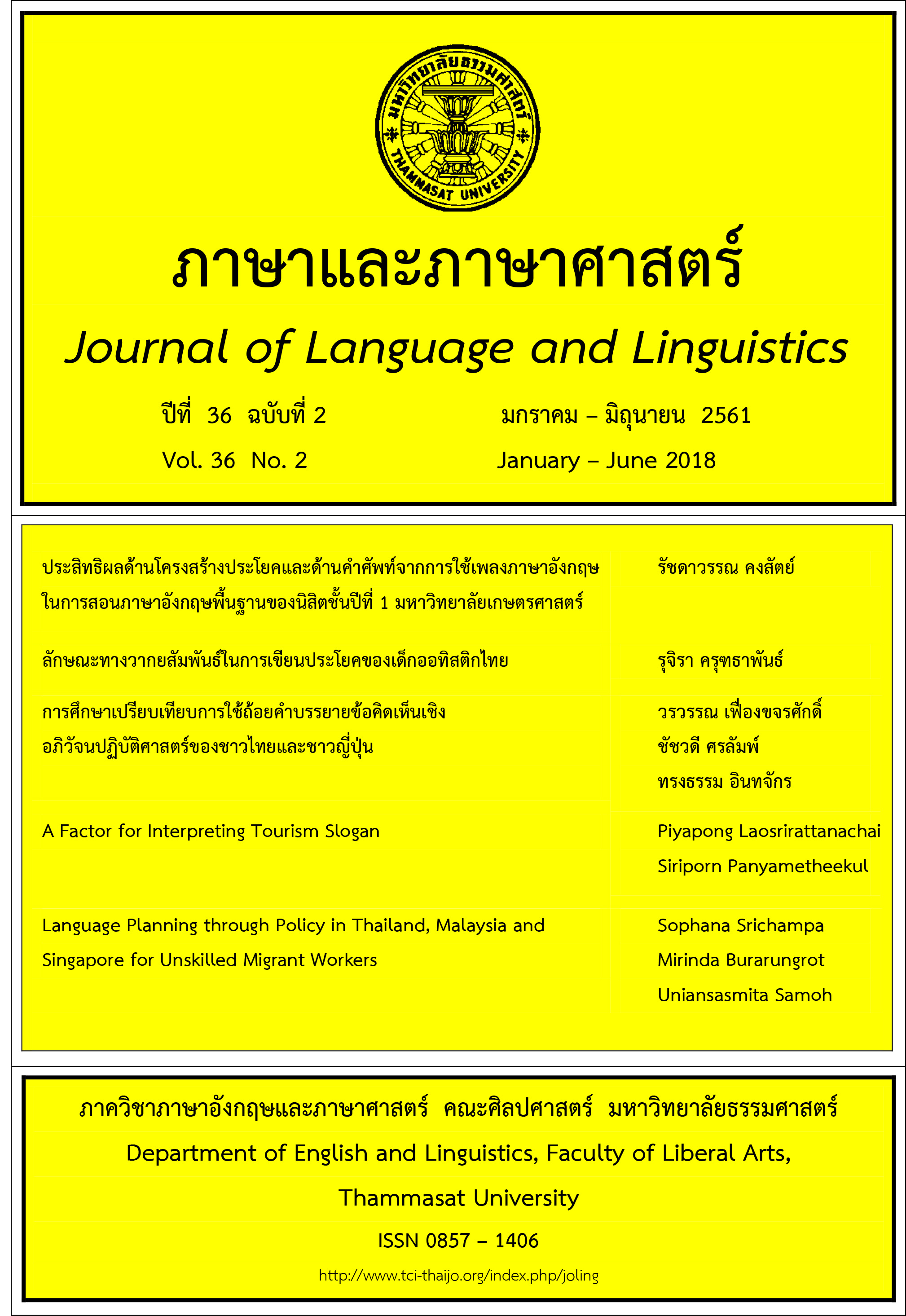
Language Planning through Policy in Thailand, Malaysia and Singapore for Unskilled Migrant Workers
Article Sidebar
Main Article Content
บทคัดย่อ
ประชาคมอาเซียนไม่ได้มีนโยบายภาษาสำหรับประชาคม มีเพียงการประกาศไว้ในอาเซียนชาร์เตอร์ว่าให้ใช้ ภาษาอังกฤษเป็นภาษาในการท างานของอาเซียน แต่ด้วยเหตุที่ประชาคมอาเซียนมีความหลากหลายของกลุ่มชาติพันธุ์ ศาสนา และวัฒนธรรม และแต่ละประเทศมีนโยบายภาษาที่แตกต่างกัน ดังนั้นผลของการดำเนินนโยบายภาษาในแต่ละ ประเทศส่งผลทั้งในด้านบวกและด้านลบต่อการพัฒนาทรัพยากรมนุษย์และการธำรงรักษาอัตลักษณ์ของกลุ่มชาติพันธุ์ แตกต่างกัน นอกจากนี้การเคลื่อนย้ายประชากรในประชาคมอาเซียนที่มีปัจจัยผลักและปัจจัยดึงดูดให้มีการเคลื่อนย้าย แรงงานในประเทศสมาชิกอาเซียนและนอกประเทศสมาชิก โดยเฉพาะอย่างยิ่งแรงงานไร้ฝีมือ ดังนั้นบทความนี้ต้องการ ศึกษานโยบายภาษาของประเทศไทยเพื่อเปรียบเทียบกับมาเลเซียและสิงคโปร์ในฐานะประเทศปลายทางของการรับ แรงงานไร้ฝีมือว่ามีการจัดการความหลากหลายด้านภาษาให้กับแรงงานไร้ฝีมืออย่างไรเพื่อน าไปสู่การวิจัยและหาแนวทาง เสนอแนะเชิงนโยบายให้กับประเทศไทยและอาเซียนต่อไป ผลการศึกษาในเบื้องต้นพบว่าประเทศไทยมีการร่างนโยบายภาษาแล้ว แต่ยังไม่นำไปสู่การปฏิบัติการที่เป็น รูปธรรม ผลของการไม่มีนโยบายภาษาที่ชัดเจนส่งผลกระทบในด้านลบต่อการพัฒนาศักยภาพด้านภาษาของคนไทยทั้งใน ระดับท้องถิ่น ระดับชาติ และระดับนานาชาติ และส่งผลต่อการจัดการศึกษาให้กับแรงงานและลูกหลานแรงงานต่างชาติ ไร้ฝีมือ นโยบายภาษาของมาเลเซียเป็นนโยบายผกผันเริ่มด้วยการใช้สองระบบคือ 1) ทวิภาษาในโรงเรียนรัฐบาลให้ใช้ ภาษามาเลเซียและอังกฤษ 2) โรงเรียนชาวจีนและทมิฬให้ใช้สามภาษา: ทมิฬ-มาเลเซีย-อังกฤษ หรือจีน-มาเลเซีย-อังกฤษ ต่อมาเปลี่ยนมาใช้ภาษามาเลเซียภาษาเดียว แต่เมื่อผู้นำเห็นว่ามาเลเซียได้รับผลกระทบจากโลกาภิวัตน์เพราะการใช้ ภาษาเดียวจึงปรับเปลี่ยนให้ใช้ภาษาอังกฤษในการสอนคณิตศาสตร์และวิทยาศาสตร์และล่าสุดเปลี่ยนเป็นทวิภาษาคือ ภาษาอังกฤษและภาษามาเลเซีย สำหรับแรงงานต่างชาติไร้ฝีมือ ไม่มีนโยบายด้านภาษาที่ชัดเจนเพื่อช่วยเหลือ แต่มี ภาคเอกชนที่ให้ความช่วยเหลือในเรื่องนี้ นโยบายภาษาของสิงคโปร์-ภายหลังเอกราช ผู้นำสิงคโปร์ประกาศใช้ทวิภาษาคือ ภาษาอังกฤษกับภาษาจีนแมนดาริน ทั้งนี้เพื่อสร้างชาวสิงคโปร์ให้สามารถเป็นพลเมืองโลกได้ โดยที่ไม่มีการปรับเปลี่ยน นโยบาย แต่นโยบายภาษาดังกล่าวส่งผลกระทบในด้านลบต่อภาษาถิ่นอื่นๆ และไม่มีนโยบายที่ชัดเจนสำหรับพัฒนาและ ช่วยเหลือทักษะด้านภาษาให้กับแรงงานไร้ฝีมืออย่างเป็นทางการ ข้อเสนอแนะสำหรับนโยบายภาษาของอาเซียนควรจะ เป็นนโยบายพหุภาษา
Article Details
บทความทุกบทความเป็นลิขสิทธิ์ของภาษาและภาษาศาสตร์
เอกสารอ้างอิง
‘Barnes Report’. (n.d.). [Online: https://en.wikipedia.org/wiki/Barnes_Report] retrieved September 17, 2017.
Cavallaro, Francesco and Stefan Karl Serwe. (2010.). ‘Language Use and Language Shift among the Malays in Singapore’. Applied Linguistic Review. De Gruyter. 129-168.
Chua, B. H. (1995). Communitarian Ideology and Democracy in Singapore. London: Routledge.
Chew, P.G.L. (2007). Remaking Singapore: Language, Culture and Identity in a Globalized World. Amy B.M. Tsui and James W. Tollefson (Ed.). Language Policy, Culture, and Identity in
Asian Context (73-93). Mahwah, New Jersey: Lawrence Erlbaum.
Dalarna, Hogskolan. (2011). Speak Good English Movement in Singapore: Reaction in Social and Traditional Media. BA Thesis EN 2015.
David, Maya Khemlani and others. (2009). ‘Language Policies: Impact on Language Maintenance and Teaching: Focus on Malaysia, Singapore, Brunei and the
Philippines’. The Linguistics Journal. [Online: www.researchgate.net/publication/287311128_Language_Policies__Impact_on_Language_Maintenance_and_Teaching_Focus_on_
Malaysia_Singapore_Brunei_and_the_Philippines_1] retrieved August 13, 2017.
‘Demographic of Singapore’.(n.d.).[Online: https://en.wikipedia.org/wiki/demographics_of_ Singapore] retrieved August 6, 2017.
Department of Statistics, Ministry of Trade & Industry, Republic of Singapore. (2010). ‘Census of Population 2010 Statistical Release 1: Demographic Characteristics,
Education, Language and Religion’. [Online: https://www.singstat.gov.sg/docs/default-source/default-document library/publications/publications_and_papers/cop2010/
census_ 2010_release1/cop2010sr1.pdf] retrieved August 6, 2017.
Devadason, E. S., & Meng, C. W. (2014). Policies and Laws Regulating Migrant Workers in Malaysia: A Critical Appraisal. Journal of Contemporary Asia, 44(1), 19-35.
Doğançay-Aktuna, Seran. (1997). ‘Language Planning’. Encyclopedia of Language and Education. Edited by Nancy H. Hornberger, David Corson. Vol.8, p.15-22.
Springer Netherlands.
Edwards, John. (1996). "Language, Prestige, and Stigma," in Contact Linguistics. Ed. Hans Goebel. New York: de Gruyter.
Encyclopedia.com. (1998). ‘Language Planning’. [ Online: http://www.encyclopedia.com/humanities/ encyclopedias-almanacs-transcripts-and-maps/language-planning]
retrieved August 14, 2017.
‘Eurasians in Singapore’. (n.d.). [Online: https://en.wikipedia.org/wiki/Eurasians_in_Singapore] retrieved August 6, 2017.
Fah, Edmond Lee Eu. (n.d.). ‘Profile of the Singapore Chinese Dialect Groups’. Statistics
Singapore Newsletter. [Online: http://www.howardscott.net/4/Swatow_A_Colonial_Heritage/Files/ Documentation/Lee%20Eu%20Fah.pdf] retrieved August 6, 2017.
Federation of Malaya Central Advisory Committee on Education. (1951). Report on the Barnes Report on Malay Education and the Fenn-Wu Report on Chinese
Education. Federation of Malaya Central Advisory Committee on Education.
Gill, S. K. (2005). ‘Language Policy in Malaysia: Reversing Direction’. Language Policy. Volume 4, Issue 3, pp 241–260. Springer Netherlands.
Gill, S. K. (2014). Language Policy Challenges in Multi-ethnic Malaysia (Vol. 8). Springer Science & Business Media.
Gintai. (2012). ‘Malay is still the National Language of Singapore’. [Online: https://gintai. wordpress. com/ 2012/ 07/ 03/ malay -is-still-the-national-language-of-singapore/ ]
retrieved August 13, 2017.
Gopinathan et al. (1999). ‘Language Policy Changes 1979-1997: Politics and Pedagogy’. In S. Gopinathan, A. Pakir, W.K. Ho and V. Saravanan (eds). Language, Society and
Education in Singapore: Issues and Trends. [2nd edn, pp.19-44). Singapore: Time Academic Press.
Government Printer Federation of Malaya. (1960). Report of the Education Review Committee. Government Printer Federation of Malaya.
Gupta, A. and Siew, P.K. (1995). ‘Language Shift in a Singapore Family’. Journal of Multilingual and Multicultural Development 16(4), 301-313.
Hassan, Ahmad. (1988). Bahasa Sastera Buku Cetusan Fikiran. Kuala Lumpur: Dewan Bahasa dan Pustaka.
Hvitfeldt, C. and Gloria Poedjosoedarmo. (1998). ‘Language Use and Identity across Generations in Singapore’. [Online: sala/archives/pdf8/hvitfeldt1998language.pdf]
retrieved August 12, 2017.Index Mundi. (2017).
‘Singapore Demographics Profile’. [Online: http://www. indexmundi.com/ singapore/demographics_profile.html] retrieved August 6, 2017.
Institute for Population and Social Research, Mahidol University (2014). Migrant children’s education in Thailand: Policy brief. [Online: http://www.ipsr.mahidol.ac.th/ipsrbeta/
FileUpload/PDF/Report-File-503.pdf] retrieved November 3, 2017.
K. S. Kua (Ed.), ‘Mother Tongue Education of Malaysian Ethnic Minorities’. Kajang: Dong Jiao Zong Higher Learning Centre.
Kaur, A. (2007). Migration Matters in the Asia-Pacific Region: Immigration Frameworks, Knowledge Workers and National Policies. International Journal on Multicultural
Societies, 9(2), 135-157.
Kuo, C.Y. (1985). A Quantity Approach to the Study of Sociolinguistic Situation in MultiLinguistic Society. Singapore: Regional English Language Centre. ‘Languages of Singapore’. (n.d.). [Online: https://en.wikipedia.org/wiki/ Languages_of_Singapore] retrieved August 6, 2017.
Lay, Belmont. (2015). ‘This Guy in S’pore is Teaching English to Migrant Workers to Make the World Suck Less’. [Online: http://mothership.sg/2015/11/this-guy-in-spore-isteaching- english-to-migrant-workers-to-make-the-world-suck-less/ ] retrieved August 13, 2017.
Letchumanan, R. (2015). ‘What is ASEAN Community 2015 All About?’.The Diplomat. [ Online: http: / / thediplomat.com/2015/02/ what-is-asean-community-2015-allabout/] retrieved August 14, 2017.
‘Lee Kuan Yew’.(n.d.). [Online: https://en.wikipedia.org/wiki/Lee_Kuan_Yew] retrieved August 6, 2017.
Ministry of Manpower. (2016). Foreign Workforce Numbers. [Online: http://www.mom.gov.sg/ documents-and-publications/foreign-workforce-numbers] retrieved December 8, 2017.
NG Chin Leong, P. (2010.). ‘Reflections on Singapore’s Speak Mandarin Campaign’.[Online: Nearconference. weebly. com/ uploads/ 1/ 2/ 7/ 1/ 12718010/ near-2010-05. pdf]
retrieved August 12, 2017.
Office of Foreign Workers Administration Department of Employment Ministry of Labour. (2017). Report of statistics number of migrants who are allowed to work in the Kingdom of Thailand. [Online: http://www.doe.go.th/alien กกจ.45/2560 สบต.21] retrieved November 2, 2017.
Ong, Yunita. (2015). ‘Lee Kuan Yew's Legacy For Singapore: A Language Policy For A Globalized World’.[Online: https://www.forbes.com/sites/yunitaong/2015/03/23/leekuan-yews-legacy-for-singapore-a-language-policy-for-a-globalized-world/#28057e173ef9] retrieved August 6, 2017.
Pete, Aussie. (2008). ‘SINGLISH - A Language Guide for Foreigners’. [Online: http://www.aussiepete.com/2008/05/singlish-language-guide-for-foreigners.html]
retrieved August 8, 2017.
Piper, Nicola. (2005). Migrant Labour in Southeast Asia, Country Study: Singapore.[Online: http://www.fes.de/aktuell/focus_interkulturelles/focus_1/documents/8_000.pdf]
retrieved August 13, 2017.
Platt, J. (1980). ‘Multilingualism, Polyglossia, and Code Selection in Singapore’. In Afendras, E.A. Afendras and Eddie C.Y. Kuo (Eds). Language and society in
Singapore (63-83). Singapore: Singapore University Press.
Premsrirat et al. (2004). Ethnolinguistic Maps of Thailand. Ministry of Culture and Mahidol University
Sacco, Mathew. (2016). ‘What does Singapore Owe Its Migrant Workers?’ [Online: https://www.carnegiecouncil.org/publications/ethics_online/0114] retrieved August
13, 2017.
Saravanan, V. (1999). ‘Bilingual Chinese, Malay and Tamil’s Children Language Choice in Multi-lingual society’. Early Child Development and Care. 152: 43-54.
Sim Ann. (2016). ‘Policies for Women, Bilingualism among Mr Lee Kuan Yew's Legacies: Sim Ann’. [Online: http://www.todayonline.com/rememberinglky/sim-ann-paystribute-mr-lee-kuan-yew] retrieved August 8, 2017.
Sim, Cheryl. (n.d.). ‘Bilingual Policy’. [Online: http://eresources.nlb.gov.sg/infopedia/articles/SIP_ 2016-09-01_093402.html] retrieved August 6, 2017.
Sim, Cheryl. (n.d.). ‘Speak Good English Movement’. [Online: http://eresources.nlb.gov.sg/
infopedia/] retrieved August 12, 2017.
‘Singapore population’. (2017). [Online: http://www.worldometers.info/world-population/] singapore- population/] retrieved August 6, 2017.
Singh, Sinderpal. (2011). ‘Language Policy and Indian Languages in Singapore’. [Online:http://blog.nus.edu. sg/ southasiansoundings/2011/11/28/ language-policy-andindian-languages-in-singapore/] retrieved August 13, 2017.
Stewart, William A. (1968). "Sociolinguistic Typology of Multilingualism," in Readings in the Sociology of Language. Ed. Joshua Fishman. The Hague: Mouton Publishers.
Stroud C., and Wee L. (2007). ‘Consuming Identities: Language Planning and Policy in Singaporean Late Modernity’. Language Policy. 6, 253-279.
Tan, K.B. (2007). ‘The Multilingual State in Search of the Nation: The Language Discourse in Singapore’s Nation-Building’. In Lee H.G. and Leo Suryadinata.(Eds). Language
Nation and Development in Southeast Asia (74-117). Singapore: Institute of Southeast Asia Studies Publishing.
Teng, Yap Mui. (2015). ‘Immigration and Integration in Singapore’. Migration and Integration in Singapore. Edited by Yap Mui Teng, Gillian Koh and Debbie Soon.
London and New York: Routledge.
Tharmalingam, S. (2012). ‘Language policy changes in Malaysia: progressive or regressive?’. In International Conference on Linguistics, Literature, and Culture
2012 (ICLLIC 2012), 7 - 9 November 2012, Park Royal Hotel Penang.
Warotamasikkhadit, Udom and Person, Kirk. (2011). ‘Development of the National Language Policy (2006-2010) Committee to Draft the National Language Policy
The Royal Institute of Thailand’. The Journal of the Royal Institute of Thailand. 3, (29-44).
Wasuprasat, Pracha. (2010). Migrant Workers Policy: Pathways to Long-Term Competitiveness. International Labor Organization.
[Online: http://www.ilo.org/wcmsp5/groups/public/---asia/---ro-bangkok/---srobangkok/documents/publication/wcms_145133.pdf] retrieved November 3, 2017.
Wong, Tessa. (2015). ‘The rise of Singlish’. [Online: http://www.bbc.com/news/magazine33809914] retrieved August 8, 2017.
Woon, W. (1992, Sep, 13). Eastern versus Western Values. The Straits Times, 3.
Yang, P. K. (1998). ‘Constitutional & legal provision for mother tongue education in Malaysia. In K. S. Kua (Ed.), Mother tongue education of Malaysian ethnic
minorities (pp. 26-71). Kajang: Dong Jiao Zong Higher Learning Centre.
Zainuri, Z. (1998). Speak Mandarin Campaign-A Study of the Opinions of Malay Singaporeans, unpublished paper for the Bachelor of Arts (English Language and
Literature) programme, National University of Singapore, 30 December.
