
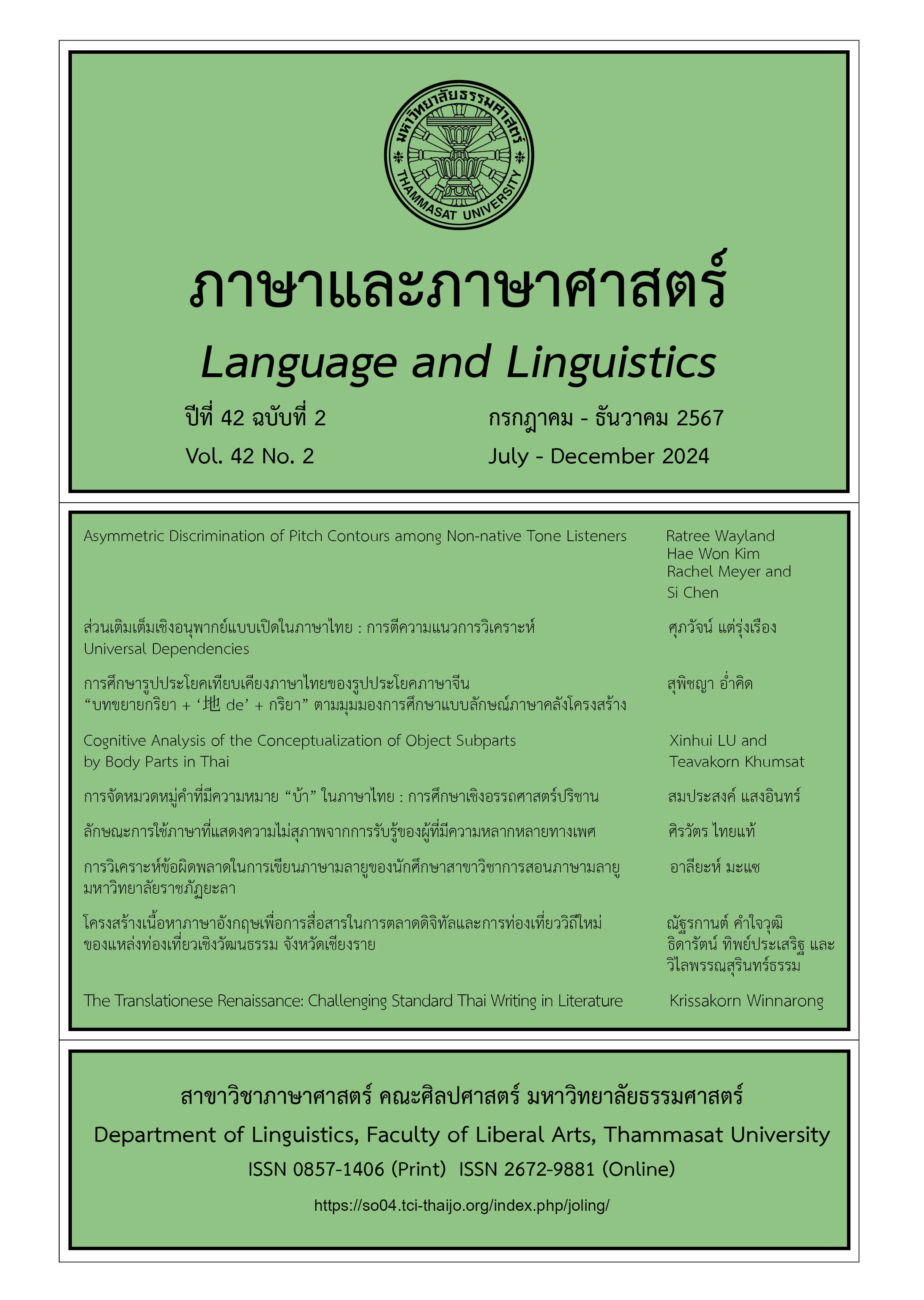
ส่วนเติมเต็มเชิงอนุพากย์แบบเปิดในภาษาไทย : การตีความแนวการวิเคราะห์ Universal Dependencies
Article Sidebar
Main Article Content
บทคัดย่อ
งานวิจัยชิ้นนี้มุ่งตีความกรอบแนวคิด Universal Dependencies ในส่วนที่เกี่ยวข้องกับความสัมพันธ์ทางไวยากรณ์ประเภทส่วนเติมเต็มเชิงอนุพากย์แบบเปิดในภาษาไทย โดยมีวัตถุประสงค์ 2 ประการ ได้แก่ เพื่อสร้างเกณฑ์การทดสอบและระบุส่วนเติมเต็มเชิงอนุพากย์แบบเปิดในภาษาไทย และเพื่อทดสอบประสิทธิภาพของเกณฑ์ที่สร้างขึ้น ทั้งนี้ผู้วิจัยได้ประยุกต์แนวคิดเรื่องความแท้จากทั้งภาษาศาสตร์รูปนัยและภาษาศาสตร์หน้าที่เป็นแนวทางในการพัฒนาเกณฑ์การทดสอบ จนกระทั่งสามารถสร้างเกณฑ์การทดสอบและระบุส่วนเติมเต็มเชิงอนุพากย์แบบเปิดในภาษาไทยทั้งหมด 6 ข้อ จากนั้นผู้วิจัยได้ทดสอบประสิทธิภาพของเกณฑ์ที่สร้างขึ้นโดยใช้โครงสร้างที่ปรากฏกริยาเรียงต่อเนื่องกันแบบ V1V2 ที่สกัดได้จากคลังต้นไม้ Universal Dependencies แบบขนานภาษาไทยเป็นข้อมูล ผลการทดสอบประสิทธิภาพปรากฏว่าเกณฑ์ที่สร้างขึ้นสามารถใช้ระบุกริยาหลักที่ปรากฏร่วมกับส่วนเติมเต็มเชิงอนุพากย์แบบเปิดได้ โดยสามารถจำแนกให้เห็นความแตกต่างจากโครงสร้างที่ปรากฏกริยาเรียงต่อเนื่องกันแบบ V1V2 อีก 2 ประเภท ได้แก่ หน่วยสร้างกริยาเรียง และกริยาหลักที่ตามด้วยส่วนเติมเต็มเชิงอนุพากย์
Article Details

อนุญาตภายใต้เงื่อนไข Creative Commons Attribution-NonCommercial-NoDerivatives 4.0 International License.
บทความทุกบทความเป็นลิขสิทธิ์ของภาษาและภาษาศาสตร์
เอกสารอ้างอิง
กิ่งกาญจน์ เทพกาญจนา. (2553). หน่วยสร้างกริยาเรียงต้นแบบในภาษาไทย. ใน อมรา ประสิทธิ์รัฐสินธุ์ (บรรณาธิการ), หน่วยสร้างที่มีข้อขัดแย้งในไวยากรณ์ไทย: หน่วยสร้างคุณานุประโยค หน่วยสร้างประโยคเติมเต็ม หน่วยสร้างกริยาเรียง และหน่วยสร้างกรรมวาจก (พิมพ์ครั้งที่ 2, น. 66-173). โรงพิมพ์แห่งจุฬาลงกรณ์มหาวิทยาลัย.
นลินี อินต๊ะซาว. (2556). การแยกอนุพากย์ภาษาไทยด้วยการใช้แบบจำลองซัพพอร์ตเวกเตอร์แมชชีน [วิทยานิพนธ์ปริญญามหาบัณฑิต, จุฬาลงกรณ์มหาวิทยาลัย]. คลังทรัพยากรสารสนเทศอิเล็กทรอนิกส์ของจุฬาลงกรณ์มหาวิทยาลัย. http://cuir.car.chula.ac.th/handle/123456789/42818
ประภัสสร เจริญสุข. (2533). กริยาที่มีคุณสมบัติในการควบคุมประธานของอนุประโยคในภาษาไทย [วิทยานิพนธ์ปริญญามหาบัณฑิต, มหาวิทยาลัยธรรมศาสตร์]. คลังทรัพยากรสารสนเทศอิเล็กทรอนิกส์ของมหาวิทยาลัยธรรมศาสตร์. https://digital.library.tu.ac.th/tu_dc/frontend/Info/item/dc:111640
วิโรจน์ อรุณมานะกุล และ ธารทอง แจ่มไพบูลย์. (2566). คู่มือการกํากับข้อมูล Thai Dependency Tree Bank ตามแนว Universal Dependencies v.2. ศูนย์วิจัยการประมวลผลภาษาและวัจนะ ภาควิชาภาษาศาสตร์ คณะอักษรศาสตร์ จุฬาลงกรณ์มหาวิทยาลัย.
สุรสา สุขก้อน. (2557). การจำแนกประเภทโครงสร้างกริยาเรียงในภาษาไทย [วิทยานิพนธ์ปริญญามหาบัณฑิต, มหาวิทยาลัยธรรมศาสตร์]. คลังทรัพยากรสารสนเทศอิเล็กทรอนิกส์ของมหาวิทยาลัยธรรมศาสตร์. https://digital.library.tu.ac.th/tu_dc/frontend/Info/item/dc:144117
Ahrenberg, L. (2017). Swedish prepositions are not pure function words. In Proceedings of the NoDaLiDa 2017 Workshop on Universal Dependencies (UDW 2017) (pp. 11-18). Association for Computational Linguistics.
Bender, E. M. (2013). Linguistic fundamentals for natural language processing: 100 Essentials from morphology and syntax. Morgan & Claypool.
Bisang, W. (2016). Finiteness, nominalization, and information structure: Convergence and divergence. In C. Chamoreau & Z. Estrada-Fernández (Eds.), Finiteness and nominalization (pp. 13-42). John Benjamins.
Chomsky, N. (1981). Lectures on government and binding: The Pisa Lectures. Foris.
de Marneffe, M.-C., Manning, C. D., Nivre, J., & Zeman, D. (2021). Universal Dependencies. Computational linguistics, 47(2), 255-308. Eide, K. M. (2016). Introduction. In K. M. Eide (Ed.), Finiteness matters: On finiteness-related phenomena in natural languages (pp. 1-44). John Benjamins.
Elliott, J. R. (2000). Realis and irrealis: Forms and concepts of the grammaticalisation of reality. Linguistic Typology, 4(1), 55-90.
Estrada-Fernández, Z. (2016). Exploring finiteness and non-finiteness in Pima Bajo (Uto-Aztecan). In C. Chamoreau & Z. Estrada-Fernández (Eds.), Finiteness and nominalization (pp. 43-68). John Benjamins.
Givón, T. (1990). Syntax: A functional-typological introduction (Vol. II). John Benjamins.
Givón, T. (2001). Syntax: An introduction (Vol. II). John Benjamins.
Grano, T. (2015). Control and restructuring. Oxford University Press.
Han, J. Y., Oh, T. H., Jin, L., & Kim, H. (2020). Annotation issues in Universal Dependencies for Korean and Japanese. In Proceedings of the Fourth Workshop on Universal Dependencies (UDW 2020) (pp. 99-108). Association for Computational Linguistics.
Karttunen, L. (1971). Implicative verbs. Language, 47(2), 340-358.
Lambrecht, K. (1994). Information structure and sentence form: Topic, focus, and the mental representations of discourse referents. Cambridge University Press.
Lehmann, C. (1988). Towards a typology of clause linkage. In J. Haiman & S. A. Thompson (Eds.), Clause combining in grammar and discourse (pp. 181-225). John Benjamins Publishing Company.
Nikolaeva, I. (2007). Introduction. In I. Nikolaeva (Ed.), Finiteness: Theoretical and empirical foundations (pp. 1-19). Oxford University Press.
Nivre, J., de Marneffe, M.-C., Ginter, F., Goldberg, Y., Hajič, J., Manning, C. D., McDonald, R., Petrov, S., Pyysalo, S., Silveira, N., Tsarfaty, R., & Zeman, D. (2016). Universal Dependencies v1: A multilingual treebank Collection. In Proceedings of the Tenth International Conference on Language Resources and Evaluation (LREC 2016) (pp. 1659-1666). European Language Resources Association (ELRA).
Nivre, J., de Marneffe, M.-C., Ginter, F., Hajič, J., Manning, C. D., Pyysalo, S., Schuster, S., Tyers, F., & Zeman, D. (2020). Universal Dependencies v2: An evergrowing multilingual treebank collection. In Proceedings of the Twelfth Language Resources and Evaluation Conference (pp. 4034–4043). European Language Resources Association.
Poiret, R., Wong, T.-S., Lee, J., Gerdes, K., & Leung, H. (2021). Universal Dependencies for Mandarin Chinese. Language Resources and Evaluation, 57, 673-710.
Prasertsom, P. (2017). A descriptive and constructional approach to the tʰîː-càʔ complementation in Thai [Unpublished senior project]. Chalalongkorn University.
Prokopidis, P. (2017). Universal Dependencies for Greek. In Proceedings of the NoDaLiDa 2017 Workshop on Universal Dependencies (UDW 2017) (pp. 102-106). Association for Computational Linguistics.
Rangkupan, S. (2005). A system of epistemic modality in Thai. MANUSYA: Journal of Humanities, 8(1), 51-67.
Santorini, B., & Kroch, A. (2007). The syntax of natural language: An online introduction. University of Pennsylvania.
Schneider, N., & Zeldes, A. (2021). Mischievous nominal constructions in Universal Dependencies. In Proceedings of the Fifth Workshop on Universal Dependencies (UDW, SyntaxFest 2021) (pp. 160–172). Association for Computational Linguistics.
Singhapreecha, P. (2010). Modals and control infinitives: A view of Thîi. Lingua, 120(5), 1288-1312.
Singhapreecha, P. (2019). Non-finite clauses in Thai. Journal of the Southeast Asian Linguistics Society, 12.1, 25-51.
Sudmuk, C. (2005). The syntax and semantics of serial verb constructions in Thai [Doctoral dissertation, University of Texas at Austin]. University of Texas at Austin Repository. https://repositories.lib.utexas.edu/items/2bd63689-516d-48da-99f7-581f172682c2
Tanaka, T., Miyao, Y., Asahara, M., Uematsu, S., Kanayama, H., Mori, S., & Matsumoto, Y. (2016). Universal Dependencies for Japanese. In Proceedings of the Tenth International Conference on Language Resources and Evaluation (LREC'16) (pp. 1651–1658). European Language Resources Association (ELRA).
Toska, M., Nivre, J., & Zeman, D. (2020). Universal Dependencies for Albanian. In Proceedings of the Fourth Workshop on Universal Dependencies (UDW 2020) (pp. 178–188). Association for Computational Linguistics.
Yang, B. (2022). Non-finiteness: A process-relation perspective. Cambridge University Press.
Zhang, N. N. (2019). Sentence-final aspect particles as finite markers in Mandarin Chinese. Linguistics, 57(5), 967-1023.
