
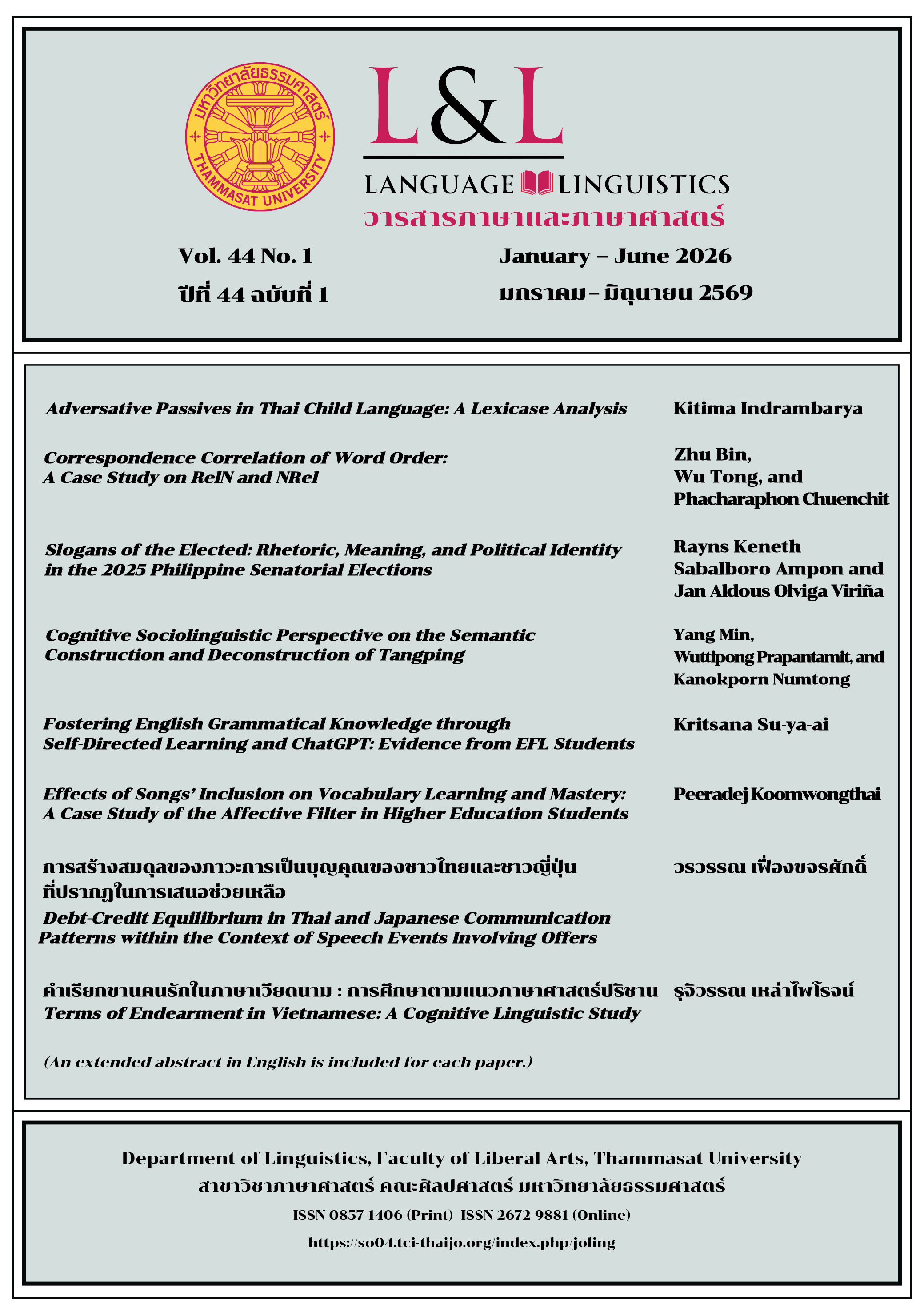
การสร้างสมดุลของภาวะการเป็นบุญคุณของชาวไทยและชาวญี่ปุ่น ที่ปรากฏในการเสนอช่วยเหลือ
Article Sidebar
Main Article Content
บทคัดย่อ
“บุญคุณ” และ “การตอบแทน” กล่าวได้ว่าเป็นแนวคิดที่ได้รับการให้คุณค่าในหลายสังคมรวมทั้งในสังคมไทยและสังคมญี่ปุ่นที่มีวัฒนธรรมใกล้เคียงกัน การที่ฝ่ายหนึ่งมีบุญคุณกับอีกฝ่ายหนึ่งย่อมเท่ากับเกิดความไม่สมดุลขึ้นในความสัมพันธ์ของทั้งสองฝ่าย ฝ่ายที่ติดหนี้บุญคุณจึงพยายามตอบแทนในทางใดทางหนึ่งเพื่อสร้างสมดุลของภาวะการเป็นบุญคุณกลับคืนมา ในการศึกษานี้ผู้วิจัยศึกษากระบวนการสร้างความสมดุลของภาวะการเป็นบุญคุณของชาวไทยและชาวญี่ปุ่น โดยการวิเคราะห์รูปแบบการสนทนาโต้ตอบในบริบทการเสนอช่วยเหลือ ผู้วิจัยเก็บข้อมูลจากละครโทรทัศน์ร่วมสมัยไทยและญี่ปุ่นอย่างละ 5 เรื่อง พบจำนวนตัวอย่างบทสนทนาในภาษาไทยจำนวน 78 ตัวอย่าง และภาษาญี่ปุ่น 85 ตัวอย่าง ผลการศึกษาแบ่งออกเป็น 3 กรณี ได้แก่ กรณีที่การเสนอช่วยเหลือได้รับการตอบรับ กรณีที่การเสนอช่วยเหลือได้รับการตอบรับแบบมีการต่อรองระหว่างคู่สนทนา และกรณีที่การเสนอช่วยเหลือถูกปฏิเสธ แต่ละกรณีแสดงให้เห็นถึงกระบวนการสร้างความสมดุลที่เป็นลักษณะเฉพาะแตกต่างกันไปของแต่ละภาษา ภาษาญี่ปุ่นพบว่ารูปแบบของผลัดการสนทนามีความซับซ้อน มีการใช้รูปภาษาที่แสดงความกังวลต่อการเป็นภาระ และมีการกระตุ้นให้ผู้เสนอยืนยันความตั้งใจในขณะที่ภาษาไทยมีรูปแบบการสนทนาที่สั้นและกระชับกว่าเน้นกระบวนการบรรเทาการรบกวนเพื่อลดระดับความไม่สมดุลให้มีน้อยลง อย่างไรก็ตามทั้งสองภาษามีจุดร่วมที่สำคัญคือ ความร่วมมือกันระหว่างผู้เสนอช่วยเหลือและผู้รับในการฟื้นฟูดุลยภาพของความเป็นบุญคุณให้มีความสมดุลดังเดิม โดยมีแนวคิดเรื่องความเกรงใจเป็นกลไกทางสังคมพื้นฐานที่ทั้งสองวัฒนธรรมยึดถือร่วมกัน
Article Details

อนุญาตภายใต้เงื่อนไข Creative Commons Attribution-NonCommercial-NoDerivatives 4.0 International License.
บทความทุกบทความเป็นลิขสิทธิ์ของภาษาและภาษาศาสตร์
เอกสารอ้างอิง
Almusallam, I. (2023). Offers in Saudi EFL talks: A focus on the learners’ pragmatic competence in interactions. Journal of Pragmatics, 214, 164–182. https://doi.org/10.1016/j.pragma.2023.05.003
Anchimbe, E. A. (2018). Offers and offer refusals: A postcolonial pragmatics perspective on World Englishes. John Benjamins. https://doi.org/10.1075/pbns.298
Arita, Y. (2023). Demo “but”-prefaced responses to inquiry in Japanese. Discourse Processes, 60(8), 594–611. https://doi.org/10.1080/0163853X.2023.2255501
Befu, H. (1980). Structural and motivational approaches to social exchange. In K. J. Gergen, M. S. Greenberg, & R. H. Willis (Eds.), Social exchange: Advances in theory and research (pp. 281–302). Plenum Press.
Couper-Kuhlen, E. (2014). What Does Grammar Tell Us About Action?. Pragmatics, 24(3), 623–647. https://doi.org/10.1075/prag.24.3.08cou
Fukushima, S. (2009). Evaluation of politeness: Do the Japanese evaluate attentiveness more positively than the British?. Pragmatics, 19(4), 501–518. https://doi.org/10.1075/prag.19.4.01fuk
Fukushima, S. (2013). An attentiveness perspective in metapragmatics of im/politeness. Tsuru Bunka Daigaku Daigakuin Kiyo, 17, 19–34.
Fukushima, S. (2015). In search of another understanding of politeness: From the perspective of attentiveness. Journal of Politeness Research, 11(2), 261–287. https://doi.org/10.1515/pr-2015-0011.
Gu, Y. (1990). Politeness phenomena in modern Chinese. Journal of Pragmatics, 14(2), 237–257. https://doi.org/10.1016/0378-2166(90)90082-O
Haugh, M. (2024). Ostensible offers, politeness and sincere hypocrisy. In S. Sorlin & T. Virtanen (Eds.), The pragmatics of Hypocrisy (pp. 162–186). John Benjamins.
Ide, R. (1998). ‘Sorry for your kindness’: Japanese interactional ritual in public discourse. Journal of Pragmatics, 29(5), 509–529. https://doi.org/10.1016/S0378-2166(98)80006-4
Intachakra, S. (2012). Politeness motivated by the ‘heart’ and ‘binary rationality’ in Thai culture. Journal of Pragmatics, 44(5), 619–635. https://doi.org/10.1016/j.pragma.2011.07.016
Knutson, T. J., Komolsevin, R., Chatiketu, P. & Smitha, V. R. (2003). A cross-cultural comparison of Thai and US American rhetorical sensitivity: Implications for intercultural communication effectiveness. International Journal of Intercultural Relations, 27(1), 63–78. https://doi.org/10.1016/S0147-1767(02)00060-3
Kumatoridani, T. (1999). Alternation and co-occurrence in Japanese thanks. Journal of Pragmatics, 31(5), 623–642. https://doi.org/10.1016/S0378-2166(98)00092-7
Lebra, S. (1976). Japanese patterns of behavior. University of Hawaii Press.
Leech, G. (2014). The pragmatics of politeness. Oxford University Press.
Liu, X., & Allen, T. J. (2014). A study of linguistic politeness in Japanese. Open Journal of Modern Linguistics, 4(5), 651–663. http://dx.doi.org/10.4236/ojml.2014.45056
Matsumoto, Y. (1988). Reexamination of the universality of face: Politeness phenomena in Japanese. Jornal of Pragmatics, 12(4), 403–426. https://doi.org/10.1016/0378-2166(88)90003-3
Mekthawornwathana, T. (2012). Comprehensive meanings of krengchai and the important aspects of Thai culture [in Thai]. NIDA Development Journal, 52(1), 235–263.
Narita, M., & Narita, T. (2010). Differences in semantic formulas used by Japanese and Thai native speakers and Thai learners of Japanese in refusing offers [in Japanese]. Koide Kinen Nihongo Kyouiku Kenkyuukai, 18, 23–37.
Narrog, H. (2018). Modality. In Y. Hasegawa (Ed.), The Cambridge handbook of Japanese Linguistics (pp. 357–378). Cambridge University Press.
Obana, Y. (2019). Politeness. In P. Heinrich & Y. Ohara (Eds.), Routledge Handbook of Japanese Sociolinguistics (pp. 248–263). Routledge.
Ohashi, J. (2008). Linguistic rituals for thanking in Japanese: Balancing obligations. Journal of Pragmatics, 40(12), 2150–2174. https://doi.org/10.1016/j.pragma.2008.04.001
Ohashi, J. (2010). Balancing obligations: Bowing and linguistic features in thanking in Japanese. Journal of Politeness Research, 6, 183–214. DOI 10.1515/JPLR.2010.010
Ohashi, J. (2013). Thanking and politeness in Japanese. Palgrave Macmillan.
Panpothong, N., & Phakdeephasook, S. (2023). Independence or interdependence?: The Thai self-construal as reflected by linguistic evidence. Manusya: Journal of Humanities, 20(1), 1–25. https://doi.org/10.1163/26659077-26010002
Phatthanasutinon, T. (2022). Conceptual Metaphor related to “Bunkhun” in Thai [in Thai]. Vannavidas, 22(2), 41–68.
Prasithrathsint, A. (2001). Syntactic distribution and communicative function of the /kh/ olite particles in Thai. Journal of Language and Linguistics, 20(1), 11-23.
Rattanaburee, N. (2015). Characteristics of the act of offering: focusing on the comparison between the behaviors of Thai and Japanese people [in Japanese]. Sesshoku bamen ni okeru sougou koui no chikuseki to hyouka, Sesshoku bamen no gengo kanri kenkyuu. 12, 97–108.
Roungtheera, W. (2004). Pragmatic transfer in “refusals of suggestions” by Thai learners of Japanese: From a comparison of Thai and Japanese utterance patterns [in Japanese]. Nihongo Kyouiku, 121, 46–55.
Schegloff, E. A. (2007). Sequence organization in interaction: A primer in conversation analysis. Cambridge University Press.
Searle, J. (1969). Speech acts: An essay in the philosophy of language. Cambridge University Press.
Spencer-Oatey, H. (Ed.). (2008). Culturally speaking: Culture, communication and politeness theory (2nd ed.). Continuum.
Terkourafi, M., & Kádár, D. (2017). Convention and ritual (Im)politeness. In J. Culpeper, M. Haugh, & Kádár, D. (Eds.), The Palgrave Handbook of Linguistic Politeness (pp. 171–196). Palgrave Macmillan.
Wierzbicka, A. (2003). Cross-cultural pragmatics: The Semantics of Human Interaction (2nd ed.). Mouton de Gruyter.
Yaowarittha, C. (2012). The concept of “Bunkhun” and three types of speech acts in Thai society [in Thai]. [Master's Thesis, Chulalongkorn University]. Chulalongkorn University Intellectual Repository. http://cuir.car.chula.ac.th/handle/123456789/45258
Yoshinari, Y. (2008). A pragmatic study on indirect “offer” expressions [in Japanese]. [Doctoral dissertation, Kobe University]. Kobe University Repository Kernel. https://hdl.handle.net/20.500.14094/D1004491
