
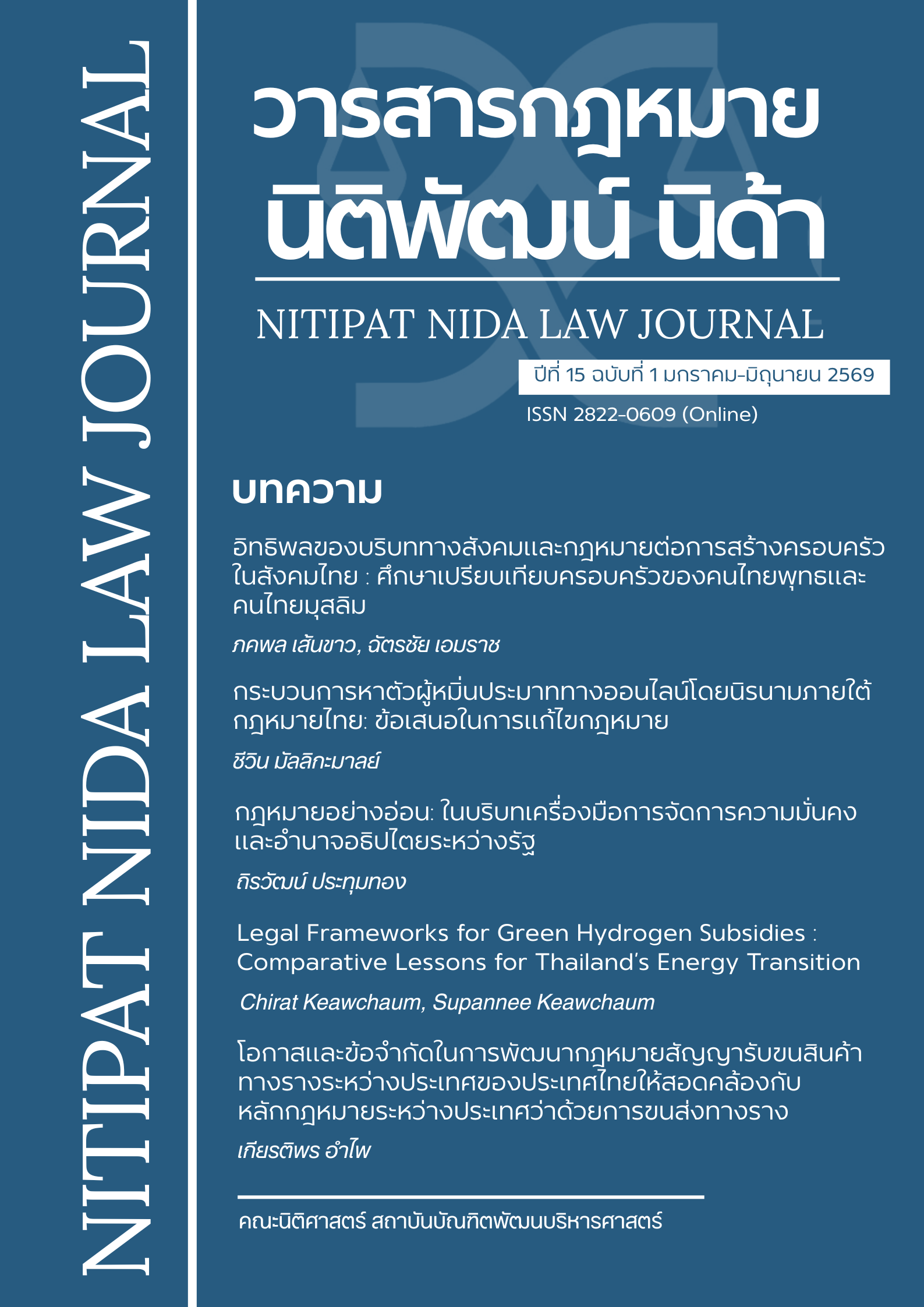
Soft Law: In the Context of Interstate Security and Sovereignty Management Instruments
Keywords:
Soft Law, Sovereignty, State SecurityAbstract
“Soft Law” is known in the academic circles of international laws for a reason that “Soft Law” is brought up for use as legal tools, or in some cases, it may be defined as semi-legal tools under international contexts to bring about flexible interstate ties. Similar to obligations under general international commitments, it may be compared in the definition of “Hard Law”. In this Article, the basis of “Soft Law” has been analyzed together with the contexts of tools for management of interstate security and sovereignty. In general, it can be seen that obligations under international commitments which are related to interstate security and sovereignty may be mentioned on the basis international laws in general, with which member states shall strictly comply. The Author has opinions that the study of “Soft Law” which is used under international obligations with impacts on flexible interstate ties related to the security issues and the principle of respects to state sovereignty may open up the academic perspectives in another interesting issue that could be understood by learners from the basis of definitions or interpretation of “Soft Law” under the related concepts to the use of “Soft Law” in diverse international contexts overlapped with the management of interstate security and sovereignty, particularly the international principles which must be respected and given importance by all countries, i.e., the principle of non-interference and the principle of respects to state sovereignty, which are important basis in the establishment or determination of interstate ties under the basis of “Soft Law”. Such important principles shall be the basis of the Author’s study and analysis of functioning of “Soft Law” and the creation of rules and regulations on interstate security based on the principle of respects to state sovereignty, including challenges of “Soft Law” under the dynamic security situations.
References
Abbott KW, Soft Law Oversight Mechanisms for Nanotechnology (JURIMETRICS, Spring 2012) cited in Ryan Hagemann, Jennifer Skees and Adam Thierer, Soft Law for Hard Problems: The Governance of Emerging Technologies in an Uncertain Future (Colorado Technology Law Journal 2018)
Abbott KW and Snidal D, ‘Hard and Soft Law in International Governance’ (2000) 54(3) International Organization 421
Ahmed A and Mustofa MJ, ‘Role of Soft Law in Environmental Protection: An Overview’ (2016) 4 Global Journal of Politics and Law Research 1
di Robilant A, ‘Genealogies of Soft Law’ (2006) Scandinavian Studies In Law 218
European University Association, ‘Bologna Process and European Higher Education Area’ (European University Association) <https://www.eua.eu/our-work/topics/bologna-process.html> accessed 17 April 2026
Galbraith J and Zaring D, ‘Soft Law as Foreign Relations Law’ (2014) 103 Cornell Law Review 735
Huszti-Orban K and Ní Aoláin F, ‘The Impact of “Soft Law” and Informal Standard-Setting in the Area of Counter-Terrorism on Civil Society and Civic Space’ (Human Rights Center, University of Minnesota Law School 2020)
Liu J, ‘Globalisation of Corporate Governance Depends on both Soft Law and Hard Law’ (2021) Renmin University of China - Law School 1
Naicker M, ‘The Use of Soft Law in the International Legal System in the Context of Global Governance’ (mini-dissertation, University of Pretoria 2013)
Shaffer GC and Pollack MA, ‘Hard versus Soft Law in International Security’ (2011) 52 BCL Rev 1147
Terpan F, ‘Soft Law in the European Union - The Changing Nature of EU Law’ (2013) 21(1) European Law Journal 1
Zerilli FM, ‘The Rule of Soft Law: An Introduction’ (2010) 56 Journal of Global and Historical Anthropology 1
Downloads
Published
How to Cite
Issue
Section
License
Copyright (c) 2026 Nitipat NIDA Law Journal

This work is licensed under a Creative Commons Attribution-NonCommercial-NoDerivatives 4.0 International License.

