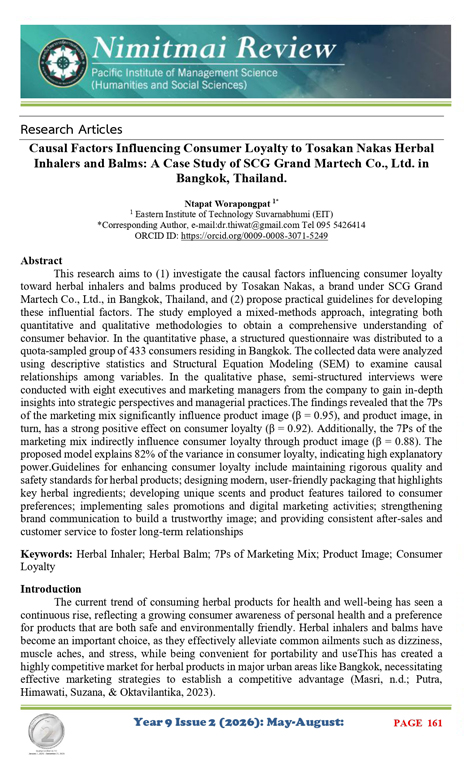
Causal Factors Influencing Consumer Loyalty to Tosakan Nakas Herbal Inhalers and Balms: A Case Study of SCG Grand Martech Co., Ltd. in Bangkok, Thailand.
Causal Analysis of Consumer Loyalty to Tosakan Nakas Herbal Products: A Case Study in Bangkok, Thailand
คำสำคัญ:
Herbal Inhaler, Herbal Balm, 7Ps of Marketing Mix, Product Image; Consumer Loyaltyบทคัดย่อ
This research aims to (1) investigate the causal factors influencing consumer loyalty toward herbal inhalers and balms produced by Tosakan Nakas, a brand under SCG Grand Martech Co., Ltd., in Bangkok, Thailand, and (2) propose practical guidelines for developing these influential factors. The study employed a mixed-methods approach, integrating both quantitative and qualitative methodologies to obtain a comprehensive understanding of consumer behavior. In the quantitative phase, a structured questionnaire was distributed to a quota-sampled group of 433 consumers residing in Bangkok. The collected data were analyzed using descriptive statistics and Structural Equation Modeling (SEM) to examine causal relationships among variables. In the qualitative phase, semi-structured interviews were conducted with eight executives and marketing managers from the company to gain in-depth insights into strategic perspectives and managerial practices.The findings revealed that the 7Ps of the marketing mix significantly influence product image (β = 0.95), and product image, in turn, has a strong positive effect on consumer loyalty (β = 0.92). Additionally, the 7Ps of the marketing mix indirectly influence consumer loyalty through product image (β = 0.88). The proposed model explains 82% of the variance in consumer loyalty, indicating high explanatory power.Guidelines for enhancing consumer loyalty include maintaining rigorous quality and safety standards for herbal products; designing modern, user-friendly packaging that highlights key herbal ingredients; developing unique scents and product features tailored to consumer preferences; implementing sales promotions and digital marketing activities; strengthening brand communication to build a trustworthy image; and providing consistent after-sales and customer service to foster long-term relationships
เอกสารอ้างอิง
Era, W. K. N. (1886, December 3). Weekly Kentucky New Era.
Huang, L. ., Muangsan , U. ., & Teerapattanakiat, N. . (2025). Consumer Behavior Characteristics of Martial Arts Training Institutions in Chongqing. Nimitmai Review Journal, 8(1), 231–246. retrieved from https://so04.tci-thaijo.org/index.php/nmrj/article/view/278634
Masri, M. B. (n.d.). The impact of marketing mix elements on consumer preference towards supplement product among UUM students.
Putra, H. D., Himawati, D., Suzana, D., & Oktavilantika, D. M. (2023). The influence of social media marketing, e-WOM, brand awareness, and brand image on brand loyalty of herbs product. Almana: Jurnal Manajemen dan Bisnis, 7(1), 77–83.
Perrine, F. (1913). Significance of the English and the American almanac of the seventeenth-century and eighteenth-century (Doctoral dissertation, New York University).
Bhattacharjee, B., Sandhanam, K., Ghose, S., Barman, D., & Sahu, R. K. (2024). Market overview of herbal medicines for lifestyle diseases. In Role of herbal medicines: Management of lifestyle diseases (pp. 597–614). Singapore: Springer Nature Singapore.
Khayru, R. K., & Issalillah, F. (2021). Study on consumer behavior and purchase of herbal medicine based on the marketing mix. Journal of Marketing and Business Research (MARK), 1(1), 1–14.
Kim, H., Kim, J. W., Kim, Y. K., Ku, S. K., & Lee, H. J. (2022). Immunoenhancement effects of the herbal formula hemomine on cyclophosphamide-induced immunosuppression in mice. Applied Sciences, 12(10), 4935. https://doi.org/10.3390/app12104935
Oppong, P. K., Gyawu, A., & Yawson, C. A. (2021). The relationship between word-of-mouth, satisfaction, trust, and loyalty in herbal medicine industry. Economics and Business Quarterly Reviews, 4(2).
Oppong, P. K., Owusu-Ansah, W., & Owusu, J. (2023). Customer satisfaction and willingness to pay more: Mediating effects of perceived herbal quality and brand trust in Ghana. Journal of Business and Management, 29(1), 57–79.
Ouyang, J., & Suteeca, R. (2025, January). The analysis of consumer preferences and purchasing behavior of Thai herbal products in the Chinese market of Gold Mint Products Co., Ltd. In 2025 Joint International Conference on Digital Arts, Media and Technology with ECTI Northern Section Conference on Electrical, Electronics, Computer and Telecommunications Engineering (ECTI DAMT & NCON) (pp. 755–760). IEEE. https://doi.org/10.1109/ECTIDAMTNCON60713.2025.10532472
Qolbi, N. M., & Rahmi, V. A. (2024). Marketing strategies to enhance consumer repurchase interest in herbal beverage products. Journal of Economic Education and Entrepreneurship Studies, 5(4), 672–684.
Sofiana, E. (2021). Determinants of consumer purchase interest factors for immune-enhancing herb products during COVID-19 pandemic. Inovbiz, 9(1), 16–26.
Singh, S., & Malik, G. (2022). Testing the relationship between referral marketing, consumer perception and brand loyalty in ayurvedic products amongst women. Asia Pacific Journal of Health Management, 17(2), 1–11.
Srisunthron, C., & Daungprom, D. (2025, March). Marketing factors affecting purchase decisions of herbal inhaler products among consumers in Udon Thani. In Proceeding National & International Conference, 18(1), 143.
Ningsih, P. S., Reza, R., Permatasari, I., & Astuti, R. F. (2025). Developing an effective marketing strategy for traditional herbal medicine: A strategic approach based on qualitative insights. Journal of Economic Education and Entrepreneurship Studies, 6(1), 150–159.
Manaswatcharapong, R. (2021). Role of marketing mix and brand loyalty to buying decision making of client in the herbal drink business. International Journal of Development Administration Research, 4(2), 14–19.
Worapongpat, N. (2024). The impact of production management on the competitiveness of full-service supplement and beauty product manufacturing businesses: A case study of SCG Grand Co., Ltd. Journal of Public and Private Issues, 1(3), 159–171. https://so17.tci-thaijo.org/index.php/jppi/article/view/577
Worapongpat, N. (2025a). Buddhist entrepreneurial leadership innovation and its impact on employee happiness at work: A case study of the comprehensive health and beauty supplement manufacturing business of SCG Grand Co., Ltd. and its affiliates. Journal of Liberal Arts Rajamangala University of Technology Phra Nakhon, 5(1), 17–33. https://so07.tci-thaijo.org/index.php/LiberalJ/article/view/8360
Worapongpat, N. (2025b). Best practices (ESG) for the comprehensive OEM business of dietary supplements, health, and beauty: SCG Grand Co., Ltd. and its affiliates. Chiang Mai University Journal of Economics, 29(1), 1–14. https://so01.tci-thaijo.org/index.php/CMJE/article/view/279192
ดาวน์โหลด
เผยแพร่แล้ว
รูปแบบการอ้างอิง
ฉบับ
ประเภทบทความ
สัญญาอนุญาต
ลิขสิทธิ์ (c) 2026 ณฐาพัชร์ วรพงศ์พัชร์

อนุญาตภายใต้เงื่อนไข Creative Commons Attribution-NonCommercial-NoDerivatives 4.0 International License.