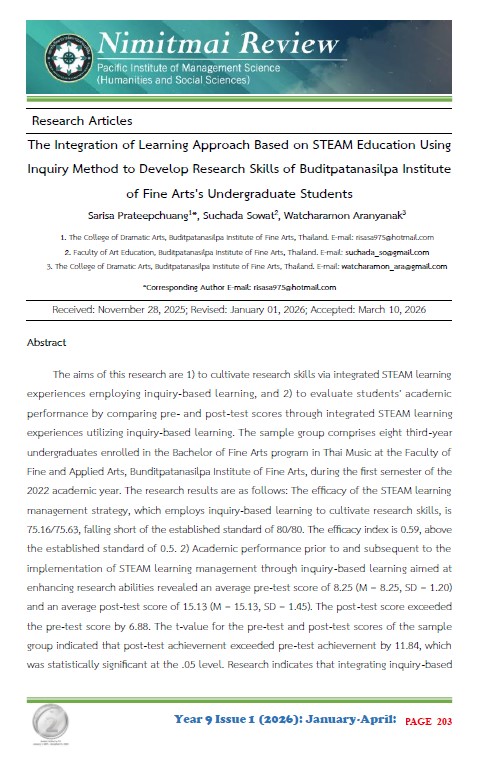
The Integration of Learning Approach Based on STEAM Education Using Inquiry Method to Develop Research Skills of Buditpatanasilpa Institute of Fine Arts's Undergraduate Students
คำสำคัญ:
STEAM, Inquiry Method, Research Skills, Undergraduate Student, Bunditpatanasilpa Institute of Fine Artsบทคัดย่อ
The aims of this research are 1) to cultivate research skills via integrated STEAM learning experiences employing inquiry-based learning, and 2) to evaluate students' academic performance by comparing pre- and post-test scores through integrated STEAM learning experiences utilizing inquiry-based learning. The sample group comprises eight third-year undergraduates enrolled in the Bachelor of Fine Arts program in Thai Music at the Faculty of Fine and Applied Arts, Bunditpatanasilpa Institute of Fine Arts, during the first semester of the 2022 academic year. The research results are as follows: The efficacy of the STEAM learning management strategy, which employs inquiry-based learning to cultivate research skills, is 75.16/75.63, falling short of the established standard of 80/80. The efficacy index is 0.59, above the established standard of 0.5. 2) Academic performance prior to and subsequent to the implementation of STEAM learning management through inquiry-based learning aimed at enhancing research abilities revealed an average pre-test score of 8.25 (M = 8.25, SD = 1.20) and an average post-test score of 15.13 (M = 15.13, SD = 1.45). The post-test score exceeded the pre-test score by 6.88. The t-value for the pre-test and post-test scores of the sample group indicated that post-test achievement exceeded pre-test achievement by 11.84, which was statistically significant at the .05 level. Research indicates that integrating inquiry-based methodologies into STEAM educational experiences can promote academic performance, expedite growth, and improve children's educational development.
เอกสารอ้างอิง
Aranyanak, C. (2016). Research processes for undergraduate thesis development in arts education. Bunditpatanasilpa Institute.
Athiwat, N. (2016). The development of inquiry-based learning activities using the 5E model to enhance academic achievement and cognitive skills.
Bloom, B. S. (1976). Human characteristics and school learning. New York, NY: McGraw-Hill.
Bruner, J. S. (1961). The act of discovery. Harvard Educational Review, 31(1), 21–32.
Chatree, K. (1999). Inquiry-based learning and critical thinking development.
Darunee, P. (2020). The effects of STEAM-based learning on academic achievement and creative problem-solving skills.
Dewey, J. (1938). Experience and education. New York, NY: Macmillan.
Jenjira, S. (2018). Development of STEAM-based learning activities to enhance process skills and creativity.
Kanhasuwan, L. (2003). Roles of instructors in student-centered and inquiry-based learning environments.
Kerdtham, C. (1999). Learning through inquiry: Principles and practices.
Krapatong, M. (2018). The development of STEM learning activity sets to improve student achievement and creativity.
Napaporn, P. (2015). The integration of inquiry techniques and project-based learning to enhance innovative thinking.
Office of the Education Council. (2017). National Education Plan B.E. 2560–2564 (2017–2021). Bangkok: Office of the Prime Minister, Thailand.
Panich, V. (2012). Ways of learning for students in the 21st century. Bangkok: Sodsri-Saritwong Foundation.
Pedaste, M., Mäeots, M., Siiman, L. A., De Jong, T., Van Riesen, S. A., Kamp, E. T., … Tsourlidaki, E. (2015). Phases of inquiry-based learning: Definitions and the inquiry cycle. Educational Research Review, 14, 47–61. https://doi.org/10.1016/j.edurev.2015.02.003
Santipaiboon, J. (2018). Effects of STEAM learning activities on students’ skills and satisfaction.
Sriboon, S. (2018). The development of STEAM learning integrated with problem-based learning in mathematics.
Srisa-ard, B. (2013). Basic research (9th ed.). Bangkok: Suwiriyasan.
Wongyai, W. (2017). Curriculum development and instruction in the 21st century. Bangkok: Ratchabhat University Press.
Yakman, G. (2008). STEAM education: An overview of creating a model of integrative education. In PATT-19 Proceedings.
ดาวน์โหลด
เผยแพร่แล้ว
รูปแบบการอ้างอิง
ฉบับ
ประเภทบทความ
สัญญาอนุญาต
ลิขสิทธิ์ (c) 2026 Nimitmai Review

อนุญาตภายใต้เงื่อนไข Creative Commons Attribution-NonCommercial-NoDerivatives 4.0 International License.