การศึกษาทัศนคติและประสบการณ์ของอาจารย์และนักศึกษาต่อการใช้ห้องเรียนแบบ Active Learning ในรูปแบบตัว U
คำสำคัญ:
ห้องเรียนแบบ Active Learning, ห้องเรียนรูปแบบตัว U, การยอมรับเทคโนโลยี, ความพึงพอใจ, โมเดลสมการโครงสร้างบทคัดย่อ
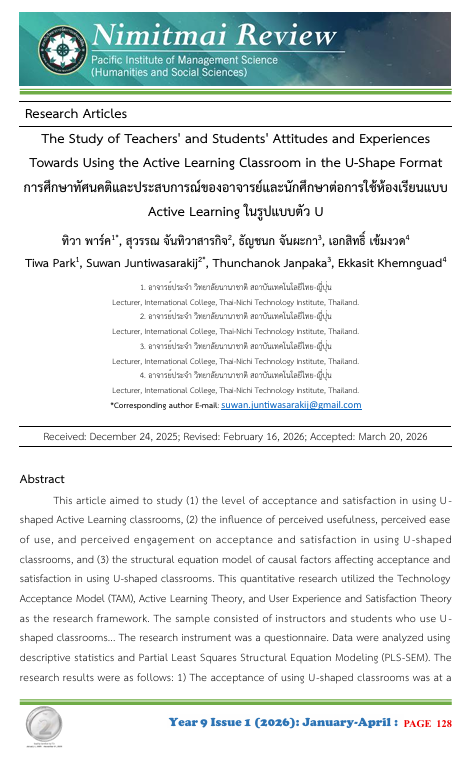
บทความนี้มีวัตถุประสงค์ 1) เพื่อศึกษาระดับการยอมรับและความพึงพอใจในการใช้ห้องเรียนแบบ Active Learning ในรูปแบบตัว U 2) เพื่อศึกษาอิทธิพลของทัศนคติด้านประโยชน์ที่รับรู้ ความสะดวกในการใช้งาน และการมีส่วนร่วมที่ส่งผลต่อการยอมรับและความพึงพอใจในการใช้ห้องเรียนรูปแบบตัว U และ 3) เพื่อศึกษาโมเดลสมการโครงสร้างปัจจัยเชิงสาเหตุที่ส่งผลต่อการยอมรับและความพึงพอใจในการใช้ห้องเรียนรูปแบบตัว U งานวิจัยชิ้นนี้เป็นรูปแบบการวิจัยเป็นการวิจัยเชิงปริมาณ ใช้ทฤษฎี Technology Acceptance Model (TAM), Active Learning Theory และ User Experience and Satisfaction Theory เป็นกรอบการวิจัย กลุ่มตัวอย่างคืออาจารย์และนักศึกษาที่ใช้ห้องเรียนรูปแบบตัว U ใช้วิธีการสุ่มตัวอย่างนักศึกษาที่เรียนในห้องเรียน U-shape ที่มีจำนวนนักศึกษาต่อวิชาไม่เกิน 25 คน เครื่องมือที่ใช้ในการวิจัยคือแบบสอบถาม วิเคราะห์ข้อมูลโดยใช้สถิติพรรณนาและการวิเคราะห์โมเดลสมการโครงสร้างเชิงเส้นบางส่วน (PLS-SEM) ผลการวิจัยพบว่า 1) การยอมรับการใช้ห้องเรียนรูปแบบตัว U มีระดับสูงมาก โดยโมเดลสามารถอธิบายความแปรปรวนได้ร้อยละ 93.6 และความพึงพอใจอยู่ในระดับสูงมาก โดยโมเดลสามารถอธิบายความแปรปรวนได้ร้อยละ 96.2 2) ทัศนคติด้านความสะดวกในการใช้งานส่งผลทางบวกต่อทัศนคติด้านประโยชน์ที่รับรู้อย่างมีนัยสำคัญ (β = 0.915, p = 0.000) ทัศนคติด้านประโยชน์ที่รับรู้ส่งผลทางบวกต่อการยอมรับการใช้งานอย่างมีนัยสำคัญ (β = 0.801, p = 0.000) การยอมรับการใช้งานส่งผลทางบวกต่อความพึงพอใจอย่างมีนัยสำคัญ (β = 0.723, p = 0.000) และทัศนคติด้านการมีส่วนร่วมส่งผลทางบวกต่อความพึงพอใจอย่างมีนัยสำคัญ (β = 0.287, p = 0.007) 3) โมเดลมีความสอดคล้องกับข้อมูลเชิงประจักษ์ โดยทัศนคติด้านประโยชน์ที่รับรู้ทำหน้าที่เป็นตัวแปรส่งผ่านแบบสมบูรณ์ (Complete Mediation) ในความสัมพันธ์ระหว่างความสะดวกในการใช้งานกับการยอมรับการใช้งาน โดยมีอิทธิพลทางอ้อมเท่ากับ 0.733 ข้อค้นพบจากงานวิจัยนี้แสดงให้เห็นว่าผู้บริหารสถาบันการศึกษาควรให้ความสำคัญกับการออกแบบห้องเรียนที่มีความสะดวกในการใช้งาน เพื่อสร้างการรับรู้ถึงประโยชน์ และนำไปสู่การยอมรับและความพึงพอใจในการใช้ห้องเรียนแบบ Active Learning
เอกสารอ้างอิง
Al-Maroof, R. S., Salloum, S. A., Hassanien, A. E., & Shaalan, K. (2023). The acceptance of metaverse in educational context: integration of TAM and user experience. Interactive Learning Environments, 1-25.
Baepler, P., Walker, J. D., Brooks, D. C., Saichaie, K., & Petersen, C. I. (2016). A Guide to Teaching in the Active Learning Classroom: History, Research, and Practice. Stylus Publishing.
Bonwell, C. C., & Eison, J. A. (1991). Active Learning: Creating Excitement in the Classroom. ASHE-ERIC Higher Education Report No. 1. Washington, D.C.: The George Washington University.
Chen, X., Liu, J., & Zhang, Y. (2023). Determinants of satisfaction with physical learning environments in higher education: A PLS-SEM approach. Building and Environment, 234, 110185.
Davis, F. D. (1989). Perceived usefulness, perceived ease of use, and user acceptance of information technology. MIS Quarterly, 13(3), 319-340.
Davis, F. D. (1989). Perceived usefulness, perceived ease of use, and user acceptance of information technology. MIS Quarterly, 13(3), 319-340.
Granito, M., & Harry, M. (2023). The effect of seating arrangement on student engagement and academic performance. Journal of Learning Spaces, 12(1), 15-24.
Hair, J. F., Hult, G. T. M., Ringle, C. M., & Sarstedt, M. (2017). A Primer on Partial Least Squares Structural Equation Modeling (PLS-SEM) (2nd ed.). Sage Publications.
Hair, J. F., Hult, G. T. M., Ringle, C. M., & Sarstedt, M. (2021). Partial Least Squares Structural Equation Modeling (PLS-SEM) Using R. Springer Nature.
Henseler, J., Ringle, C. M., & Sarstedt, M. (2015). A new criterion for assessing discriminant validity in variance-based structural equation modeling. Journal of the Academy of Marketing Science, 43(1), 115-135.
Intaprom, S. (2023). The Causal Factors Influencing Student Satisfaction in Active Learning Management. Journal of Education Naresuan University, 25(2), 112-125.
Nguyen, T. T., Nguyen, T. D., & Nguyen, T. M. (2024). Integrating TAM and Expectation-Confirmation Model to explain student satisfaction in hybrid active learning. Computers & Education, 210, 104956.
Prince, M. (2004). Does active learning work? A review of the research. Journal of Engineering Education, 93(3), 223-231.
Sura, S., Prommool, P., & Suwan, T. (2023). Active learning strategies and classroom environment: Their impact on student engagement. International Journal of Instruction, 16(3), 45-62.
Wang, Y., & Liu, Q. (2024). University students’ acceptance of smart active learning classrooms: The mediating role of perceived engagement. Education and Information Technologies, 29, 1423-1445.
Wichadee, S. (2017). Factors related to students' active learning behavior. Kasetsart Journal of Social Sciences, 38(3), 195-200.
Wongwanich, S. (2024). Design of Learning Environments for Future Skills. Bangkok: Chulalongkorn University Press.
Yang, J., Becerik-Gerber, B., & Mino, L. (2013). The influence of physical classroom environment on student satisfaction. Facilities, 31(1/2), 22-35.
ดาวน์โหลด
เผยแพร่แล้ว
รูปแบบการอ้างอิง
ฉบับ
ประเภทบทความ
สัญญาอนุญาต
ลิขสิทธิ์ (c) 2026 Nimitmai Review

อนุญาตภายใต้เงื่อนไข Creative Commons Attribution-NonCommercial-NoDerivatives 4.0 International License.