Intercultural Awareness and Attitudes Toward Intercultural Communication Among Fourth-Year Students in Thailand: A Mixed-Methods Study
คำสำคัญ:
Intercultural Awareness, Intercultural Communication, Thai EFL Students, Higher Educationบทคัดย่อ
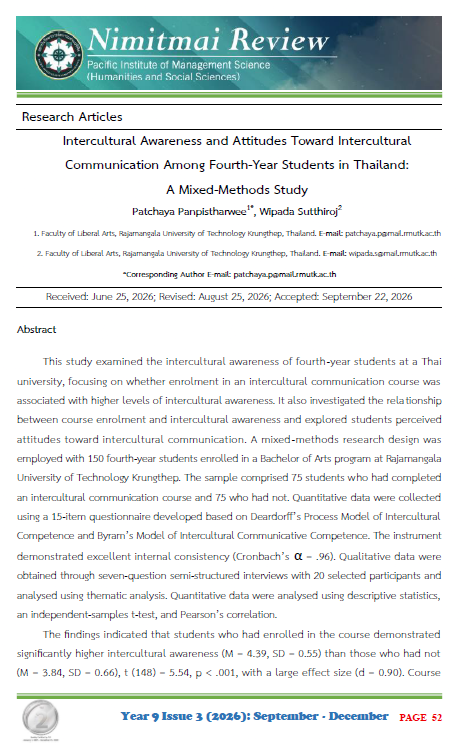
This study examined the intercultural awareness of fourth-year students at a Thai university, focusing on whether enrolment in an intercultural communication course was associated with higher levels of intercultural awareness. It also investigated the relationship between course enrolment and intercultural awareness and explored students perceived attitudes toward intercultural communication. A mixed-methods research design was employed with 150 fourth-year students enrolled in a Bachelor of Arts program at Rajamangala University of Technology Krungthep. The sample comprised 75 students who had completed an intercultural communication course and 75 who had not. Quantitative data were collected using a 15-item questionnaire developed based on Deardorff’s Process Model of Intercultural Competence and Byram’s Model of Intercultural Communicative Competence. The instrument demonstrated excellent internal consistency (Cronbach’s α = .96). Qualitative data were obtained through seven-question semi-structured interviews with 20 selected participants and analysed using thematic analysis. Quantitative data were analysed using descriptive statistics, an independent-samples t-test, and Pearson’s correlation.
The findings indicated that students who had enrolled in the course demonstrated significantly higher intercultural awareness (M = 4.39, SD = 0.55) than those who had not (M = 3.84, SD = 0.66), t (148) = 5.54, p < .001, with a large effect size (d = 0.90). Course enrolment was also positively associated with intercultural awareness, r (148) = .41, p < .001. Interview findings showed that students generally perceived intercultural communication as important for their future employment, although they reported limited opportunities for authentic intercultural interaction and anxiety related to language use. The findings highlight the potential of structured intercultural communication instruction to enhance students’ intercultural awareness and underscore the importance of experiential learning opportunities in developing practical intercultural communicative competence.
เอกสารอ้างอิง
Ajzen, I. (1991). The theory of planned behavior. Organizational Behavior and Human Decision Processes, 50(2), 179–211. https://doi.org/10.1016/0749-5978(91)90020-T
Baker, W. (2024). Intercultural communication. ELT Journal, 78(2), 212–215. https://doi.org/ 10.1093/elt/ccad040
Baldwin, J. R., González, A., Brock, N., Xie, M., & Chao, C.-C. (2023). Intercultural communication for everyday life (2nd ed.). Wiley-Blackwell.
Bremer, D. (2006). Wanted: Global workers. International Educator, 15(3), 40–45.
Byram, M. (1997). Teaching and assessing intercultural communicative competence. Multilingual Matters.
Deardorff, D. K. (2006). Identification and assessment of intercultural competence as a student outcome of internationalization. Journal of Studies in International Education, 10(3), 241–266. https://doi.org/10.1177/1028315306287002
De Block, A., & Kelly, D. (2022). Culture and cognitive science. In E. N. Zalta (Ed.), The Stanford encyclopedia of philosophy (Summer 2022 ed.). Stanford University. https://plato.stanford.edu/archives/sum2022/entries/culture-cogsci/
Fantini, A. E. (2009). Assessing intercultural competence: Issues and tools. In D. K. Deardorff (Ed.), The SAGE handbook of intercultural competence (pp. 456–476). SAGE Publications. https://doi.org/10.4135/9781071872987.n27
Geertz, C. (1973). Thick description: Toward an interpretive theory of culture. In The interpretation of cultures: Selected essays (pp. 3–30). Basic Books.
Hall, E. T. (1973). The silent language. Anchor Press/Doubleday.
Hulstrand, J. (2008). Supply and demand: Building a fluent workforce. International Educator, 17(5), 24–31.
Karras, I. (2017). The effectiveness of an intercultural communication course in increasing international and European studies students’ intercultural sensitivity. Intercultural Communication Studies, 26(2), 96–118.
Namfah, N., & Kulsitthiboon, S. (2025). Promoting intercultural awareness among Thai EFL tertiary students through inquiry-based learning and digital platforms in a virtual classroom. THAITESOL Journal, 38(1), 62–84.
Rattanaphumma, R., & Visuttakul, C. (2022). Impact of study abroad experiences on the multilingual development of Chinese students: A case study in Thailand. Journal of Research and Curriculum Development, 12(1), 43–57.
Samovar, L. A., Porter, R. E., McDaniel, E. R., & Roy, C. S. (2017). Communication between cultures (9th ed.). Cengage Learning.
Thongprayoon, T., Wangphasit, L., Yamrung, R., & Langka, W. (2020). Intercultural communicative language learning competencies of undergraduate students in an international program in Thailand. THAITESOL Journal, 33(2), 1–19.
Wattanavorakijkul, N. (2020). Measuring intercultural sensitivity of Thai university students: Impact of their participation in the US Summer Work Travel Program. rEFLections, 27(1), 81–102. https://doi.org/10.61508/refl.v27i1.241822
Williams, R. (2014). Keywords: A vocabulary of culture and society. Oxford University Press.
ดาวน์โหลด
เผยแพร่แล้ว
รูปแบบการอ้างอิง
ฉบับ
ประเภทบทความ
สัญญาอนุญาต
ลิขสิทธิ์ (c) 2026 Nimitmai Review

อนุญาตภายใต้เงื่อนไข Creative Commons Attribution-NonCommercial-NoDerivatives 4.0 International License.