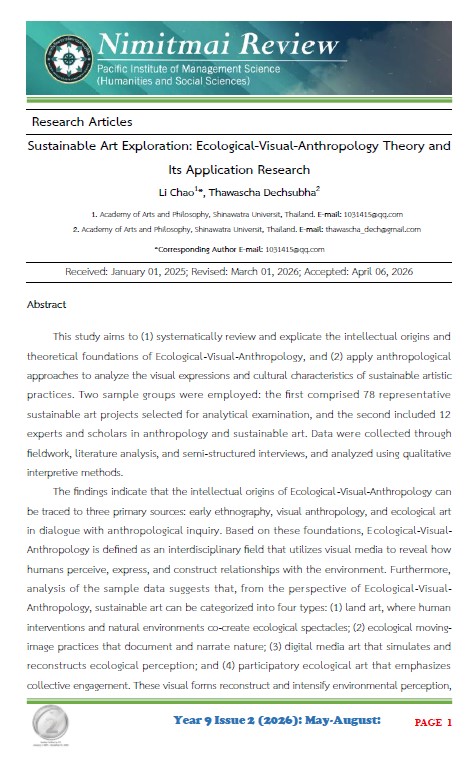
Sustainable Art Exploration: Ecological-Visual-Anthropology Theory and Its Application Research
คำสำคัญ:
Sustainable Art, Ecological-Visual-Anthropology, Human–Nature Relationship, Interdisciplinary Practicesบทคัดย่อ
This study aims to (1) systematically review and explicate the intellectual origins and theoretical foundations of Ecological-Visual-Anthropology, and (2) apply anthropological approaches to analyze the visual expressions and cultural characteristics of sustainable artistic practices. Two sample groups were employed: the first comprised 78 representative sustainable art projects selected for analytical examination, and the second included 12 experts and scholars in anthropology and sustainable art. Data were collected through fieldwork, literature analysis, and semi-structured interviews, and analyzed using qualitative interpretive methods.
The findings indicate that the intellectual origins of Ecological-Visual-Anthropology can be traced to three primary sources: early ethnography, visual anthropology, and ecological art in dialogue with anthropological inquiry. Based on these foundations, Ecological-Visual-Anthropology is defined as an interdisciplinary field that utilizes visual media to reveal how humans perceive, express, and construct relationships with the environment. Furthermore, analysis of the sample data suggests that, from the perspective of Ecological-Visual-Anthropology, sustainable art can be categorized into four types: (1) land art, where human interventions and natural environments co-create ecological spectacles; (2) ecological moving-image practices that document and narrate nature; (3) digital media art that simulates and reconstructs ecological perception; and (4) participatory ecological art that emphasizes collective engagement. These visual forms reconstruct and intensify environmental perception, fostering critical reflection on ecological issues. Overall, the study elucidates both the theoretical framework of Ecological-Visual-Anthropology and its practical applications in sustainable art. It contributes to a deeper understanding of the dynamic relationship between visual media and ecological environments, offering an interdisciplinary perspective for addressing contemporary environmental challenges.
เอกสารอ้างอิง
Bailey, R., Booth-Kurpnieks, C., Davies, K., & Delsante, I. (2019). Cultural ecology and cultural critique. Arts, 8(4), 166. https://doi.org/10.3390/arts8040166
Banks, M., & Ruby, J. (2011). Made to be seen: Perspectives on the history of visual anthropology. University of Chicago Press.
Banks, M., & Ruby, J. (2020). Made to be seen: Perspectives on the history of visual anthropology. University of Chicago Press.
Bateson, G. (1942). Balinese character: A photographic analysis. New York Academy of Sciences.
Bishop, C. (2020). Artificial hells: Participatory art and the politics of spectatorship. Verso.
Burtynsky, E. (2013). Water. Steidl.
Carson, R. (2002). Silent spring. Houghton Mifflin. (Original work published 1962)
Curtis, D. J., Reid, N., & Reeve, I. (2014). Towards ecological sustainability: Observations on the role of the arts. S.A.P.I.EN.S.
Curtis, E. S. (2022). The North American Indian. Taschen.
Demos, T. J. (2020). Beyond the world’s end: Arts of living at the crossing. Duke University Press.
El Guindi, F. (2004). Visual anthropology: Essential method and theory. AltaMira Press.
Gablik, S. (2021). The reenchantment of art. Thames & Hudson.
Giannachi, G. (2022). Technologies of the self-portrait: From the daguerreotype to the hologram. Bloomsbury.
Goldsworthy, A. (1990). A collaboration with nature. Abrams.
Grimshaw, A., & Ravetz, A. (2005). Visualizing anthropology. University of Chicago Press.
Ingold, T. (2000). The perception of the environment: Essays on livelihood, dwelling and skill. Routledge.
Ingold, T. (2021). The perception of the environment: Essays on livelihood, dwelling and skill (New ed.). Routledge.
Jeremijenko, N. (2016). Environmental health clinic: Art, engineering, and public participation. NYU Press.
Kagan, S. (2021). Art and sustainability: Connecting patterns for a culture of complexity. Transcript Verlag.
Loizos, P. (2001). Visual anthropology. In International encyclopedia of the social & behavioral sciences.
MacDougall, D. (1998). Transcultural cinema. Princeton University Press.
Malinowski, B. (1922). Argonauts of the Western Pacific. Routledge.
Mead, M., & Bateson, G. (1942). Balinese character: A photographic analysis. New York Academy of Sciences.
Miles, M. (2021). Eco-aesthetics: Art, literature and architecture in a period of climate change. Bloomsbury.
Omrani, A. (2022). A critical review of visual anthropology. International Visual Culture Review.
Pink, S. (2006). The future of visual anthropology: Engaging the senses. Routledge.
Pink, S. (2021a). Doing sensory ethnography (3rd ed.). Sage.
Pink, S. (2021b). Doing visual ethnography (4th ed.). Sage Publications.
Radcliffe-Brown, A. R. (1922). The Andaman Islanders. Cambridge University Press.
Rose, G. (2022). Visual methodologies: An introduction to researching with visual materials (5th ed.). Sage Publications.
Rust, S. (2020). Ecocinema and the environmental documentary. Routledge.
Schroer, S. A. (2021). The arts of coexistence: A view from anthropology. Frontiers in Conservation Science, 2, 711019. https://doi.org/10.3389/fcosc.2021.711019
Smithson, R. (1979). The writings of Robert Smithson. New York University Press.
Tsing, A. L. (2021). The mushroom at the end of the world: On the possibility of life in capitalist ruins. Princeton University Press.
Walker, S., Mullagh, L., Evans, M., & Wang, Y. (2019). Design ecologies: Sustaining ethno-cultural significance through creative practice. International Journal of Anthropology and Ethnology, 3(10). https://doi.org/10.1186/s41257-019-0025-7
Young, M. W. (2004). Malinowski: Odyssey of an anthropologist, 1884–1920. Yale University Press.
ดาวน์โหลด
เผยแพร่แล้ว
รูปแบบการอ้างอิง
ฉบับ
ประเภทบทความ
สัญญาอนุญาต
ลิขสิทธิ์ (c) 2026 Nimitmai Review

อนุญาตภายใต้เงื่อนไข Creative Commons Attribution-NonCommercial-NoDerivatives 4.0 International License.