Artificial Intelligence (AI) Analytics to Enhance EdPEx Self-Assessment Quality and Data-Driven Strategic Decision Making
คำสำคัญ:
Education, Excellence, Self-Assessment, Artificial Intelligenceบทคัดย่อ
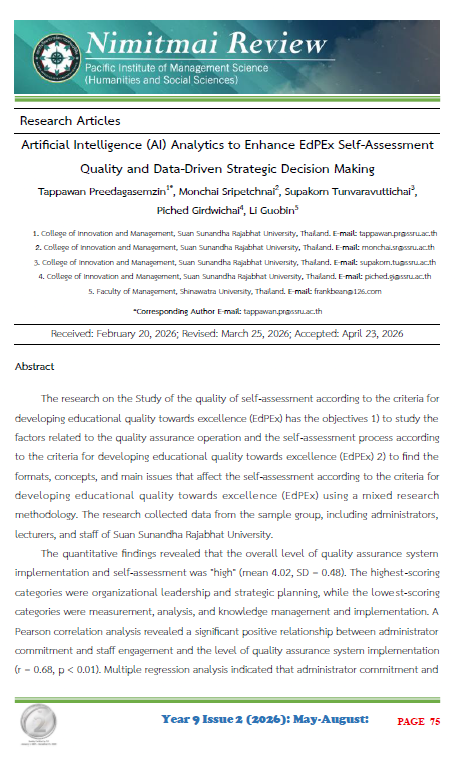
The research on the Study of the quality of self-assessment according to the criteria for developing educational quality towards excellence (EdPEx) has the objectives 1) to study the factors related to the quality assurance operation and the self-assessment process according to the criteria for developing educational quality towards excellence (EdPEx) 2) to find the formats, concepts, and main issues that affect the self-assessment according to the criteria for developing educational quality towards excellence (EdPEx) using a mixed research methodology. The research collected data from the sample group, including administrators, lecturers, and staff of Suan Sunandha Rajabhat University.
The quantitative findings revealed that the overall level of quality assurance system implementation and self-assessment was "high" (mean 4.02, SD = 0.48). The highest-scoring categories were organizational leadership and strategic planning, while the lowest-scoring categories were measurement, analysis, and knowledge management and implementation. A Pearson correlation analysis revealed a significant positive relationship between administrator commitment and staff engagement and the level of quality assurance system implementation (r = 0.68, p < 0.01). Multiple regression analysis indicated that administrator commitment and internal communication were key factors positively influencing quality assurance system implementation (p < 0.05) and accounted for 55% of the variance. The qualitative findings from in-depth interviews indicated that Respondents have a basic understanding of EdPEx principles but lack a systematic understanding. Organizational leadership and governance play a crucial role in driving educational quality. Strategic planning is clear but lacks the use of evidence-based data to support decision-making. Regarding customer focus and knowledge management, there are still developments to include a central tracking system and database. Meanwhile, personnel have positive attitudes toward quality assurance but require further knowledge development.
เอกสารอ้างอิง
Baird, J. (2017). The role of assessment in improving higher education quality. Higher Education Research & Development, 36(3), 1–15.
Baldrige Performance Excellence Program. (2020). Education criteria for performance excellence framework. National Institute of Standards and Technology (NIST), U.S. Department of Commerce. https://www.nist.gov/baldrige
Davenport, T. H., & Prusak, L. (2010). Working knowledge: How organizations manage what they know. Harvard Business School Press.
Evans, J. R. (2015). Quality and performance excellence: Management, organization, and strategy (7th ed.). Cengage Learning.
International Organization for Standardization. (2018). ISO 21001:2018 Educational organizations — Management systems for educational organizations — Requirements with guidance for use. ISO.
Isariyanan, N. (2021). Vision-driven leadership and institutional goal achievement in higher education. Journal of Educational Administration and Leadership, 12(3), 45–58.
Kaplan, R. S., & Norton, D. P. (2014). The balanced scorecard: Translating strategy into action. Harvard Business Review Press.
Noe, R. A. (2017). Employee training and development (7th ed.). McGraw-Hill Education.
Office of the Higher Education Commission (OHEC). (2013). Education Criteria for Performance Excellence (EdPEx). Ministry of Education, Thailand.
Office for National Education Standards and Quality Assessment (ONESQA). (2020). Manual for external quality assessment in higher education institutions. ONESQA, Thailand.
Phetaeng, P., et al. (2024). Strategic success evaluation and holistic quality management in higher education: A case study of Suan Sunandha Rajabhat University. Journal of Educational Administration and Development, 16(2), 45–62.
Putiwattanachai, C., & Boonphadung, S. (2024). Organizational culture and quality assurance effectiveness in higher education institutions. Journal of Educational Quality Development, 9(1), 33–50.
Sallis, E. (2014). Total quality management in education (3rd ed.). Routledge.
Siriyota, S. (2023). Leadership commitment and EdPEx implementation in higher education quality assurance. Thai Journal of Higher Education Management, 15(2), 101–118.
Sparks, D. (2018). Transformative leadership in educational quality systems. International Journal of Leadership in Education, 21(4), 389–405.
Srikanjanaruk, N. (2022). Quality assurance in Thai higher education: Challenges and development trends. Higher Education Quality Review, 9(1), 33–48.
Srikanok, A., & Promsaka Na Sakolnakorn, T. (2016). Quality assurance system and educational development in higher education institutions in Thailand. Journal of Education and Learning, 5(4), 123–134.
Stufflebeam, D. L. (2003). The CIPP model for evaluation. In T. Kellaghan & D. L. Stufflebeam (Eds.), International handbook of educational evaluation (pp. 31–62). Kluwer Academic Publishers.
Subcommittee on the Development and Enhancement of Education Quality Towards Excellence. (2021). EdPEx guidelines for educational quality improvement and organizational excellence. Thailand Higher Education Standards Office.
Suan Sunandha Rajabhat University. (2023). Internal quality assurance report (Self-Assessment Report: SAR). Suan Sunandha Rajabhat University.
Wongwanich, S. (2019). Educational research methodology: Concept and practice. Chulalongkorn University Press.
Yamkasikorn, M., & Srisuantang, S. (2021). Internal quality assurance systems and continuous improvement in Thai universities. Journal of Education and Learning Innovation, 7(3), 88–102.
ดาวน์โหลด
เผยแพร่แล้ว
รูปแบบการอ้างอิง
ฉบับ
ประเภทบทความ
สัญญาอนุญาต
ลิขสิทธิ์ (c) 2026 Nimitmai Review

อนุญาตภายใต้เงื่อนไข Creative Commons Attribution-NonCommercial-NoDerivatives 4.0 International License.