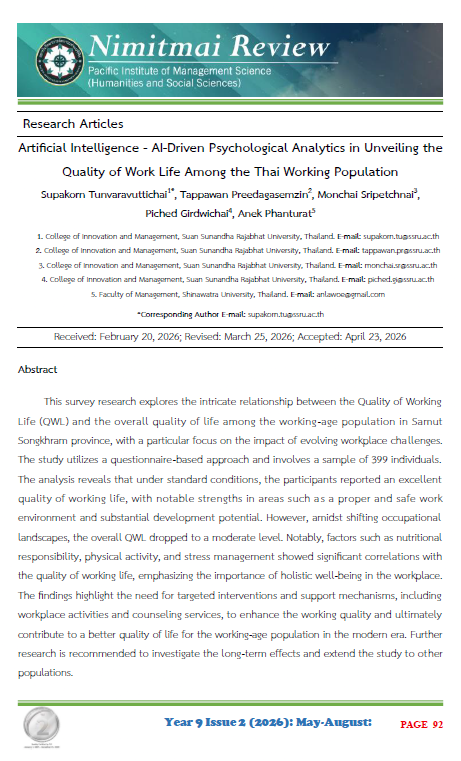
Artificial Intelligence - AI-Driven Psychological Analytics in Unveiling the Quality of Work Life Among the Thai Working Population
คำสำคัญ:
Artificial Intelligence, Quality of Working life, QWL, Nutritionalบทคัดย่อ
This survey research explores the intricate relationship between the Quality of Working Life (QWL) and the overall quality of life among the working-age population in Samut Songkhram province, with a particular focus on the impact of evolving workplace challenges. The study utilizes a questionnaire-based approach and involves a sample of 399 individuals. The analysis reveals that under standard conditions, the participants reported an excellent quality of working life, with notable strengths in areas such as a proper and safe work environment and substantial development potential. However, amidst shifting occupational landscapes, the overall QWL dropped to a moderate level. Notably, factors such as nutritional responsibility, physical activity, and stress management showed significant correlations with the quality of working life, emphasizing the importance of holistic well-being in the workplace. The findings highlight the need for targeted interventions and support mechanisms, including workplace activities and counseling services, to enhance the working quality and ultimately contribute to a better quality of life for the working-age population in the modern era. Further research is recommended to investigate the long-term effects and extend the study to other populations.
เอกสารอ้างอิง
Bakker, A. B., & Demerouti, E. (2017). Job demands–resources theory: Taking stock and looking forward. Journal of Occupational Health Psychology, 22(3), 273–285.
Carayon, P., & Smith, M. J. (2000). Work organization and ergonomics. Applied Ergonomics, 31(6), 649–662.
Cascio, W. F. (2016). Managing human resources: Productivity, quality of work life, profits (10th ed.). McGraw-Hill.
Davis, K., & Newstrom, J. W. (1989). Human behavior at work: Organizational behavior (8th ed.). McGraw-Hill.
Guest, D. E. (2017). Human resource management and employee well-being: Towards a new analytic framework. Human Resource Management Journal, 27(1), 22–38.
Kittiprapas, S., & Suthiphand, C. (2019). Quality of work life of Thai workers: Trends and implications. Journal of Social Development, 21(2), 45–62.
Kniffin, K. M., Narayanan, J., Anseel, F., et al. (2021). COVID-19 and the workplace: Implications, issues, and insights for future research and action. American Psychologist, 76(1), 63–77.
Koonmee, K., Singhapakdi, A., Virakul, B., & Lee, D. J. (2010). Ethics institutionalization, quality of work life, and employee job-related outcomes. Journal of Business Research, 63(1), 20–26.
Lalita, S. (2012). Health-promoting behaviors and their impact on work efficiency and well-being. Journal of Occupational Health Psychology, 17(3), 245–256.
Lazarus, R. S., & Folkman, S. (1984). Stress, appraisal, and coping. Springer.
Pender, N. J., Murdaugh, C. L., & Parsons, M. A. (2015). Health promotion in nursing practice (7th ed.). Pearson.
Siengthai, S., & Pila-Ngarm, P. (2016). The interaction effect of job redesign and job satisfaction on employee performance. Evidence-based HRM, 4(2), 162–180.
Sirgy, M. J., Efraty, D., Siegel, P., & Lee, D. J. (2001). A new measure of quality of work life (QWL) based on need satisfaction and spillover theories. Social Indicators Research, 55(3), 241–302.
Sirgy, M. J., Efraty, D., Siegel, P., & Lee, D. J. (2001). A new measure of quality of work life. Social Indicators Research, 55(3), 241–302.
Visarut, P. (2014). Quality of working life among employees at NY Food Co., Ltd. Bangkok: Kasetsart University Press.
Walton, R. E. (1975). Criteria for quality of working life. In L. E. Davis & A. B. Cherns (Eds.), The quality of working life (pp. 91–104). Free Press.
Warburton, D. E. R., & Bredin, S. S. D. (2017). Health benefits of physical activity. Current Opinion in Cardiology, 32(5), 541–556.
Wirote, K., Somchai, T., & Anong, P. (2015). Determinants of quality of life among workers in Samut Sakorn Province. Thai Journal of Public Health, 45(2), 123–135.
World Health Organization. (2020). Healthy diet. https://www.who.int
ดาวน์โหลด
เผยแพร่แล้ว
รูปแบบการอ้างอิง
ฉบับ
ประเภทบทความ
สัญญาอนุญาต
ลิขสิทธิ์ (c) 2026 Nimitmai Review

อนุญาตภายใต้เงื่อนไข Creative Commons Attribution-NonCommercial-NoDerivatives 4.0 International License.