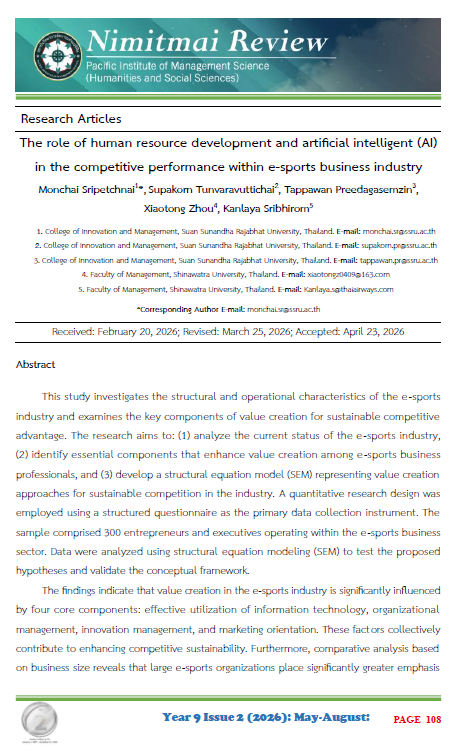
The role of human resource development and artificial intelligent (AI) in the competitive performance within e-sports business industry
คำสำคัญ:
Creating Added Value, Technology Industrial, Skills, Esports Businessบทคัดย่อ
This study investigates the structural and operational characteristics of the e-sports industry and examines the key components of value creation for sustainable competitive advantage. The research aims to: (1) analyze the current status of the e-sports industry, (2) identify essential components that enhance value creation among e-sports business professionals, and (3) develop a structural equation model (SEM) representing value creation approaches for sustainable competition in the industry. A quantitative research design was employed using a structured questionnaire as the primary data collection instrument. The sample comprised 300 entrepreneurs and executives operating within the e-sports business sector. Data were analyzed using structural equation modeling (SEM) to test the proposed hypotheses and validate the conceptual framework.
The findings indicate that value creation in the e-sports industry is significantly influenced by four core components: effective utilization of information technology, organizational management, innovation management, and marketing orientation. These factors collectively contribute to enhancing competitive sustainability. Furthermore, comparative analysis based on business size reveals that large e-sports organizations place significantly greater emphasis on these value creation components than small and medium-sized enterprises, with statistical significance at the 0.05 level. The study contributes to the growing body of knowledge on the e-sports industry by providing an empirically validated model of value creation. It also offers practical implications for industry stakeholders seeking to strengthen their competitive position through strategic integration of technological and managerial capabilities.
เอกสารอ้างอิง
Abraham, J., Ali, M. M., Andangsari, E. W., & Hartanti, L. E. P. (2020). Confirmatory factor analysis of celebrity worship, digital literacy, and nostalgia: Dataset of Indonesians. Data Brief, 33, 106417. https://doi.org/10.1016/j.dib.2020.106417
Alotaibi, B., & Alotaibi, A. (2021). Exploratory and confirmatory factor analyses of the Arabic version of the Childhood Autism Rating Scale. Research in Autism Spectrum Disorders, 86. https://doi.org/10.1016/j.rasd.2021.101827
Barnes, J., Prescott, T., & Muncer, S. (2012). Confirmatory factor analysis for the Eating Disorder Examination Questionnaire: Evidence supporting a three-factor model. Eat Behav, 13(4), 379-381. https://doi.org/10.1016/j.eatbeh.2012.05.001
Barney, J. (1991). Firm resources and sustained competitive advantage. Journal of Management, 17(1), 99–120.
Campo-Arias, A., & Caballero-Dominguez, C. C. (2021). Confirmatory factor analysis of the family APGAR questionnaire. Rev Colomb Psiquiatr (Engl Ed), 50(4), 234-237. https://doi.org/ 10.1016/j.rcpeng.2021.10.002
Chanias, S., Myers, M. D., & Hess, T. (2019). Digital transformation strategy making in pre-digital organizations: The case of a financial services provider. The Journal of Strategic Information Systems, 28(1), 17-33. https://doi.org/10.1016/j.jsis.2018.11.003
Chen, J., & Wu, Y. (2024). Would you be willing to purchase virtual gifts during esports live streams? Streamer characteristics and cultural traits. Computers in Human Behavior, 152. https://doi.org/10.1016/j.chb.2023.108075
Cunningham, G. B., Fink, J. S., & Doherty, A. (2018). Esports: A new industry and its implications for sport management. Sport Management Review, 21(4), 443–447.
Department of Business Development. (2024). Registered business database in Thailand (esports and technology-driven businesses). Ministry of Commerce, Thailand.
Funk, D. C., Pizzo, A. D., & Baker, B. J. (2018). eSport management: Embracing eSport education and research opportunities. Sport Management Review, 21(1), 7–13.
Ginting, H., Mahiranissa, A., Bekti, R., & Febriansyah, H. (2020). The effect of outing Team Building training on soft skills among MBA students. The International Journal of Management Education, 18(3). https://doi.org/10.1016/j.ijme.2020.100423
Hamari, J., & Sjöblom, M. (2017). What is eSports and why do people watch it? Internet Research, 27(2), 211–232.
Industry Ministerial Regulations, B.E. 2545 (2002). Definition and classification of small, medium, and large enterprises. Thailand.
Jenny, S. E., Manning, R. D., Keiper, M. C., & Olrich, T. W. (2017). Virtual(ly) athletes: Where eSports fit within the definition of “sport”. Quest, 69(1), 1–18.
Jordan-Vallverdú, V., Plaza-Navas, M.-A., Maria Raya, J., & Torres-Pruñonosa, J. (2024). The Intellectual Structure of Esports Research. Entertainment Computing, 49. https://doi. org/10.1016/j.entcom.2023.100628
Klarenberg, H., Dekkers, I. A., Peeters, C. F. W., de Mutsert, R., Jukema, J. W., Rosendaal, F. R., Leiner, T., Gosselink, M., Froeling, M., Strijkers, G. J., Boekholdt, S. M., & Lamb, H. J. (2022). Confirmatory factor analysis including MRI-derived adipose tissues quantification improves associations of metabolic dysregulation to diastolic dysfunction. J Diabetes Complications, 108202. https://doi.org/10.1016/j.jdiacomp.2022.108202
Makransky, G., Lilleholt, L., & Aaby, A. (2017). Development and validation of the Multimodal Presence Scale for virtual reality environments: A confirmatory factor analysis and item response theory approach. Computers in Human Behavior, 72, 276-285. https://doi.org/ 10.1016/j.chb.2017.02.066
Mardani, A., Saraji, M. K., Mishra, A. R., & Rani, P. (2020). A novel extended approach under hesitant fuzzy sets to design a framework for assessing the key challenges of digital health interventions adoption during the COVID-19 outbreak. Appl Soft Comput, 96, 106613. https://doi.org/10.1016/j.asoc.2020.106613
Marshall, G. N., Schell, T. L., & Miles, J. N. (2013). A multi-sample confirmatory factor analysis of PTSD symptoms: what exactly is wrong with the DSM-IV structure? Clin Psychol Rev, 33(1), 54-66. https://doi.org/10.1016/j.cpr.2012.10.004
Newzoo. (2024). Global esports market report. Newzoo.
Scholz, T. M. (2019). eSports is business: Management in the world of competitive gaming. Springer.
Teece, D. J., Pisano, G., & Shuen, A. (1997). Dynamic capabilities and strategic management. Strategic Management Journal, 18(7), 509–533.
Vargo, S. L., & Lusch, R. F. (2004). Evolving to a new dominant logic for marketing. Journal of Marketing, 68(1), 1–18.
Verdugo, M. A., Guillen, V. M., Arias, B., Vicente, E., & Badia, M. (2016). Confirmatory factor analysis of the support’s intensity scale for children. Res Dev Disabil, 49-50, 140-152. https://doi.org /10.1016/j.ridd.2015.11.022
Yamane, T. (1973). Statistics: An Introductory Analysis. New York: Harper & Row.
ดาวน์โหลด
เผยแพร่แล้ว
รูปแบบการอ้างอิง
ฉบับ
ประเภทบทความ
สัญญาอนุญาต
ลิขสิทธิ์ (c) 2026 Nimitmai Review

อนุญาตภายใต้เงื่อนไข Creative Commons Attribution-NonCommercial-NoDerivatives 4.0 International License.