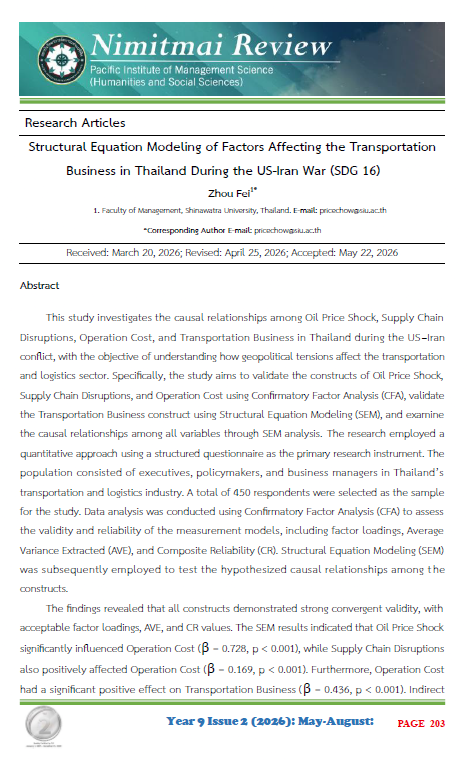
Structural Equation Modeling of Factors Affecting the Transportation Business in Thailand During the US-Iran War (SDG 16)
คำสำคัญ:
Oil Price Shock, Supply Chain Disruptions, Operation Cost, Transportation Business, SDG 16บทคัดย่อ
This study investigates the causal relationships among Oil Price Shock, Supply Chain Disruptions, Operation Cost, and Transportation Business in Thailand during the US–Iran conflict, with the objective of understanding how geopolitical tensions affect the transportation and logistics sector. Specifically, the study aims to validate the constructs of Oil Price Shock, Supply Chain Disruptions, and Operation Cost using Confirmatory Factor Analysis (CFA), validate the Transportation Business construct using Structural Equation Modeling (SEM), and examine the causal relationships among all variables through SEM analysis. The research employed a quantitative approach using a structured questionnaire as the primary research instrument. The population consisted of executives, policymakers, and business managers in Thailand’s transportation and logistics industry. A total of 450 respondents were selected as the sample for the study. Data analysis was conducted using Confirmatory Factor Analysis (CFA) to assess the validity and reliability of the measurement models, including factor loadings, Average Variance Extracted (AVE), and Composite Reliability (CR). Structural Equation Modeling (SEM) was subsequently employed to test the hypothesized causal relationships among the constructs.
The findings revealed that all constructs demonstrated strong convergent validity, with acceptable factor loadings, AVE, and CR values. The SEM results indicated that Oil Price Shock significantly influenced Operation Cost (β = 0.728, p < 0.001), while Supply Chain Disruptions also positively affected Operation Cost (β = 0.169, p < 0.001). Furthermore, Operation Cost had a significant positive effect on Transportation Business (β = 0.436, p < 0.001). Indirect effects were also identified, indicating that Operation Cost mediated the relationships between external disruptions and transportation business performance. The study contributes to the literature on geopolitical risk and transportation economics and provides practical implications for policymakers and logistics managers in enhancing supply chain resilience and cost management strategies.
เอกสารอ้างอิง
Acemoglu, D., & Robinson, J. A. (2012). Why nations fail: The origins of power, prosperity, and poverty. Crown Business.
Barron, L. M., Mikhaylov, S., & Lee, S. (2023). The political economy of international conflict: The implications of energy markets. Journal of Global Economics, 45(2), 34-50.
Barron, A., et al. (2023). Geopolitical tensions and global energy market disruptions. Energy Economics, 118, 106489.
Creswell, J. W., & Poth, C. N. (2018). Qualitative inquiry and research design: Choosing among five approaches (4th ed.). SAGE Publications.
Dasandi, N., & Mikhaylov, S. (2019). Institutions and global economic stability in conflict zones: The case of oil and sanctions. International Economics and Development Review, 23(4), 67-81. https://doi.org/10.1080/08911991.2019.1575897
De Coning, C. (2016). From peacebuilding to sustaining peace: Implications of complexity for resilience and sustainability. Resilience, 4(3), 166–181.
Eizenberg, E., & Jabareen, Y. (2017). Social sustainability: A new conceptual framework. Sustainability, 9(1), 68. https://doi.org/10.3390/su9010068
Fearon, J. D., & Laitin, D. D. (2003). Ethnicity, insurgency, and civil war. American Political Science Review, 97(1), 75–90.
Goetz, A. R., & Jenkins, D. (2016). Transportation planning and policy. Routledge.
Goetz, A. R., & Jenkins, D. (2016). Understanding transport and economic development. In The geography of transport systems (4th ed.). Routledge.
Hair, J. F., Black, W. C., Babin, B. J., & Anderson, R. E. (2010). Multivariate data analysis (7th ed.). Pearson Prentice Hall.
Hope, L. D. (2019). Global energy economics: The implications of oil price shocks. Palgrave Macmillan.
Hope, D. (2019). The political economy of oil price shocks. Review of International Political Economy, 26(3), 456–482.
Hu, L. T., & Bentler, P. M. (1999). Cutoff criteria for fit indexes in covariance structure analysis: Conventional criteria versus new alternatives. Structural Equation Modeling: A Multidisciplinary Journal, 6(1), 1–55. https://doi.org/10.1080/10705519909540118
Hussain, M., Khan, M., & Al-Aomar, R. (2018). Operational efficiency and cost management in transportation systems. International Journal of Logistics Management, 29(4), 1123–1145.
Karl, T. L. (1997). The paradox of plenty: Oil booms and petro-states. University of California Press.
Khadzhynov, I., et al. (2022). SDG 16, peacebuilding, and institutional strengthening [Unpublished manuscript / publication details not available].
Khadzhynov, I., Khadzhynova, O., & Shkromydas, I. (2022). Operational efficiency and competitiveness in transportation enterprises. Transport Problems, 17(2), 45–58.
Khorram-Manesh, A. (2023). Economic resilience and oil price shocks: A case study of the Middle East. International Journal of Energy Economics, 40(4), 120-131. https://doi.org/10. 1111/ ijee.2023.00422
Khorram-Manesh, A. (2023). Supply chain resilience and transportation disruptions in global crises. Journal of Transportation Security, 16(1), 1–18.
Kline, R. B. (2016). Principles and practice of structural equation modeling (4th ed.). Guilford Press.
Lee, H. L., Padmanabhan, V., & Whang, S. (2016). Information distortion in a supply chain: The bullwhip effect. Management Science, 43(4), 546–558.
Lee, S. M., Rha, J. S., & Park, D. (2023). Supply chain disruptions and resilience strategies in transportation industries. Sustainability, 15(5), 4217.
Martin, C. (2023). Customer satisfaction and operational performance in transportation services. Journal of Service Management, 34(2), 215–230.
North, D. C. (1990). Details not provided in source text (foundational work referenced on economic systems and cost structures).
Richmond, O. P. (2020). Peace in international relations. Routledge.
Richmond, K. (2020). Details not provided in source text (research on supply chain disruptions and operational/logistics costs).
Takian, A., & Rajaeieh, G. (2020). Peace, health, and sustainable development in conflict regions [Journal details not available].
Wambui, P. N. (2020). Cost structures and operational efficiency in logistics and transportation firms. International Journal of Supply Chain Management, 9(3), 88–97.
ดาวน์โหลด
เผยแพร่แล้ว
รูปแบบการอ้างอิง
ฉบับ
ประเภทบทความ
สัญญาอนุญาต
ลิขสิทธิ์ (c) 2026 Nimitmai Review

อนุญาตภายใต้เงื่อนไข Creative Commons Attribution-NonCommercial-NoDerivatives 4.0 International License.