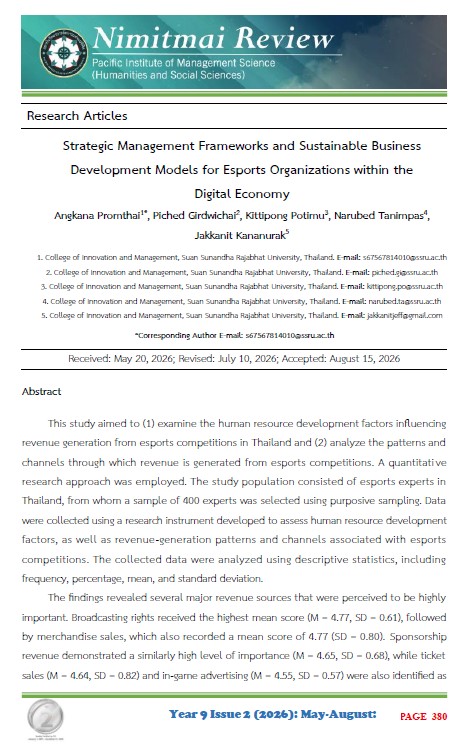
Strategic Management Frameworks and Sustainable Business Development Models for Esports Organizations within the Digital Economy
คำสำคัญ:
Management Strategies, Esports Team, Business Successบทคัดย่อ
This study aimed to (1) examine the human resource development factors influencing revenue generation from esports competitions in Thailand and (2) analyze the patterns and channels through which revenue is generated from esports competitions. A quantitative research approach was employed. The study population consisted of esports experts in Thailand, from whom a sample of 400 experts was selected using purposive sampling. Data were collected using a research instrument developed to assess human resource development factors, as well as revenue-generation patterns and channels associated with esports competitions. The collected data were analyzed using descriptive statistics, including frequency, percentage, mean, and standard deviation.
The findings revealed several major revenue sources that were perceived to be highly important. Broadcasting rights received the highest mean score (M = 4.77, SD = 0.61), followed by merchandise sales, which also recorded a mean score of 4.77 (SD = 0.80). Sponsorship revenue demonstrated a similarly high level of importance (M = 4.65, SD = 0.68), while ticket sales (M = 4.64, SD = 0.82) and in-game advertising (M = 4.55, SD = 0.57) were also identified as important revenue-generating channels. Overall, the findings suggest that esports competitions in Thailand have considerable potential for generating revenue through diversified commercial channels. The results provide practical implications for esports team managers, event organizers, and other industry stakeholders in formulating effective human resource development strategies and sustainable revenue-generation models. Such strategies may contribute to improving organizational and business performance while supporting the continued growth and development of Thailand’s esports industry.
เอกสารอ้างอิง
Brown, T. (2022). The evolution of internet cafes in the digital age. Tech Trends Journal, 35(2), 45-60.
Chung, J., & Lee, H. (2023). Sustainability in esports: Technology-driven revenue generation strategies. Journal of Esports Economics, 15(2), 123-135.
García, R., & Murillo, A. (2022). The impact of artificial intelligence and VR in esports development. International Journal of Esports Studies, 8(4), 45-60.
Johnson, D., Smith, J., & Lee, M. (2021). Expanding live streaming platforms in esports: The role of VR and AR technologies. Journal of Digital Entertainment, 22(1), 89-102.
Kim, S., Lee, J., & Park, K. (2022). Enhancing sponsor relationships in esports: Dynamic pricing and tailored sponsorship packages. Esports Business Review, 19(3), 110-125.
Miller, A. (2021). Customer behavior shifts in the digital era: What internet cafes need to know. Consumer Insights Quarterly, 14(1), 55-70.
Smith, A., & Lee, H. (2022). The future of merchandising in esports: Direct-to-consumer strategies. Journal of Marketing and Digital Media, 14(2), 67-80.
Smith, J. (2021). The decline of public internet access points: Challenges and opportunities. Technology and Society Review, 22(5), 89-105.
Thompson, R. (2022). Value-added services as a competitive advantage for internet cafés. Journal of Entrepreneurial Strategies, 14(1), 55-70.
Wang, T., Zhang, Q., & Li, S. (2021). Dynamic pricing strategies for esports ticket sales. Journal of Sports Economics, 10(1), 15-29.
Yamane, T. (1967). Statistics: An introductory analysis (2nd ed.). Harper & Row.
ดาวน์โหลด
เผยแพร่แล้ว
รูปแบบการอ้างอิง
ฉบับ
ประเภทบทความ
สัญญาอนุญาต
ลิขสิทธิ์ (c) 2026 Nimitmai Review

อนุญาตภายใต้เงื่อนไข Creative Commons Attribution-NonCommercial-NoDerivatives 4.0 International License.