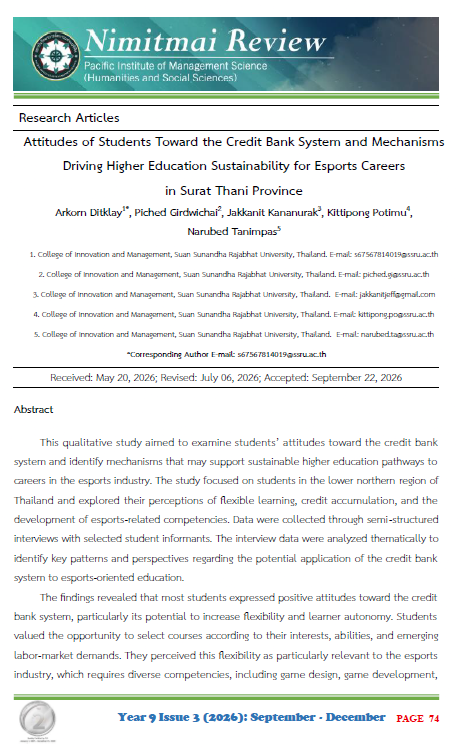
Attitudes of Students Toward the Credit Bank System and Mechanisms Driving Higher Education Sustainability for Esports Careers in Surat Thani Province
คำสำคัญ:
Credit Bank System, Driving Sustainability, E-sportsบทคัดย่อ
This qualitative study aimed to examine students’ attitudes toward the credit bank system and identify mechanisms that may support sustainable higher education pathways to careers in the esports industry. The study focused on students in the lower northern region of Thailand and explored their perceptions of flexible learning, credit accumulation, and the development of esports-related competencies. Data were collected through semi-structured interviews with selected student informants. The interview data were analyzed thematically to identify key patterns and perspectives regarding the potential application of the credit bank system to esports-oriented education.
The findings revealed that most students expressed positive attitudes toward the credit bank system, particularly its potential to increase flexibility and learner autonomy. Students valued the opportunity to select courses according to their interests, abilities, and emerging labor-market demands. They perceived this flexibility as particularly relevant to the esports industry, which requires diverse competencies, including game design, game development, event organization, teamwork, and competition management. Furthermore, students indicated that credits could potentially be accumulated through a range of esports-related learning experiences, including competitions, professional training, workshops, and project development. Such an approach was perceived as enabling students to integrate formal and experiential learning while developing practical skills and industry-relevant experience. Overall, the findings suggest that a flexible credit bank system could contribute to more personalized and career-oriented higher education by connecting students’ learning pathways with the evolving requirements of the esports labor market. The study highlights the potential of credit accumulation mechanisms to support lifelong learning, competency development, and sustainable career preparation in the rapidly developing esports sector.
เอกสารอ้างอิง
Khanchai, K., Puisuwan, P., Panyakanphon, C., Sirirat, Y., & Pruettipuranee, T. (2025). Analyzing workforce demands in the game & esports industries for higher education curriculum development in Thailand. Journal of Computer and Creative Technology. https://doi.org/ 10.65205/jcct.2025.2863
Kunkum, W., Kumpetch, N., Thongves, M., & Tunvaravuttichai, S. (2025). Preceding factors influencing enrollment in higher education e-sports programs among students in Lower Northeastern Thailand (Region 2). Ph.D. in Social Sciences Journal.
Scott, M. J., Summerley, R., Besombes, N., Connolly, C., Gawrysiak, J., Halevi, T., Jenny, S. E., Miljanovic, M., Stange, M., Taipalus, T., & Williams, J. P. (2021). Towards a framework to support the design of esports curricula in higher education. In Proceedings of the 26th ACM Conference on Innovation and Technology in Computer Science Education (ITiCSE 2021) (pp. 599–600). Association for Computing Machinery. https://doi.org/10.1145/ 3456565.3461440
Sereenonchai, S., & Sriburapapirom, C. (2025). Flexible education in Thai higher education: A learning system design framework for lifelong learning. Journal of Information and Learning, 36(3), e279216.
Siridhrungsri, P. (2020). Credit bank system of basic education. Suthiparithat Journal, 30(93), 250–262.
Songsaen, S. (2023). The development of the credit bank system mechanism model for the management of lifelong learning education at Chiang Rai Rajabhat University. Journal of Education Studies, Chulalongkorn University, 51(3), EDUCU5103007. https://doi.org/10. 14456/educu.2023.25
Thammetar, T., Khlaisang, J., & Theeraroungchaisri, A. (2025). Synergizing the academic credit bank system and the Thai national digital learning massive open online course platform for lifelong learning: A data-mining approach. Humanities, Arts and Social Sciences Studies. https://doi.org/10.69598/hasss.25.3.275987
Zhong, Y., Guo, K., Su, J., & Chu, S. K. W. (2022). The impact of esports participation on the development of 21st century skills in youth: A systematic review. Computers & Education, 191, 104640. https://doi.org/10.1016/j.compedu.2022.104640
ดาวน์โหลด
เผยแพร่แล้ว
รูปแบบการอ้างอิง
ฉบับ
ประเภทบทความ
สัญญาอนุญาต
ลิขสิทธิ์ (c) 2026 Nimitmai Review

อนุญาตภายใต้เงื่อนไข Creative Commons Attribution-NonCommercial-NoDerivatives 4.0 International License.