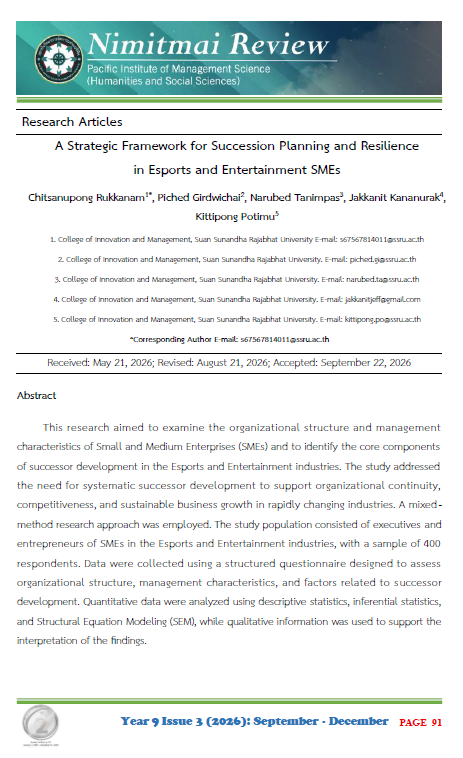
A Strategic Framework for Succession Planning and Resilience in Esports and Entertainment SMEs
คำสำคัญ:
Strategic Guidelines, Successor Development, Esports and Entertainment Industriesบทคัดย่อ
This research aimed to examine the organizational structure and management characteristics of Small and Medium Enterprises (SMEs) and to identify the core components of successor development in the Esports and Entertainment industries. The study addressed the need for systematic successor development to support organizational continuity, competitiveness, and sustainable business growth in rapidly changing industries. A mixed-method research approach was employed. The study population consisted of executives and entrepreneurs of SMEs in the Esports and Entertainment industries, with a sample of 400 respondents. Data were collected using a structured questionnaire designed to assess organizational structure, management characteristics, and factors related to successor development. Quantitative data were analyzed using descriptive statistics, inferential statistics, and Structural Equation Modeling (SEM), while qualitative information was used to support the interpretation of the findings.
The findings indicated that successor development consists of four critical components: Innovation and Technology, Cooperation Networks, Knowledge Management, and Business Transfer. Innovation and Technology emphasized the adoption of new technologies and innovative approaches to strengthen organizational competitiveness. Cooperation Networks highlighted the importance of organizational policies and collaboration among relevant stakeholders. Knowledge Management focused on establishing systematic mechanisms and dedicated units for knowledge sharing and transfer. Business Transfer involved appropriate methods and processes for preparing future leaders to assume managerial and ownership responsibilities. Statistical analysis demonstrated that entrepreneurs placed significant importance on all four components at the 0.05 significance level. The findings provide a framework for developing successor development strategies that can strengthen organizational continuity and support sustainable growth among SMEs in the Esports and Entertainment industries.
เอกสารอ้างอิง
Abbu, H. R., & Gopalakrishna, P. (2021). Synergistic effects of market orientation implementation and internalization on firm performance: Direct marketing service provider industry. Journal of Business Research, 125, 851–863. https://doi.org/10.1016/j.jbusres.2019.06.004
Allal-Chérif, O., Guaita-Martínez, J. M., & Montesinos Sansaloni, E. (2024). Sustainable esports entrepreneurs in emerging countries: Audacity, resourcefulness, innovation, transmission, and resilience in adversity. Journal of Business Research, 171, 114382. https://doi.org/10.1016/j.jbusres.2023.114382
Anugerah, A. R., Muttaqin, P. S., & Trinarningsih, W. (2022). Social network analysis in business and management research: A bibliometric analysis of the research trend and performance from 2001 to 2020. Heliyon, 8(4), e09270. https://doi.org/10.1016/j.heliyon.2022.e09270
Arvate, P., & Story, J. (2021). Leaders affect business creation: Evidence from mayoral elections. The Leadership Quarterly. doi: 10.1016/j.leaqua.2021.101577
Ashiru, F., Whitfield, I., & Warwick, P. (2022). Business school capital and study choices in undergraduate education: A student-centred approach. The International Journal of Management Education, 20(2), 100633. https://doi.org/10. 1016/j.ijme.2022.100633
Baabdullah, A. M., Alalwan, A. A., Slade, E. L., Raman, R., & Khatatneh, K. F. (2021). SMEs and artificial intelligence (AI): Antecedents and consequences of AI-based B2B practices. Industrial Marketing Management, 98, 255–270. https://doi.org/10.1016/j.indmarman. 2021.09.003
Blocker, C. P. (2011). Modeling customer value perceptions in cross-cultural business markets. Journal of Business Research, 64(5), 533–540. https://doi.org/10. 1016/j.jbusres.2010.05.001
Cannavacciuolo, L., Capaldo, G., & Ponsiglione, C. (2023). Digital innovation and organizational changes in the healthcare sector: Multiple case studies of telemedicine project implementation. Technovation, 120, 102550. https://doi.org/10.1016/j.technovation. 2022.102550
Chowdhury, S., Budhwar, P., Dey, P. K., Joel-Edgar, S., & Abadie, A. (2022). AI-employee collaboration and business performance: Integrating knowledge-based view, socio-technical systems and organisational socialisation framework. Journal of Business Research, 144, 31-49. doi: 10.1016/j.jbusres.2022.01.069
Colovic, A. (2022). Leadership and business model innovation in late internationalizing SMEs. Long Range Planning, 55(1), 102083. https://doi.org/10. 1016/j.lrp.2021.102083
Coskun-Setirek, A., & Tanrikulu, Z. (2021). Digital innovations-driven business model regeneration: A process model. Technology in Society, 64, 101461. https://doi.org/10. 1016/j.techsoc.2020.101461
De, R., Pandey, N., & Pal, A. (2020). Impact of digital surge during Covid-19 pandemic: A viewpoint on research and practice. Int J Inf Manage, 55, 102171. doi: 10.1016/j.ijinfomgt.2020.102171
Fantke, P., Cinquemani, C., Yaseneva, P., De Mello, J., Schwabe, H., Ebeling, B., & Lapkin, A. A. (2021). Transition to sustainable chemistry through digitalization. Chem, 7(11), 2866-2882. doi: 10.1016/j.chempr.2021.09.012
Magno, F., & Cassia, F. (2021). Effects of agritourism businesses' strategies to cope with the COVID-19 crisis: The key role of corporate social responsibility (CSR) behaviours. J Clean Prod, 325, 129292. doi: 10.1016/j.jclepro.2021.129292
Miele, C., Maquigneau, A., Joyal, C. C., Bertsch, I., Gangi, O., Gonthier, H., . . . Lacambre, M. (2023). International guidelines for the prevention of sexual violence: A systematic review and perspective of WHO, UN Women, UNESCO, and UNICEF's publications. Child Abuse Negl, 146, 106497. doi: 10.1016/j.chiabu.2023.106497
Sandeep, S. R., Ahamad, S., Saxena, D., Srivastava, K., Jaiswal, S., & Bora, A. (2022). To understand the relationship between Machine learning and Artificial intelligence in large and diversified business organisations. Materials Today: Proceedings, 56, 2082-2086. doi: 10.1016/j.matpr.2021.11.409
Secundo, G., Mele, G., Vecchio, P. D., Elia, G., Margherita, A., & Ndou, V. (2021). Threat or opportunity? A case study of digital-enabled redesign of entrepreneurship education in the COVID-19 emergency. Technol Forecast Soc Change, 166, 120565. doi: 10.1016/j.techfore.2020.120565
ดาวน์โหลด
เผยแพร่แล้ว
รูปแบบการอ้างอิง
ฉบับ
ประเภทบทความ
สัญญาอนุญาต
ลิขสิทธิ์ (c) 2026 Nimitmai Review

อนุญาตภายใต้เงื่อนไข Creative Commons Attribution-NonCommercial-NoDerivatives 4.0 International License.