Strategic Adaptation of Internet Cafes for Sustainable Competitive Advantage in the Digital Era in Thailand
คำสำคัญ:
Strategies, Adaptation, Internet Cafes, Competitive Advantageบทคัดย่อ
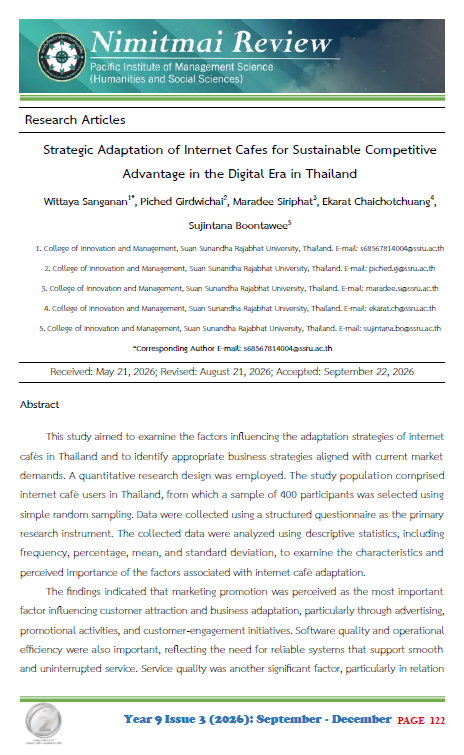
This study aimed to examine the factors influencing the adaptation strategies of internet cafés in Thailand and to identify appropriate business strategies aligned with current market demands. A quantitative research design was employed. The study population comprised internet café users in Thailand, from which a sample of 400 participants was selected using simple random sampling. Data were collected using a structured questionnaire as the primary research instrument. The collected data were analyzed using descriptive statistics, including frequency, percentage, mean, and standard deviation, to examine the characteristics and perceived importance of the factors associated with internet café adaptation.
The findings indicated that marketing promotion was perceived as the most important factor influencing customer attraction and business adaptation, particularly through advertising, promotional activities, and customer-engagement initiatives. Software quality and operational efficiency were also important, reflecting the need for reliable systems that support smooth and uninterrupted service. Service quality was another significant factor, particularly in relation to customer care and responsiveness. Location and physical environment were also important, with customers valuing convenient locations and comfortable, well-designed facilities. In addition, the availability and quality of equipment, including high-performance computers and high-speed internet connectivity, contributed to customer attraction. In contrast, price was perceived as a relatively less important factor, suggesting that customers placed greater emphasis on service quality, technological performance, and overall experience than on low prices. These findings provide practical implications for internet café operators seeking to develop adaptive and customer-oriented business strategies in an increasingly competitive digital environment.
เอกสารอ้างอิง
Abbasi, A. Z., Alqahtani, N., Tsiotsou, R. H., Rehman, U., & Ting, D. H. (2023). Esports as playful consumption experiences: Examining the antecedents and consequences of game engagement. Telematics and Informatics, 77, 101937. https://doi.org/10.1016/ j.tele.2023.101937
Can, O., & Foxman, M. (2021). Out of the cafe and into the arena: Esports spaces and neoliberalization in Turkey. ROMchip: A Journal of Game Cultures, 3(1).
Hamari, J., & Sjöblom, M. (2017). What is eSports and why do people watch it. Internet Research, 27(2), 211–232. https://doi.org/10.1108/IntR-04-2016-0085
Hua, Y.-T., Liu, K.-Y., Huang, H.-C., Rotherham, I. D., & Ma, S.-C. (2023). Testing variation in esports spectators’ motivations in relation to consumption behaviour. Sustainability, 15(3), 2028. https://doi.org/10.3390/su15032028
Indarti, N. (2004). Business location and success: The case of Internet café business in Indonesia. Gadjah Mada International Journal of Business, 6(2). https://doi.org/10.22146/ gamaijb.5543
Marchand, A., & Hennig-Thurau, T. (2013). Value creation in the video game industry: Industry economics, consumer benefits, and research opportunities. Journal of Interactive Marketing, 27(3), 141–157. https://doi.org/10.1016/j.intmar.2013.05.001
Park, S.-H., & Kim, H. (2020). The origin and expansion of e-sports space as a sports facility: From the ancient Greek stadion to PC room. Journal of Korean Society for the Sociology of Sport, 82, 55–67. https://doi.org/10.51979/KSSLS.2020.10.82.55
Pizzo, A. D., Baker, B. J., Na, S., Lee, M. A., Kim, D., & Funk, D. C. (2018). eSport vs. sport: A comparison of spectator motives. Sport Marketing Quarterly, 27(2), 108–123. https://doi.org/10.32731/SMQ.272.062018.04
Qian, T. Y., Wang, J. J., Zhang, J. J., & Lu, L. (2020). It is in the game: Dimensions of esports online spectator motivation and development of a scale. European Sport Management Quarterly, 20(4), 639–660. https://doi.org/10.1080/ 16184742.2019.1630464
Seo, Y. (2016). Professionalized consumption and identity transformations in the field of eSports. Journal of Business Research, 69(1), 264–272. https://doi.org/10.1016/ j. jbusres.2015.07.039
Wibowo, T. O., Udasmoro, W., & Noviani, R. (2020). Understanding new consumption sites of Internet cafe in Yogyakarta, Indonesia. Jurnal Ilmu Sosial dan Ilmu Politik, 23(3), 237–249. https://doi.org/10.22146/jsp.51707
ดาวน์โหลด
เผยแพร่แล้ว
รูปแบบการอ้างอิง
ฉบับ
ประเภทบทความ
สัญญาอนุญาต
ลิขสิทธิ์ (c) 2026 Nimitmai Review

อนุญาตภายใต้เงื่อนไข Creative Commons Attribution-NonCommercial-NoDerivatives 4.0 International License.