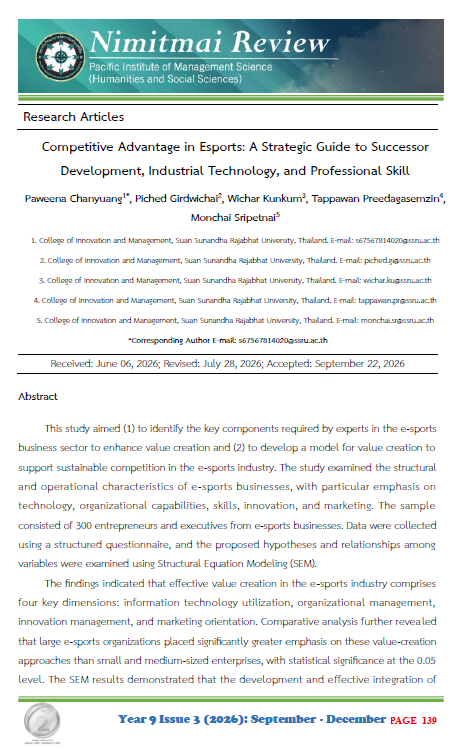
Competitive Advantage in Esports: A Strategic Guide to Successor Development, Industrial Technology, and Professional Skill
คำสำคัญ:
Competitive Advantage, Technology Industrial, Skills, Esports Businessบทคัดย่อ
This study aimed (1) to identify the key components required by experts in the e-sports business sector to enhance value creation and (2) to develop a model for value creation to support sustainable competition in the e-sports industry. The study examined the structural and operational characteristics of e-sports businesses, with particular emphasis on technology, organizational capabilities, skills, innovation, and marketing. The sample consisted of 300 entrepreneurs and executives from e-sports businesses. Data were collected using a structured questionnaire, and the proposed hypotheses and relationships among variables were examined using Structural Equation Modeling (SEM).
The findings indicated that effective value creation in the e-sports industry comprises four key dimensions: information technology utilization, organizational management, innovation management, and marketing orientation. Comparative analysis further revealed that large e-sports organizations placed significantly greater emphasis on these value-creation approaches than small and medium-sized enterprises, with statistical significance at the 0.05 level. The SEM results demonstrated that the development and effective integration of technology, organizational capabilities, and managerial skills are important mechanisms for strengthening sustainable competitiveness in the e-sports industry. The proposed model provides an integrated framework for e-sports organizations to enhance value creation through the strategic alignment of technological capabilities, organizational management, innovation, and marketing. These findings contribute to both e-sports management research and industry practice by providing a structured approach to sustainable competitive development in a rapidly evolving digital environment.
เอกสารอ้างอิง
Abraham, J., Ali, M. M., Andangsari, E. W., & Hartanti, L. E. P. (2020). Confirmatory factor analysis of celebrity worship, digital literacy, and nostalgia: Dataset of Indonesians. Data Brief, 33, 106417. https://doi.org/10.1016/j.dib.2020.106417
Allal-Chérif, O., Guaita-Martínez, J. M., & Montesinos Sansaloni, E. (2024). Sustainable esports entrepreneurs in emerging countries: Audacity, resourcefulness, innovation, transmission, and resilience in adversity. Journal of Business Research, 171. https://doi.org/ 10.1016/j.jbusres.2023.114382
Alotaibi, B., & Alotaibi, A. (2021). Exploratory and confirmatory factor analyses of the Arabic version of the Childhood Autism Rating Scale. Research in Autism Spectrum Disorders, 86. https://doi.org/10.1016/j.rasd.2021.101827
Babin, J. J., Chauhan, H. S., & Kistler, S. L. (2024). When pretty hurts: Beauty premia and penalties in eSports. Journal of Economic Behavior & Organization, 217, 726-741. https://doi.org/10.1016/j.jebo.2023.12.002
Baptista, J., Stein, M.-K., Klein, S., Watson-Manheim, M. B., & Lee, J. (2020). Digital work and organisational transformation: Emergent Digital/Human work configurations in modern organisations. The Journal of Strategic Information Systems, 29(2). https://doi.org/ 10.1016/j.jsis.2020.101618
Barnes, J., Prescott, T., & Muncer, S. (2012). Confirmatory factor analysis for the Eating Disorder Examination Questionnaire: Evidence supporting a three-factor model. Eat Behav, 13(4), 379-381. https://doi.org/10.1016/j.eatbeh.2012.05.001
Campo-Arias, A., & Caballero-Dominguez, C. C. (2021). Confirmatory factor analysis of the family APGAR questionnaire. Rev Colomb Psiquiatr (Engl Ed), 50(4), 234-237. https://doi.org/ 10.1016/j.rcpeng.2021.10.002
Chanias, S., Myers, M. D., & Hess, T. (2019). Digital transformation strategy making in pre-digital organizations: The case of a financial services provider. The Journal of Strategic Information Systems, 28(1), 17-33. https://doi.org/10.1016/j.jsis.2018.11.003
Chen, J., & Wu, Y. (2024). Would you be willing to purchase virtual gifts during esports live streams? Streamer characteristics and cultural traits. Computers in Human Behavior, 152. https://doi.org/10.1016/j.chb.2023.108075
Ginting, H., Mahiranissa, A., Bekti, R., & Febriansyah, H. (2020). The effect of outing Team Building training on soft skills among MBA students. The International Journal of Management Education, 18(3). https://doi.org/10.1016/j.ijme.2020.100423
Víctor Jordan-Vallverdú, Miquel-Angel Plaza-Navas, Josep Maria Raya, & Jose Torres-Pruñonosa (2024). The Intellectual Structure of Esports Research. Entertainment Computing, 49. https://doi.org/10.1016/j.entcom.2023.100628
Ke, X., & Wagner, C. (2024). What explains the next level of gaming? An experience-anticipation model for amateur esports participation. Computers in Human Behavior, 153. https://doi.org/10.1016/j.chb.2023.108125
Klarenberg, H., Dekkers, I. A., Peeters, C. F. W., de Mutsert, R., Jukema, J. W., Rosendaal, F. R., Leiner, T., Gosselink, M., Froeling, M., Strijkers, G. J., Boekholdt, S. M., & Lamb, H. J. (2022). Confirmatory factor analysis including MRI-derived adipose tissues quantification improves associations of metabolic dysregulation to diastolic dysfunction. J Diabetes Complications, 108202. https://doi.org/10.1016/j.jdiacomp.2022.108202
Makransky, G., Lilleholt, L., & Aaby, A. (2017). Development and validation of the Multimodal Presence Scale for virtual reality environments: A confirmatory factor analysis and item response theory approach. Computers in Human Behavior, 72, 276-285. https://doi.org/ 10.1016/j.chb.2017.02.066.
Mancı, Güdücü, Günay, Güvendi, Campbell & Bediz. (2024). The relationship between esports game genres and cognitive performance: A comparison between first-person shooter vs. multiplayer online battle arena games in younger adults. Entertainment Computing, 50. https://doi.org/10.1016/j.entcom.2024.100640.
Mardani, A., Saraji, M. K., Mishra, A. R., & Rani, P. (2020). A novel extended approach under hesitant fuzzy sets to design a framework for assessing the key challenges of digital health interventions adoption during the COVID-19 outbreak. Appl Soft Comput, 96, 106613. https://doi.org/10.1016/j.asoc.2020.106613.
Marshall, G. N., Schell, T. L., & Miles, J. N. (2013). A multi-sample confirmatory factor analysis of PTSD symptoms: what exactly is wrong with the DSM-IV structure? Clin Psychol Rev, 33(1), 54-66. https://doi.org/10.1016/j.cpr.2012.10.004
Verdugo, M. A., Guillen, V. M., Arias, B., Vicente, E., & Badia, M. (2016). Confirmatory factor analysis of the supports intensity scale for children. Res Dev Disabil, 49-50, 140-152. https://doi.org/10.1016/j.ridd.2015.11.022.
ดาวน์โหลด
เผยแพร่แล้ว
รูปแบบการอ้างอิง
ฉบับ
ประเภทบทความ
สัญญาอนุญาต
ลิขสิทธิ์ (c) 2026 Nimitmai Review

อนุญาตภายใต้เงื่อนไข Creative Commons Attribution-NonCommercial-NoDerivatives 4.0 International License.