Strategic Talent Management and Succession Planning: A Roadmap for Long-term Competitiveness in the Esports Sections
คำสำคัญ:
Strategic, Talent Management, Esports and Entertainment Industriesบทคัดย่อ
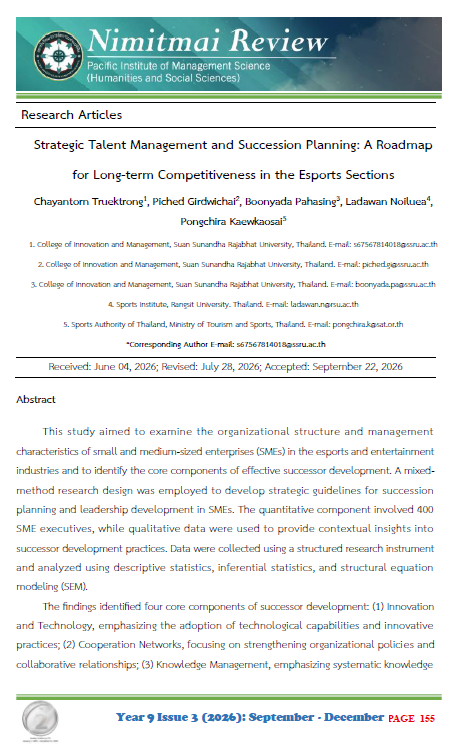
This study aimed to examine the organizational structure and management characteristics of small and medium-sized enterprises (SMEs) in the esports and entertainment industries and to identify the core components of effective successor development. A mixed-method research design was employed to develop strategic guidelines for succession planning and leadership development in SMEs. The quantitative component involved 400 SME executives, while qualitative data were used to provide contextual insights into successor development practices. Data were collected using a structured research instrument and analyzed using descriptive statistics, inferential statistics, and structural equation modeling (SEM).
The findings identified four core components of successor development: (1) Innovation and Technology, emphasizing the adoption of technological capabilities and innovative practices; (2) Cooperation Networks, focusing on strengthening organizational policies and collaborative relationships; (3) Knowledge Management, emphasizing systematic knowledge transfer and the establishment of dedicated mechanisms or units for organizational learning; and (4) Business Transfer, involving systematic approaches to preparing and developing future business leaders. The statistical results indicated that SME entrepreneurs placed significant importance on all four components, with statistically significant relationships at the 0.05 level. Furthermore, the structural equation model demonstrated a good fit with the empirical data, supporting the proposed framework for successor development. The findings contribute to the development of a systematic approach to succession planning and provide practical guidelines for strengthening leadership continuity, organizational resilience, and long-term competitiveness among SMEs in the esports and entertainment industries.
เอกสารอ้างอิง
Abbu, H. R., & Gopalakrishna, P. (2021). Synergistic effects of market orientation implementation and internalization on firm performance: Direct marketing service provider industry. Journal of Business Research, 125, 851-863. doi:10.1016/j.jbusres.2019.06.004
Abraham, J., Ali, M. M., Andangsari, E. W., & Hartanti, L. E. P. (2020). Confirmatory factor analysis of celebrity worship, digital literacy, and nostalgia: Dataset of Indonesians. Data Brief, 33, 106417. doi:10.1016/j.dib.2020.106417
Al Zarooni, M., Awad, M., & Alzaatreh, A. (2022). Confirmatory factor analysis of work-related accidents in UAE. Safety Science, 153. doi:10.1016/j.ssci.2022.105813
Allal-Chérif, O., Guaita-Martínez, J. M., & Montesinos Sansaloni, E. (2024). Sustainable esports entrepreneurs in emerging countries: Audacity, resourcefulness, innovation, transmission, and resilience in adversity. Journal of Business Research, 171. doi:10.1016/j. jbusres.2023.114382
Andión, O., Ferrer, M., Gancedo, B., Calvo, N., Barral, C., Torrubia, R., & Casas, M. (2011). Confirmatory factor analysis of borderline personality disorder symptoms based on two different interviews: The Structured Clinical Interview for DSM-IV Axis II Disorder and the Revised Diagnostic Interview for Borderlines. Psychiatry Research, 190(2–3), 304–308. https://doi.org/10.1016/j.psychres.2011.05.014
Anugerah, A. R., Muttaqin, P. S., & Trinarningsih, W. (2022). Social network analysis in business and management research: A bibliometric analysis of the research trend and performance from 2001 to 2020. Heliyon, 8(4), e09270. doi:10.1016/j.heliyon.2022.e09270
Arvate, P., & Story, J. (2024). Leaders affect business creation: Evidence from mayoral elections. The Leadership Quarterly, 35(5), 101577. https://doi.org/10.1016/j.leaqua.2021.101577
Asgari, A., & Asgari, R. (2021). How circular economy transforms business models in a transition towards circular ecosystem: the barriers and incentives. Sustainable Production and Consumption, 28, 566-579. doi:10.1016/j.spc.2021.06.020
Ashiru, F., Whitfield, I., & Warwick, P. (2022). Business school capital and study choices in undergraduate education: A student-centred approach. The International Journal of Management Education, 20(2). doi:10.1016/j.ijme.2022.100633
Baabdullah, A. M., Alalwan, A. A., Slade, E. L., Raman, R., & Khatatneh, K. F. (2021). SMEs and artificial intelligence (AI): Antecedents and consequences of AI-based B2B practices. Industrial Marketing Management, 98, 255-270. doi:10.1016/j.indmarman.2021.09.003
Blocker, C. P. (2011). Modeling customer value perceptions in cross-cultural business markets. Journal of Business Research, 64(5), 533-540. doi:10.1016/j.jbusres.2010.05.001
Bouwman, H., Nikou, S., & de Reuver, M. (2019). Digitalization, business models, and SMEs: How do business model innovation practices improve performance of digitalizing SMEs? Telecommunications Policy, 43(9). doi:10.1016/j.telpol.2019.101828
Cannavacciuolo, L., Capaldo, G., & Ponsiglione, C. (2023). Digital innovation and organizational changes in the healthcare sector: Multiple case studies of telemedicine project implementation. Technovation, 120, 102550. https://doi.org/10.1016/j.technovation. 2022.102550
Chowdhury, S., Budhwar, P., Dey, P. K., Joel-Edgar, S., & Abadie, A. (2022). AI-employee collaboration and business performance: Integrating knowledge-based view, socio-technical systems and organisational socialisation framework. Journal of Business Research, 144, 31-49. doi:10.1016/j.jbusres.2022.01.069
Colovic, A. (2022). Leadership and business model innovation in late internationalizing SMEs. Long Range Planning, 55(1), 102083. https://doi.org/10.1016/j.lrp.2021.102083
Coskun-Setirek, A., & Tanrikulu, Z. (2021). Digital innovations-driven business model regeneration: A process model. Technology in Society, 64. doi:10.1016/j.techsoc. 2020.101461
De’, R., Pandey, N., & Pal, A. (2020). Impact of digital surge during Covid-19 pandemic: A viewpoint on research and practice. International Journal of Information Management, 55, 102171. https://doi.org/10.1016/j.ijinfomgt.2020.102171
Fantke, P., Cinquemani, C., Yaseneva, P., De Mello, J., Schwabe, H., Ebeling, B., & Lapkin, A. A. (2021). Transition to sustainable chemistry through digitalization. Chem, 7(11), 2866-2882. doi:10.1016/j.chempr.2021.09.012
Magno, F., & Cassia, F. (2021). Effects of agritourism businesses' strategies to cope with the COVID-19 crisis: The key role of corporate social responsibility (CSR) behaviours. J Clean Prod, 325, 129292. doi:10.1016/j.jclepro.2021.129292
Miele, C., Maquigneau, A., Joyal, C. C., Bertsch, I., Gangi, O., Gonthier, H., Rawlinson, C., Vigourt-Oudart, S., Symphorien, E., Heasman, A., Letourneau, E., Moncany, A.-H., & Lacambre, M. (2023). International guidelines for the prevention of sexual violence: A systematic review and perspective of WHO, UN Women, UNESCO, and UNICEF's publications. Child Abuse & Neglect, 146, 106497. https://doi.org/10.1016/j.chiabu.2023.106497
Poch, M., Garrido-Baserba, M., Corominas, L., Perelló-Moragues, A., Monclús, H., Cermerón-Romero, M., Melitas, N., Jiang, S. C., & Rosso, D. (2020). When the fourth water and digital revolution encountered COVID-19. Science of the Total Environment, 744, 140980. https://doi.org/10.1016/j.scitotenv.2020.140980
Sandeep, S. R., Ahamad, S., Saxena, D., Srivastava, K., Jaiswal, S., & Bora, A. (2022). To understand the relationship between Machine learning and Artificial intelligence in large and diversified business organisations. Materials Today: Proceedings, 56, 2082-2086. doi:10.1016/j.matpr.2021.11.409
Sarasini, S., & Langeland, O. (2021). Business model innovation as a process for transforming user mobility practices. Environmental Innovation and Societal Transitions, 39, 229-248. doi:10.1016/j.eist.2021.04.005
Secundo, G., Mele, G., Vecchio, P. D., Elia, G., Margherita, A., & Ndou, V. (2021). Threat or opportunity? A case study of digital-enabled redesign of entrepreneurship education in the COVID-19 emergency. Technol Forecast Soc Change, 166, 120565. doi:10.1016/j.techfore.2020.120565
Seydi, M., Akhbari, B., Abdollahi, I., Karimi Ghasem Abad, S., & Biglarian, A. (2021). Confirmatory Factor Analysis, Reliability, and Validity of the Persian Version of the Coping Strategies Questionnaire for Iranian People With Nonspecific Chronic Neck Pain. J Manipulative Physiol Ther, 44(1), 72-84. doi:10.1016/j.jmpt.2020.08.004
Wang, L., Zhang, J., Shi, Z., Zhou, M., Huang, D., & Liu, P. (2011). Confirmatory factor analysis of posttraumatic stress symptoms assessed by the Impact of Event Scale-Revised in Chinese earthquake victims: Examining factor structure and its stability across sex. Journal of Anxiety Disorders, 25(3), 369–375. https://doi.org/10.1016/j.janxdis.2010.10.011
Zou, Y. M., Yang, H. X., Zhang, R. T., Lui, S. S. Y., Cheung, E. F. C., & Chan, R. C. K. (2020). Validation of the Chinese version of the Multidimensional Schizotypy Scale (MSS): Convergent evidence from exploratory and confirmatory factor analyses. Asian J Psychiatr, 51, 102057. doi:10.1016/j.ajp.2020.102057
ดาวน์โหลด
เผยแพร่แล้ว
รูปแบบการอ้างอิง
ฉบับ
ประเภทบทความ
สัญญาอนุญาต
ลิขสิทธิ์ (c) 2026 Nimitmai Review

อนุญาตภายใต้เงื่อนไข Creative Commons Attribution-NonCommercial-NoDerivatives 4.0 International License.