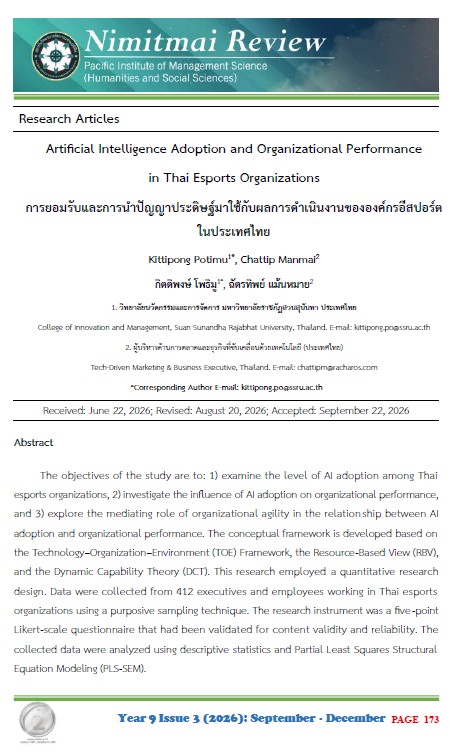
การยอมรับและการนำปัญญาประดิษฐ์มาใช้กับผลการดำเนินงานขององค์กรอีสปอร์ต ในประเทศไทย
คำสำคัญ:
ปัญญาประดิษฐ์, การยอมรับเทคโนโลยี, องค์กรอีสปอร์ต, ความคล่องตัวขององค์กร, ผลการดำเนินงานขององค์กรบทคัดย่อ
วัตถุประสงค์ของการวิจัยเพื่อ 1) ศึกษาระดับการยอมรับและการนำปัญญาประดิษฐ์ (Artificial Intelligence: AI) มาใช้ในองค์กรอีสปอร์ตของประเทศไทย 2) ศึกษาอิทธิพลของการยอมรับและการนำ AI มาใช้ที่มีต่อผลการดำเนินงานขององค์กร และ 3) ศึกษาบทบาทของความคล่องตัวขององค์กรในฐานะตัวแปรส่งผ่านระหว่างการยอมรับ AI กับผลการดำเนินงานขององค์กรอีสปอร์ต โดยพัฒนากรอบแนวคิดการวิจัยบนพื้นฐานของกรอบแนวคิดเทคโนโลยี–องค์กร–สภาพแวดล้อม ทฤษฎีฐานทรัพยากรขององค์กร และทฤษฎีความสามารถเชิงพลวัต เป็นการวิจัยเชิงปริมาณ โดยกลุ่มตัวอย่างเป็นผู้บริหารและบุคลากรที่ปฏิบัติงานในองค์กรอีสปอร์ตของประเทศไทย จำนวน 412 คน คัดเลือกโดยวิธีการสุ่มแบบเจาะจง เครื่องมือที่ใช้ในการวิจัยคือแบบสอบถามมาตราส่วนประมาณค่า 5 ระดับ ซึ่งผ่านการตรวจสอบความตรงเชิงเนื้อหาและความเชื่อมั่นของเครื่องมือ การวิเคราะห์ข้อมูลใช้สถิติเชิงพรรณนาและการวิเคราะห์แบบจำลองสมการโครงสร้างด้วยวิธี Partial Least Squares Structural Equation Modeling (PLS-SEM)
ผลการวิจัยพบว่า การยอมรับและการนำ AI มาใช้มีอิทธิพลเชิงบวกและมีนัยสำคัญทางสถิติต่อความคล่องตัวขององค์กรและผลการดำเนินงานขององค์กรอีสปอร์ต นอกจากนี้ ความคล่องตัวขององค์กรยังมีอิทธิพลเชิงบวกต่อผลการดำเนินงานขององค์กร โดยทำหน้าที่เป็นตัวแปรส่งผ่านบางส่วนระหว่างการยอมรับ AI กับผลการดำเนินงานขององค์กร ซึ่งสะท้อนให้เห็นได้ว่า AI เป็นทรัพยากรเชิงกลยุทธ์ที่จะช่วยยกระดับประสิทธิภาพการดำเนินงาน ความสามารถในการปรับตัว และความได้เปรียบในการแข่งขันขององค์กรอีสปอร์ตในยุคดิจิทัล สำหรับข้อค้นพบจากการวิจัยครั้งนี้มีคุณูปการต่อการพัฒนาองค์ความรู้ด้านการบริหารจัดการอีสปอร์ตและการประยุกต์ใช้ปัญญาประดิษฐ์ในระดับองค์กร รวมทั้งสามารถใช้เป็นแนวทางสำหรับผู้บริหารองค์กรอีสปอร์ตและผู้กำหนดนโยบายในการส่งเสริมการเปลี่ยนผ่านสู่การบริหารจัดการที่ขับเคลื่อนด้วยปัญญาประดิษฐ์ เพื่อยกระดับขีดความสามารถในการแข่งขันของอุตสาหกรรมอีสปอร์ตไทยได้อย่างยั่งยืน
เอกสารอ้างอิง
ประชาชาติธุรกิจ. (2565). เกมมิ่งเกียร์โตตาม ‘อีสปอร์ต’ สินค้าไอทีแห่ชิงเค้กหมื่นล้าน. https://www.pracha chat.net/ict/news-834196
Barney, J. (1991). Firm resources and sustained competitive advantage. Journal of Management, 17(1), 99–120. https://doi.org/10.1177/014920639101700108
Barney, J. B. (2001). Resource-based theories of competitive advantage: A ten-year retrospective on the resource-based view. Journal of Management, 27(6), 643–650. https://doi.org/ 10.1177/014920630102700602
Barney, J. B., Ketchen, D. J., Jr., & Wright, M. (2021). Resource-based theory and the value creation framework. Journal of Management, 47(7), 1936–1955. https://doi.org/10.1177/0149 2063211021655
Belhadi, A., Mani, V., Kamble, S. S., Khan, S. A. R., & Verma, S. (2024). Artificial intelligence-driven innovation for enhancing supply chain resilience and performance under the effect of supply chain dynamism: An empirical investigation. Annals of Operations Research, 333(2–3), 627–652. https://doi.org/10.1007/s10479-021-03956-x
Chen, D., Esperança, J. P., & Wang, S. (2022). The impact of artificial intelligence on firm performance: An application of the resource-based view to e-commerce firms. Frontiers in Psychology, 13, 884830. https://doi.org/10.3389/fpsyg.2022.884830
Eisenhardt, K. M., & Martin, J. A. (2000). Dynamic capabilities: What are they? Strategic Management Journal, 21(10–11), 1105–1121. https://doi.org/10.1002/1097-0266(200010/11)21:10/11<1105: AID-SMJ133>3.0.CO;2-E
Hair, J. F., Jr., Hult, G. T. M., Ringle, C. M., & Sarstedt, M. (2022). A primer on partial least squares structural equation modeling (PLS-SEM) (3rd ed.). SAGE Publications.
Helfat, C. E., & Peteraf, M. A. (2009). Understanding dynamic capabilities: Progress along a developmental path. Strategic Organization, 7(1), 91–102. https://doi.org/ 10.1177/1476127008100133
Mikalef, P., & Gupta, M. (2021). Artificial intelligence capability: Conceptualization, measurement calibration, and empirical study on its impact on organizational creativity and firm performance. Information & Management, 58(3), 103434. https://doi.org/10.1016/ j.im.2021.103434
Pavlou, P. A., & El Sawy, O. A. (2011). Understanding the elusive black box of dynamic capabilities. Decision Sciences, 42(1), 239–273. https://doi.org/10.1111/j.1540-5915.2010.00287.x
Schilke, O. (2014). On the contingent value of dynamic capabilities for competitive advantage: The nonlinear moderating effect of environmental dynamism. Strategic Management Journal, 35(2), 179–203. https://doi.org/10.1002/smj.2099
Teece, D. J. (2007). Explicating dynamic capabilities: The nature and microfoundations of (sustainable) enterprise performance. Strategic Management Journal, 28(13), 1319–1350. https://doi.org/10.1002/smj.640
Teece, D. J., Pisano, G., & Shuen, A. (1997). Dynamic capabilities and strategic management. Strategic Management Journal, 18(7), 509–533. https://doi.org/10.1002/(SICI)1097-0266(199708)18:7<509: AID-SMJ882>3.0.CO;2-Z
Tornatzky, L. G., Fleischer, M., & Chakrabarti, A. K. (1990). The processes of technological innovation. Lexington Books.
Vial, G. (2019). Understanding digital transformation: A review and a research agenda. The Journal of Strategic Information Systems, 28(2), 118–144. https://doi.org/10.1016/j.jsis.2019.01.003
Wang, C. L., & Ahmed, P. K. (2007). Dynamic capabilities: A review and research agenda. International Journal of Management Reviews, 9(1), 31–51. https://doi.org/10.1111/j.1468-2370.2007.00201.x
Yin, R. K. (2018). Case study research and applications: Design and methods (6th ed.). SAGE Publications.
ดาวน์โหลด
เผยแพร่แล้ว
รูปแบบการอ้างอิง
ฉบับ
ประเภทบทความ
สัญญาอนุญาต
ลิขสิทธิ์ (c) 2026 Nimitmai Review

อนุญาตภายใต้เงื่อนไข Creative Commons Attribution-NonCommercial-NoDerivatives 4.0 International License.