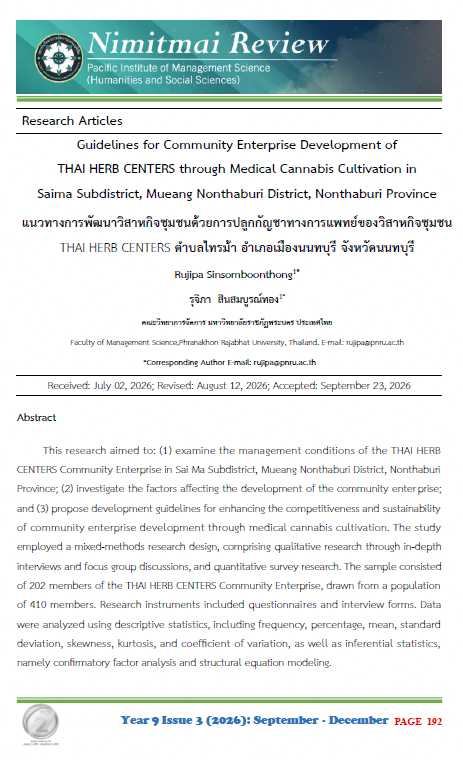
แนวทางการพัฒนาวิสาหกิจชุมชนด้วยการปลูกกัญชาทางการแพทย์ของวิสาหกิจชุมชน THAI HERB CENTERS ตำบลไทรม้า อำเภอเมืองนนทบุรี จังหวัดนนทบุรี
คำสำคัญ:
วิสาหกิจชุมชน, กัญชาทางการแพทย์, การพัฒนาวิสาหกิจชุมชน, ความสามารถทางการแข่งขัน, แบบจำลองสมการโครงสร้างบทคัดย่อ
การวิจัยนี้มีวัตถุประสงค์เพื่อ 1) ศึกษาสภาพการบริหารจัดการกลุ่มวิสาหกิจชุมชน THAI HERB CENTERS ตำบลไทรม้า อำเภอเมืองนนทบุรี จังหวัดนนทบุรี 2) ศึกษาปัจจัยที่มีผลต่อการพัฒนากลุ่มวิสาหกิจชุมชน และ 3) เสนอแนวทางการพัฒนาวิสาหกิจชุมชนด้วยการปลูกกัญชาทางการแพทย์ให้มีศักยภาพในการแข่งขันและดำเนินงานได้อย่างยั่งยืน การวิจัยใช้ระเบียบวิธีวิจัยแบบผสมผสาน ประกอบด้วยการวิจัยเชิงคุณภาพ โดยการสัมภาษณ์เชิงลึกและการสนทนากลุ่ม และการวิจัยเชิงปริมาณแบบสำรวจ กลุ่มตัวอย่างคือสมาชิกกลุ่มวิสาหกิจชุมชน THAI HERB CENTERS จำนวน 202 คน จากประชากร 410 คน เครื่องมือที่ใช้ในการวิจัยคือแบบสอบถามและแบบสัมภาษณ์ วิเคราะห์ข้อมูลด้วยสถิติเชิงพรรณนา ได้แก่ ความถี่ ร้อยละ ค่าเฉลี่ย ส่วนเบี่ยงเบนมาตรฐาน ความเบ้ ความโด่ง และค่าสัมประสิทธิ์ความแปรปรวน รวมถึงสถิติเชิงอนุมาน ได้แก่ การวิเคราะห์องค์ประกอบเชิงยืนยันและการวิเคราะห์แบบจำลองสมการโครงสร้าง
ผลการวิจัยพบว่า กลุ่มตัวอย่างส่วนใหญ่เป็นเพศหญิง อายุ 41–50 ปี มีการศึกษาต่ำกว่าปริญญาตรี และมีประสบการณ์เกี่ยวกับการปลูกกัญชาทางการแพทย์ 1–5 ปี สภาพการดำเนินงานของวิสาหกิจชุมชนส่วนใหญ่เกิดจากการแก้ไขปัญหาร่วมกันของกลุ่ม มีทุนหลักจากทรัพยากรในชุมชน และสมาชิกส่วนใหญ่มีรายได้ระหว่าง 10,000–20,000 บาทต่อเดือน ผลการวิเคราะห์ความคิดเห็นพบว่า ปัจจัยสำคัญทุกด้านอยู่ในระดับมาก ได้แก่ ทรัพยากรพื้นฐานของวิสาหกิจชุมชน ระบบการทำงาน บทบาทของภาครัฐ การเปลี่ยนแปลงทางธุรกิจ ความสามารถทางการแข่งขัน และผลการดำเนินงานขององค์กร โดยด้านการเปลี่ยนแปลงทางธุรกิจมีค่าเฉลี่ยสูงสุด รองลงมาคือระบบการทำงาน ทรัพยากรพื้นฐาน ผลการดำเนินงานขององค์กร ความสามารถทางการแข่งขัน และบทบาทของภาครัฐ ตามลำดับ ผลการวิเคราะห์องค์ประกอบเชิงยืนยันพบว่าแบบจำลองมีความสอดคล้องกับข้อมูลเชิงประจักษ์อยู่ในเกณฑ์ดี โดยมีค่า Chi-Square = 116.498, df = 113, p = 0.392, CMIN/df = 1.031, CFI = 0.999, GFI = 0.945, AGFI = 0.908, RMSEA = 0.012 และ RMR = 0.016 แสดงให้เห็นว่าองค์ประกอบของแบบจำลองมีความเหมาะสม สามารถนำไปใช้เป็นแนวทางการพัฒนาวิสาหกิจชุมชนด้านกัญชาทางการแพทย์ได้อย่างมีประสิทธิภาพ ข้อค้นพบชี้ให้เห็นว่าการพัฒนาวิสาหกิจชุมชนควรมุ่งเสริมสร้างทรัพยากรมนุษย์ ระบบฐานข้อมูล การควบคุมคุณภาพ การใช้เทคโนโลยีและนวัตกรรม การสนับสนุนจากภาครัฐ และกลยุทธ์การแข่งขันเฉพาะกลุ่ม เพื่อยกระดับเศรษฐกิจฐานรากและสร้างความยั่งยืนให้แก่ชุมชน
เอกสารอ้างอิง
พระราชบัญญัติส่งเสริมวิสาหกิจชุมชน พ.ศ. 2548. (2548, 18 มกราคม). ราชกิจจานุเบกษา, 122(6ก), 1–14.
พระราชบัญญัติยาเสพติดให้โทษ (ฉบับที่ 7) พ.ศ. 2562. (2562, 18 กุมภาพันธ์). ราชกิจจานุเบกษา, 136(19ก), 1–19.
Barney, J. (1991). Firm resources and sustained competitive advantage. Journal of Management, 17(1), 99–120. https://doi.org/10.1177/014920639101700108
Bharadwaj, A., El Sawy, O. A., Pavlou, P. A., & Venkatraman, N. (2013). Digital business strategy: Toward a next generation of insights. MIS Quarterly, 37(2), 471–482. https://doi.org/10.25300/MISQ/2013/37:2.3
Chatterjee, S., Chaudhuri, R., Vrontis, D., & Thrassou, A. (2023). Digital transformation and competitive capability of SMEs: The role of innovation and government support. Journal of Business Research, 161, 113845. https://doi.org/10.1016/j.jbusres.2023.113845
Department of Agricultural Extension. (2023). Community enterprise promotion in Thailand. Ministry of Agriculture and Cooperatives.
FAO. (2022). The State of Food and Agriculture 2022. Food and Agriculture Organization of the United Nations.
Ferreira, J. J., Fernandes, C. I., & Kraus, S. (2021). Extending the resource-based view through dynamic capabilities toward sustainable competitive advantage: A systematic literature review. Sustainability, 13(15), 8502. https://doi.org/10.3390/su13158502
Grant, R. M. (2019). Contemporary strategy analysis (10th ed.). Wiley.
Kaplan, R. S., & Norton, D. P. (1996). The balanced scorecard: Translating strategy into action. Harvard Business School Press.
Kotter, J. P. (1996). Leading change. Harvard Business School Press.
Mazzucato, M. (2018). The entrepreneurial state: Debunking public vs. private sector myths (2nd ed.). Penguin Books.
National Academies of Sciences, Engineering, and Medicine. (2017). The health effects of cannabis and cannabinoids: The current state of evidence and recommendations for research. National Academies Press. https://doi.org/10.17226/24625
Nonaka, I., & Takeuchi, H. (1995). The knowledge-creating company. Oxford University Press.
Porter, M. E. (1985). Competitive advantage: Creating and sustaining superior performance. Free Press.
Richard, P. J., Devinney, T. M., Yip, G. S., & Johnson, G. (2009). Measuring organizational performance: Towards methodological best practice. Journal of Management, 35(3), 718–804. https://doi.org/10.1177/0149206308330560
Teece, D. J. (2018). Business models and dynamic capabilities. Long Range Planning, 51(1), 40–49. https://doi.org/10.1016/j.lrp.2017.06.007
Teece, D. J., Pisano, G., & Shuen, A. (1997). Dynamic capabilities and strategic management. Strategic Management Journal, 18(7), 509–533.
United Nations Conference on Trade and Development. (2022). World Investment Report 2022. United Nations.
United Nations Development Programme. (2022). Human Development Report 2021/2022. UNDP.
Verhoef, P. C., Broekhuizen, T., Bart, Y., Bhattacharya, A., Qi Dong, J., Fabian, N., & Haenlein, M. (2021). Digital transformation: A multidisciplinary reflection and research agenda. Journal of Business Research, 122, 889–901. https://doi.org/10.1016/j.jbusres.2019.09.022
Wernerfelt, B. (1984). A resource-based view of the firm. Strategic Management Journal, 5(2), 171–180. https://doi.org/10.1002/smj.4250050207
World Bank. (2022). World Development Report 2022: Finance for an equitable recovery. World Bank.
World Health Organization. (2018). WHO Expert Committee on Drug Dependence: Cannabidiol (CBD) Critical Review Report. World Health Organization.
ดาวน์โหลด
เผยแพร่แล้ว
รูปแบบการอ้างอิง
ฉบับ
ประเภทบทความ
สัญญาอนุญาต
ลิขสิทธิ์ (c) 2026 Nimitmai Review

อนุญาตภายใต้เงื่อนไข Creative Commons Attribution-NonCommercial-NoDerivatives 4.0 International License.