Thailand's Hedging Strategy towards the United States and China in the South China Sea Context: 2020-2025
คำสำคัญ:
Hedging strategy, Thailand, United States, China, South China Sea, ASEANบทคัดย่อ
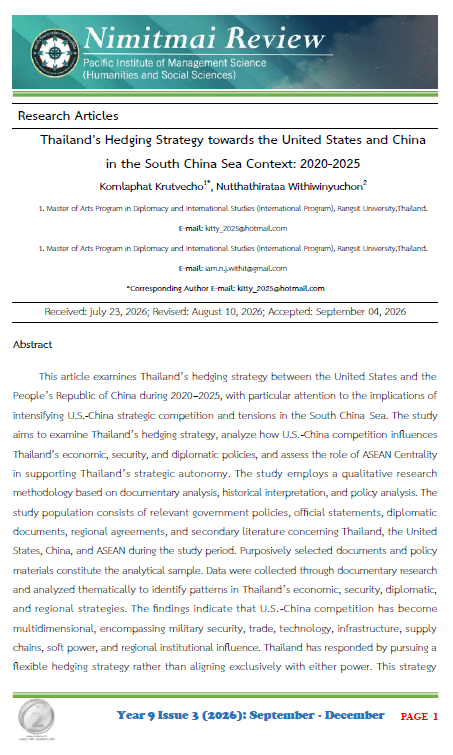
This article examines Thailand’s hedging strategy between the United States and the People’s Republic of China during 2020–2025, with particular attention to the implications of intensifying U.S.-China strategic competition and tensions in the South China Sea. The study aims to examine Thailand’s hedging strategy, analyze how U.S.-China competition influences Thailand’s economic, security, and diplomatic policies, and assess the role of ASEAN Centrality in supporting Thailand’s strategic autonomy. The study employs a qualitative research methodology based on documentary analysis, historical interpretation, and policy analysis. The study population consists of relevant government policies, official statements, diplomatic documents, regional agreements, and secondary literature concerning Thailand, the United States, China, and ASEAN during the study period. Purposively selected documents and policy materials constitute the analytical sample. Data were collected through documentary research and analyzed thematically to identify patterns in Thailand’s economic, security, diplomatic, and regional strategies. The findings indicate that U.S.-China competition has become multidimensional, encompassing military security, trade, technology, infrastructure, supply chains, soft power, and regional institutional influence. Thailand has responded by pursuing a flexible hedging strategy rather than aligning exclusively with either power. This strategy combines pragmatic economic cooperation with China, continued security cooperation with the United States and other partners, and engagement with ASEAN-led mechanisms as a strategic buffer. The study concludes that hedging and ASEAN Centrality enable Thailand to preserve strategic autonomy, maintain economic opportunities, and enhance its bargaining power. However, this strategy remains vulnerable to intensified great-power rivalry, economic and technological decoupling, and weakened ASEAN unity.
เอกสารอ้างอิง
Bowen, G. A. (2009). Document analysis as a qualitative research method. Qualitative Research Journal, 9(2), 27-40.
Braun, V., & Clarke, V. (2006). Using thematic analysis in psychology. Qualitative Research in Psychology, 3(2), 77-101.
Bunyavejchewin, P., & Buddharaksa, W. (2024). Thailand's China policy, 2014-2019: Hedging against China? Heliyon, 10(12), 1-7.
Council on Foreign Relations. (2024). Territorial disputes in the South China Sea. Global Conflict Tracker. https://www.cfr.org/global-conflict-tracker/conflict/territorial-disputes-south-china -sea
Everhart, E. (2024). The effects of great power competition on Thai foreign policy from 2001 to 2024. Graduate Review of Political Science and Public Administration Journal, 3(2), 1-42.
Feng, Y., & Netkhunakorn, C. (2024). Thailand's hedging strategy under the strategic competition between China and the United States. Berumpun: International Journal of Social, Politics, and Humanities, 7(1), 39-51.
Figiaconi, F. (2025). Choosing not to choose: Hedging as a category of neutrality. European Journal of International Security, 1-20.
Hassan, A., & Ali, S. H. (2025). Evolving US Indo-Pacific posture and strategic competition with China. Policy Perspectives, 22(1), 61-89.
He, K., & Feng, H. (2023). After hedging: Hard choices for the Indo-Pacific states between the US and China. Cambridge University Press.
Kuik, C. C. (2008). The essence of hedging: Malaysia and Singapore's response to a rising China. Contemporary Southeast Asia, 30(2), 159-185.
Kuik, C. C. (2016). How do weaker states hedge? Unpacking ASEAN states' alignment behavior towards China. Journal of Contemporary China, 25(100), 500-514.
Kuik, C. C. (2021). Getting hedging right: A small-state perspective. China International Strategy Review, 3, 300-315.
Kuik, C. C. (2024). Explaining Hedging: The Case of Malaysian Equidistance,” Contemporary Southeast Asia, 46(1), 43–76
Kuik, C. C., & Jamil, N. S. (2024). The feasibility and future of middle-state hedging. East Asian Policy, 16(4), 7-28.
Lim, D. J., & Roberts, A. (2026). The role of technology standards in strategic hedging. Asian Politics & Policy. 18(2) DOI 10.1111/aspp.70065.
Mearsheimer, J. J. (2001). The tragedy of great power politics. W. W. Norton.
Mia, M. R., Tao, J. L., & Anderson, C. D. (2024). The South China Sea dispute and regional response. Quest Journal of Management and Social Sciences, 6(1), 74-86.
Ministry of Foreign Affairs of Thailand. (2025a). Outcomes of the 2025 meeting of ambassadors and consuls-general: Recalibrating Thailand's foreign policy. https://www.mfa.go.th/en/ content/outcomes-2025-meeting-of-amb-consul-en
Murphy, A. M. (2010). Beyond balancing and bandwagoning: Thailand's response to China's rise. Asian Security, 6(1), 1-27.
Nedic, P. (2022). Hedging strategy as a response to the United States-China rivalry: The case of Southeast Asia. The Review of International Affairs, 73(1185), 91-112.
Nguyen, D. T., & Le, K. H. (2026). The South China Sea in US-China relations: Development trends and emerging maritime security strategies. Development Trends and Strategic Forecasts Toward 2028.
Poonkham, J. (2024). Thailand's Indo-Pacific adrift? A reluctant realignment with the United States and China. Journal of Indo-Pacific Affairs, 7(1), 82-96.
Pujol, I. G. (2024). Theorising the hedging strategy: National interests, objectives, and mixed foreign policy instruments. All Azimuth: A Journal of Foreign Policy and Peace, 13(2), 193-214.
Rajesh, G. K., & Deshpande, M. (2025). Hedging with the Indo-Pacific: Why Southeast Asia might benefit from embracing the construct. The Round Table, 114(1), 463-475.
Sanglee, T. (2025). ASEAN in the maelstrom: Maintaining centrality amid uncertainties. In D. Nandy & M. Das (Eds.), Decoding the chessboard of Asian geopolitics: Asian powerplay in East and Southeast Asia, The Global North, and other emerging issues (pp. 119-138). Palgrave Macmillan.
Sasaki, F. (2025). Space, maritime security, and geopolitics in the South China Sea. Journal of Indo-Pacific Affairs, 53-78.
Siriarkkalarp, N., & Poonkham, J. (2020). A study on Thailand and its positioning in the 21st century world order: The case for hedging strategy. Thammasat University.
Swaspitchayaskun, J., & Surakitbovorn, S. (2023). Thailand and its development strategies under USA-China power rivalry: The difficulty of balancing influence and hedging. The Chinese Economy, 56(2), 142-155.
Taim, A. (2025). Small-state strategy in an era of great power rivalry: Thailand between the US and China. Journal of Political Science and International Relationship, 2(1), 53-60.
Venkatachalam, S. (2022). US-China rivalry in Southeast Asia: ASEAN's significance as a pivotal mechanism for regional stability. The Journal of Defence and Security, 13(2), 1-25.
Vo, H., Nguyen, B., Tran, H., & Bui, T. (2023). US-China rivalry in Southeast Asia region: A study on the South China Sea case. Journal of Liberty and International Affairs, 9(1), 336-351.
Walt, S. M. (1987). The origins of alliances. Cornell University Press.
Waltz, K. N. (1979). Theory of international politics. Addison-Wesley.
Zha, W. (2023). Southeast Asia amid Sino-US competition: Power shift and regional order transition. The Chinese Journal of International Politics, 16(2), 241-263.
Zhao, X. (2025). Technological hedging and differentiated responses of Southeast Asian countries to US-China technological competition: A case study on artificial intelligence (AI). The Pacific Review, 38(3), 502-533.
ดาวน์โหลด
เผยแพร่แล้ว
รูปแบบการอ้างอิง
ฉบับ
ประเภทบทความ
สัญญาอนุญาต
ลิขสิทธิ์ (c) 2026 Nimitmai Review

อนุญาตภายใต้เงื่อนไข Creative Commons Attribution-NonCommercial-NoDerivatives 4.0 International License.