
Sim Isan: Development and Paradigm on Architectural Studies
Article Sidebar
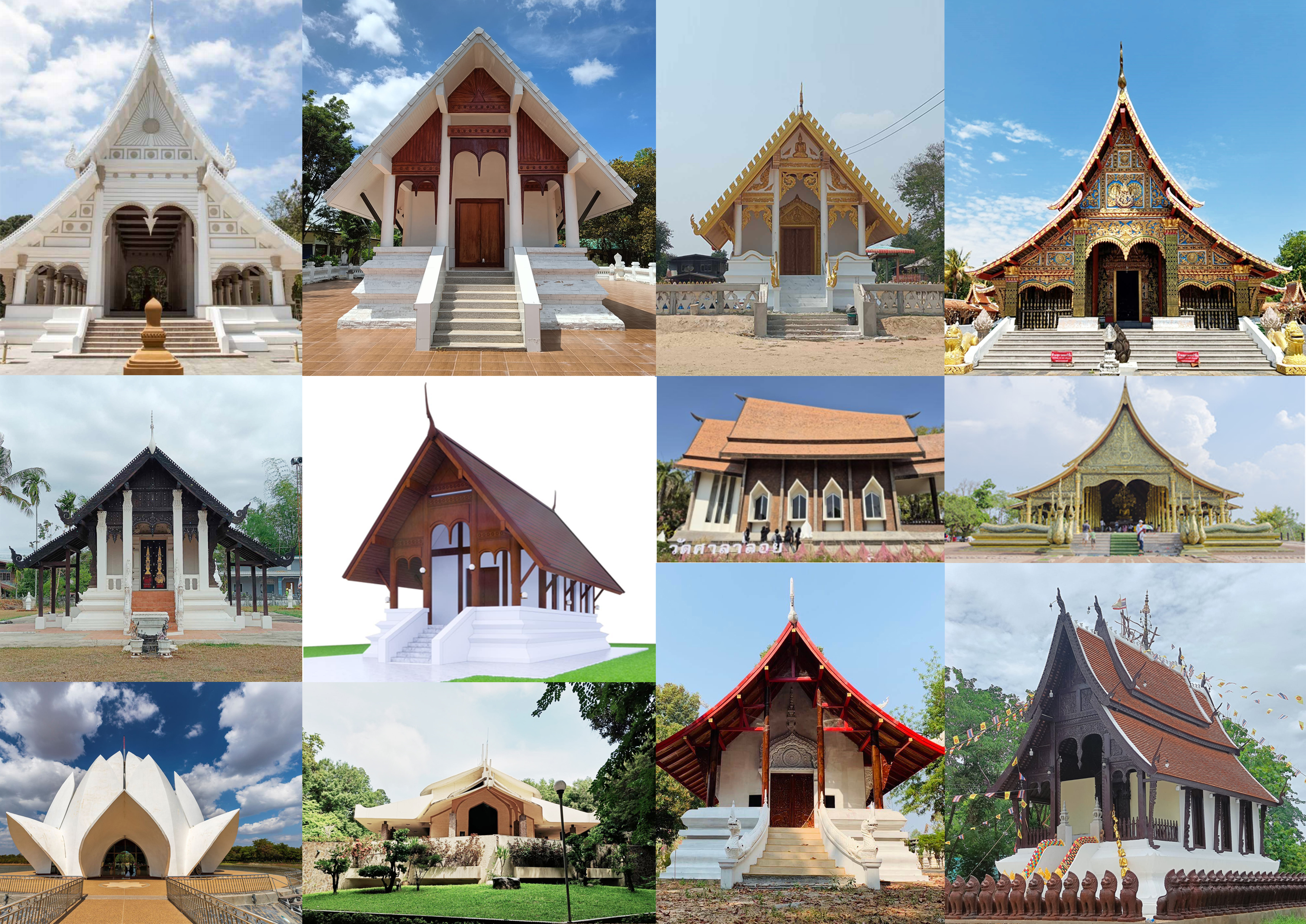
Main Article Content
Abstract
This article examines the academic discourse and educational development concerning Sim Isan (northeastern Thai ordination halls) through a systematic review of fifty-two academic publications spanning 1982-2024, including monographs, journal articles, and theses. The analysis identifies six primary research paradigms: (1) architectural stylistic analysis, (2) craftsmen's methodologies and artistic influences, (3) stylistic development and transformation, (4) conservation-oriented studies, (5) traditional wisdom and construction techniques, and (6) interdisciplinary approaches.
Based on a chronological analysis of published scholarship, Sim Isan's architectural development can be delineated into five distinct phases: Phase 1, the Lan Chang era, represents the foundational period characterized by architectural transmission influenced by Lan Chang's artistic and cultural traditions; Phase 2, the reign of King Rama III-IV (1824-1857), witnessed an architectural transition from Lan Chang craftsmanship toward vernacular temple typologies; Phase 3, the late reign of King Rama IV to the pre-constitutional era (1858-1931), was characterized by Vietnamese demographic displacement, resulting in Sim Isan forms that incorporated colonial architectural influences alongside Central Thai stylistic elements; Phase 4, the post-constitutional era (1932-1957), reflects state-directed cultural homogenization through nationalist policies that promoted standardized architectural prototypes derived from Central Thai canonical forms. This widespread dissemination of standardized designs consequently reduced traditional Sim Isan numbers through systematic demolition and reconstruction practices; Phase 5, the contemporary era (1958-2024), represents the modernist phase, characterized by the integration of reinforced concrete structural systems. This technological adoption has generated architectural diversification through material innovation, construction methodologies, and symbolic reinterpretation.
The analysis of academic literature reveals that the Sim Isan scholarship has undergone a paradigmatic shift from initial investigations focused exclusively on physical architectural attributes toward interdisciplinary approaches that conceptualize architecture as a manifestation of cultural production processes. Contemporary scholarship examines Sim Isan beyond morphological characteristics, emphasizing the dynamics of transformation resulting from economic, social, and cultural factors that have altered traditional design and construction methodologies from historical practices. Concurrently, the conceptual boundaries of "Isan" have transcended Thailand's northeastern geopolitical demarcation, evolving into a cultural territory characterized by a harmonious way of life through adaptive responses to increasingly complex external influences.
This phenomenon is evident in Sim Isan's architectural evolution across historical periods, demonstrating a transformation from traditional Lan Chang artistic forms to hybrid architectural styles that incorporate colonial influences through Vietnamese artisan techniques, subsequently amalgamating with Central Thai stylistic elements. This evolution has culminated in contemporary Sim Isan employing modern materials and construction methodologies, consequently generating enhanced stylistic diversification. Previous scholarship has demonstrated the complexity of stylistic origins, evolving from traditional Lan Chang temple forms inherited through Tai-Lao and Isan cultural groups across the Mekong River basin toward contemporary pursuits of regional identity and cultural authenticity within current social dynamics. Sim Isan represents one manifestation of this cultural creative process.
Downloads
Article Details

This work is licensed under a Creative Commons Attribution-NonCommercial-NoDerivatives 4.0 International License.
References
Chatri Prakitnonthakan. Phra Phrom Phičhit kap ngān sathāpattayakam Thai mai nai rabo̜p prachāthiptai (čhop) [Phra Phrombhichitr and the New Thai Architecture in the Democracy Regime (final installment)]. Accessed July 18, 2024. Available from https://www.matichonweekly.com/column/article_514290.
Chawalit Atipatayakul. “Rūpbǣp simō Yūan nai khēt phāk tawanōk chīangnư̄̄ a kap phatthanākān thāng ngān chāng [Styles of Vietnamese Influenced Ordination Halls in Northeast Siam and the Development of the Artwork].” Damrong Journal of the Faculty of Archaeology Silpakorn University 13, 2 (JulyDecember 2014): 147-182.
Chawalit Atipatayakul.“Rūpbǣp Simō Yūan nai khēt phāk tawanʻōk chīangnư̄̄ a kap phatthanākān thāng ngān chāng [The Style of Vietnamese Ordination Hall in the Northeast with Technician by Work].” Academic Journal of Home of Proudness (AJHP) 1, 1 (January-December 2013): 1-30
Ornsiri Panin, Vira Inpuntung, Chaiyasit Dankittikul, and Manop Isaradej. Rāingān phon kānwičhai chabap sombūn khrōngkān pramœ̜̄ nsathānaphāp Thai sưksā sākhā sathāpattayakam sinlapakam hatthakam [The Evaluation of the State of Thai Studies in Architecture, Art and Crafts, Final Report]. Bangkok: Thailand Science Research and Innovation, 2008.
Paranee Inlek. “Ngān sathāpattayakam samai mai nai ʻubōsot watpā sāI Phra ʻĀ čhā Man Phūrithattō naiphāk ʻĪsān [Modern Architecture in the Ubosots of the ForestDwelling Monastics in Phra Ajaan Mun Bhuridatta’s Line in the Northeastern Thailand].” Damrong Journal of the Faculty of Archaeology Silpakorn University 23, 1 (January-June 2024): 65-95.
Samian Aree [pseud.]. Tamnān bōt Ko̜ . Kho̜ . Kho̜ . chātniyom nai sinlapakam Thai praphēnī phāk klāng [The Legend of “Temple Hall A. B. C.” Nationalism in Traditional Thai Art of Central Thailand]. Accessed February 14, 2025. Available from https://www.silpa-mag.com/history/article_90568.
Siraporn Sihanantavong. “Kānsư̄ksā phư̄̄ a sanœ̄̄ nǣo khwāmkhit nai kānʻanurak Si mō phư̄̄ nbān nai phāk tawanʻō kchīang nư̄̄ a [A Study for Concept in Conservation of “SIM” in the Northeast of Thailand].” Master’s Thesis, Chulalongkorn University, 2000.
Sombat Prajonsant. “Saphāp kānʻanurakʻubōsot phư̄̄ nthin čhangwat Burīram [Condition of Conservation of Local Chapels Buriram Province].” Journal of Local Research and Innovation, Buriram Rajabhat University 2, 1 (January-June 2007): 81-88.
Songyot Weerataweemat. Rāingān kānwičhai rư̜ ang Si mo̜ nai prawatsāt læ watthanatham ʻĪsān ko̜ ra nī sưk sā nai Mukdāhān [Research Report on Ordination Hall (Sim) in the History and Culture of Northeast Thailand: A Case Study in Mukdahan]. Khon Kaen: Faculty of Architecture, Khon Kaen University, 2004.
Taipat Puchitchawakorn. “Bōt-wihān bǣp Lān Chāng phāk sarup: rūpbǣp laksana chapho phatthanākān læ khwām plīanplǣng [Ubosoth-Vihara of Lan Chang Architecture: Styles, Characteristics, Developments and Transformations].” NAJUA: Histor y of Architecture and Thai Architecture 11 (SeptemberDecember 2014): 274-305.
Thanit Satiennam and Nopadon Thungsakul. “Sa thā na phāp phon ngān wi chā kān kān sư̄k sā rư̄̄ an phư̄̄ n thin nai phāk ta wan ʻōk chīang nư̄̄ a khō ng prathēt Thai [The Status of Academic Outputs in Vernacular House Study in the Northeast of Thailand].”Built Environment Inquiry – BEI, Faculty of Architecture, Khon Kaen University 15, 1 (January-June 2016): 59-75.
Thanyapong Sararat . “Phra ʻubō sot khō thīam kwīan wat Bān sāng rư̄̄ angʻ amphœ̄̄ Mư̄̄ ang čhangwat Sīsakēt: kān sư̄k sā lak sa na thāng sathāpattayakam læ čhitthakam fā pha nang nai thā na pen lak thān thāng prawats ātth ōng thin [ Phra Ubosot Kho Theam Kwean, Wat Ban Sang Ruang, Mueang District, Si Sa Ket: Study of Characters in Architecture and Wall Painting as a Source for Local History].” Journal of Human and Society, Sisaket Rajabhat University 3, 2 (July-December 2019): 7-31.
Tick Saenbun. “ʻAtta ta lak nai sūan tok tǣng ʻong pra kōp sathāpattayakam sāt sa nā khān phư̄̄ n thin Thai ʻĪsān kap Sō Pō Pō . Lāo [Identity in the Decorations of Local Religious Constructions of the Isaan Region of Thailand and Lao PDR].” Built Environment Inquiry – BEI, Faculty of Architecture, Khon Kaen University 9, 1 (June-November 2010): 45-60.
Tick Saenbun. “Phutthasin ʻĪsān phatthanākān læ khwām plīan plǣng thāng sang khom kān mư̄̄ ang læ watthanatham [Isan Buddhist Art: Social, Political and Cultural Developments and Changes].” Culture Magazine Department of Cultural Promotion, Ministry of Culture 58, 3 (July-September 2019): 118-127.
Vimolsiddhi Horayangkura, Vira Inpuntung, and Santi Chantavilasvong. Rāingān kānwičhai sathānaphāp phonngān thāng wichākān sākhā sathāpattayakam nai prathēt Thai [Research Report on the Status of Academic Outputs in Architecture in Thailand. Bangkok: National Research Council of Thailand, 2001.
Waree Soktai, Somsak Boonpoo, and Peravat Chaisuk. “Wat: lǣng kānrīanrū thāng phraphutthasātsanā [Temple: Buddhist Learning Center].” Journal of Bovorn Multi-Education and Human Social Sciences 3, 2 (July–December 2022): 68-77.
Winyu Ardrugsa, Vimolsiddhi Horayangkura, Busakorn Setthavorakit, and Chutima Kachonnarongvanish. Rāingān wičhai chabap sombūn khrōng kān kānsāng san ʻēkkalak sathāpattayakam Thai samai mai: sathāpattayakam Thai samai mai phāi tai lōkāphiwat læ tho̜ ngthinphiwat [The Creation of Modern Thai Architectural Identity: Modern Thai Architecture under Globalization and Localization, Final Report]. Bangkok: The Thailand Research Fund, 2015.
Wiroj Srisuro. Si mo̜ ʻī sān [Isan Sim Northeast Buddhist Holy Temples]. Bangkok: Meka Press Public Company Limited, 1993.
Wuttisan Tanchai. Kān kračhāi ʻam nāt læ prachāthipatai nai prathēt Thai [Decentralization and Democracy in Thailand]. Bangkok: King Prajadhipok's Institute, 2014.
