
Laterite in the Construction of Brick Prang-style Chedis of the Early Ayutthaya Period on Ayutthaya Island
Article Sidebar
Main Article Content
Abstract
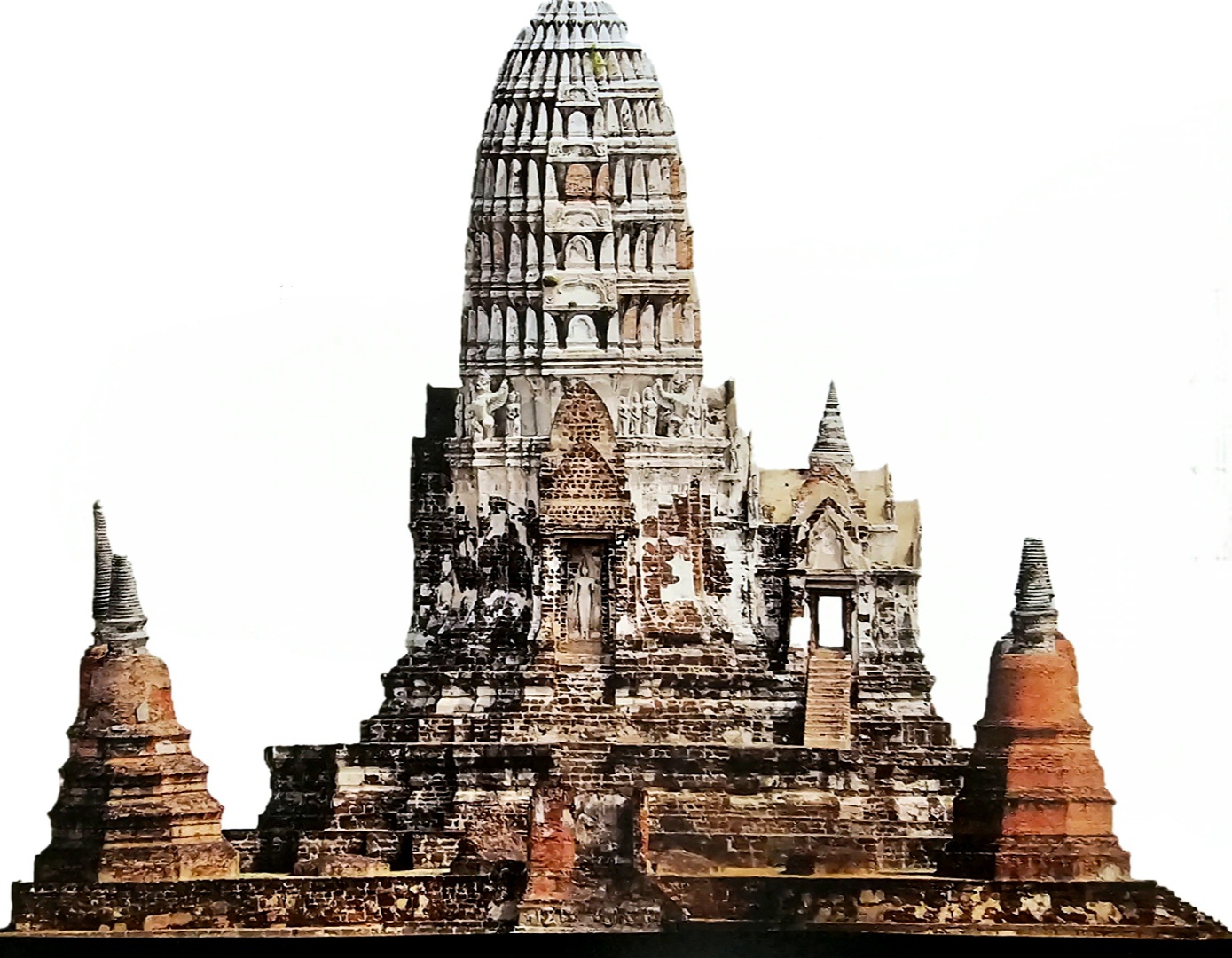
This study examines several early Ayutthaya period prang chedis or prang-style chedis located in the ancient city of Ayutthaya, highlighting the intriguing integration of laterite within their primarily masonry construction. This suggests a potential continuity in the developmental lineage of prang-style chedis that can be traced back to earlier structures, such as the principal prang at Wat Phra Si Rattana Mahathat in Lopburi. Since laterite is not a naturally occurring material in the area, large masonry chedis could have been constructed without its use. This article aims to present these perspectives through a case study analysis of prang-style chedis built with laterite and brick during the early Ayutthaya period within the ancient city.
The analysis indicated that historical documents from the Ayutthaya period reveal that builders selectively utilized laterite for specific types of structures. This suggests that builders were likely aware of the distinct characteristics of laterite compared to brick, influencing their material choices in structural construction. The laterite used may have been obtained as tribute or requisitioned from provincial cities under central authority for state purposes, possibly for the construction of chedis in royal temples of the capital.
Studies on the structural stability of buildings, based on contemporary architectural principles, suggest that the stability of chedis is influenced by multiple factors, including mass, form, and the application of suitable construction techniques. Among these, the choice of construction materials has a significant influence on structural integrity. Previous research has shown that laterite possesses greater load capacity and durability than brick.
Field survey data revealed that the laterite used in construction exhibits two types of rectangular block shapes: 1) newly quarried laterite blocks at the time of construction, and 2) laterite blocks reused from older, collapsed, or abandoned structures, which typically demonstrate more rounded edges, chipping, or breakage. The locations and patterns of laterite placement suggest that builders intentionally used laterite in the base level and chamber areas, forming the structural core that bears the greatest load. Physical evidence indicates that masons during the early Ayutthaya period possessed empirical knowledge of structural load distribution, leading them to selectively utilize laterite in areas subjected to higher compressive forces.
However, it is noteworthy that laterite is not naturally found in the local environment and was not as widely used as brick. The construction patterns of laterite masonry can be classified into three distinct types:
1) Rectangular laterite blocks, with layers that are horizontally uniform in thickness and notched to create a shoulder on the masonr block. These blocks are laid with staggered joints to enhance structural bonding strength, a technique that seems to have been inherited from the principal prang of Wat Phra Si Rattana Mahathat in Lopburi. However, the configuration in Ayutthaya appears to be more systematically arranged.
2) Rectangular blocks of approximately uniform size and thickness, laid in a pattern resembling the English bond technique. This may represent a later development in laterite masonry, specifically related to the prang structures of the early Ayutthaya period. This pattern is commonly found in early Ayutthaya masonry chedis but is not observed in the main prangs of any earlier case studies, and the use of laterite in construction is not found in earlier prangs in Lopburi.
3) Laterite blocks of various sizes and shapes, including both rectangular and square forms, laid in a non-uniform pattern across the wall, likely indicative of a reused and reassembled material. This requires supporting evidence from other contextual sources.
Thus, the development of construction techniques using laterite may have initially emerged alongside the principal prang at Phra Si Rattana Mahathat in Lopburi before evolving into a distinct form in later periods.
Downloads
Article Details

This work is licensed under a Creative Commons Attribution-NonCommercial-NoDerivatives 4.0 International License.
References
ChalathiIm-udom.Rabop khrōngsāng thāng sathāpattayakam [Structural Systems in Architecture]. Bangkok: Chulalongkorn University Press, 2003.
Executive Committee forthe 50th Anniversary Celebrations of His Majesty’s Accession to the Throne. “Phrarātchaphongsāwadān Krung Sīʻ Ayutthayā chabap Phančhanthanumāt (Čhœ̄̄ m) [Royal Chronicles of Ayutthaya Panchanthanumat (Jerm). ” In Prachum phongsāwadān chabap Kānčhanā phisēk lem sām [Collection of Annals, Golden Jubilee Edition, Volume 3]. Bangkok: Office of Literature and History, Fine Arts Department, 1999.
Karoon Chandrangsu. Rāingān phon kānwičhai kān wikhro̜̜ khrōngsāng khō̜̄ng bōrānsathān nai ʻUtthayān Prawattisāt Sukhōthai [Research Reports on Structural Analysis of Ancient Monuments in Sukhothai Historical Park]. Bangkok: Chulalongkorn University, 1985.
Nontachai Thongpumphugsar. “Botbāt nāthī læ kānʻō̜̄kbǣp Prāng nai samai ʻAyutthayā [Role and Design of Prang in Ayutthaya Period].” Master’s Thesis, Silpakorn University, 2002.
Phrarātchaphongsāwadān krung kao chabap Lūang Prasœ̄̄ tʻAksō̜̄nnit [Royal Chronicles of Ayutthaya, Luang Prasoet Aksornnit Version]. Bangkok : P.K. Press, 2001.
Prachum kham haikān Krung Sī ʻAyutthayā [Testimonies of Ayutthaya]. Bangkok: Saengdao, 2018.
“Rāingān kānsamrūat thāng bōrānnakhadī nai prathēt Thai (wan thī yīsiphā Karakadākhom thưng yīsippǣt Phrưtsačhikāyon sō̜̄ngphanhārō̜̄ičhet) [Report on Archaeological Survey in Thailand (July 25-November 28, 1964)].” Translated by Subhadradis Diskul, M.C. Silpakorn 9, 3 (September 1965): 31-70.
Ruangsak Kantabutra. “Wikhro̜̜ khrōngsāng ʻākhān nai prathēt Thai nai ʻadīt [Analysis of Building Structures in Thailand in the Past].” In ʻĒkkasān wichākān læ sarup phon kānsammanā ʻēkkalak sathāpattayakam nai prathēt Thai [Proceedings and Academic Papers from the Seminar on the Identity of Architecture in Thailand]. Bangkok: Thammasat University Press, 1984.
Ruangsak Kantabutra. Witthayākān ʻākhān [Building Technology]. Bangkok: Niyom Witthaya, 1985.
Sakchai Saising.Čhēdī nai prathēt Thai rūpbǣp phatthanākān læ phalang satthā [Chedi in Thailand: Form, Development and Faith Power]. Nonthaburi: Muang Boran, 2017.
Sangsuree Phangdaeng, Darunee Kaewpikul, Tawatchai Thoin, and Sarawon Sasawatpirom.“Saphāp khwāmchư̄̄ n tō̜̄ kam lang khō̜̄ng hin Silālǣng samrap kānkō̜̄sāng thīmai chaiwatsadu chư̄̄ amprasān (WRE35) [Moisture Condition on Strength of Laterite Stone for Non-binding Material Construction (WRE35)].” In Proceedings of the 25th National Convention on Civil Engineering (NCCE25), Chonburi, Thailand, July 15-17, 2020.
Santi Leksukhum. Sinlapa ʻAyutthayā ngān chāng lūang hǣng phǣndin [Ayutthaya Art: The Royal Craftsmen of the Kingdom]. 2nd ed. Bangkok: DarnsuthaPress, 2001.
Sarawut Darunwat. “Wat Phra Sī Rattana Mahāthāt čhangwat LopBurī [Wat Pra Sri Ratana Mahatat Lopburi].” Master’s Thesis, Silpakorn University, 2001.
Saritpong Khunsong. “Wat Phra Sī Rattana Mahāthāt: phāp sathō̜̄n phatthanākān khō̜̄ng mư̄̄ ang kao Lop Burī [Wat Phra Si Rattana Mahathat: A Reflection of Urban Development of Old Lopburi].” Muang Boran 36, 3 (July-September 2010): 108-116.
Somchart Chungsiriarak. ʻĒkkasān prakō̜̄p kānsō̜̄n rāiwichā sō̜̄ngrō̜̄ihoksipsō̜̄ng-sīrō̜̄ičhet kānʻanurak ʻākhān thāng prawattisāt læ bōrānsathān sō̜̄ng rư̄̄ ang kānʻanurak khrōngsāng læ watsadu khō̜̄ng bōrānsathān [Course Material for Subject 262-407: Conservation of Historic Buildings and Monuments II–Structural and Material Conservation of Monuments]. Bangkok: Department of Architecture and Related Arts, Faculty of Architecture, Silpakorn University, 1997.
Somchart Chungsiriarak. Prawat nǣokhit thritsadī læ kānpatibatkān nai kānʻanurak bōrānsathān [History, Concepts, Theories and Practices of Historic Monuments Conservation]. 2nd ed. Bangkok: Department of Architecture and Related Art, Faculty of Architecture, Silpakorn University, 2017.
Sudchai Pansuwan, Wongchat Chatrakul Na Ayuddhaya, and AlongkornSangnikorn. Khrōngkān wičhai kānsưksā rabop khrōngsāng læ phrưttikam khō̜̄ng bōrānsathān praphēt Čhēdī [Structural System and Behavior of Historic Masonry Pagoda: Research Project]. Bangkok: Fine Arts Department, 2019.
Suwit Lerdwimolsak. “Rabop kānchai mai bǣp nai kān kō̜̄sāng Čhēdī chanit mī phang hō̜̄ng rư̄̄ an thāt samai ʻAyutthayā [Falsework Systems in the Construction of Stupas with a Celladuring the Ayutthaya Period].” Ph.D. Dissertation, Silpakorn University, 2022.
Thanathorn Kittikant. Mahāthāt [Mahathat]. Bangkok: Matichon, 2014.
The Royal Institute. Photčhanānukrom chabap Rātbandit tayasathān Phō̜̄.Sō̜̄. sō̜̄ngphanhārō̜̄ihāsipsī [Royal Institute Dictionary, B.E. 2554 Edition]. Bangkok: The Royal Institute, 2011.
The Royal Institute. Photčhanānukrom sap thō̜̄ranīwitthayā chabap Rātbandittayasathān [Geological Glossary: Royal Institute Edition]. Bangkok: The Royal Institute, 2001.
Trongjai Hutangkura. Kān prap kǣ thīap sakkarāt læ kān ʻathibāi khwām phrarātchaphongsāwadān krung kao chabap Lūang Prasœ̄̄ t [The Chronological Revision and Explanation of the Royal Chronicles of Ayutthaya, Luang Prasoet's Edition]. Bangkok: Princess Maha Chakri Sirindhorn Anthropology Centre, 2018.
