
From Langkasuka to Pattani’s Old Town: An Analysis of the Image of the City for Guiding Conservation and Development in a Multicultural Context
Article Sidebar
Main Article Content
Abstract
Pattani is a historically and culturally significant region with deep roots in ancient civilizations that once thrived on the Malay Peninsula, including Langkasuka, Tambralinga, and Srivijaya. Over the centuries, Pattani has experienced extensive historical, social, and morphological transformations, shaping its unique identity as a multicultural society. Today, Pattani is home to a diverse population comprising Thai Buddhists, Thai Chinese, and Thai Muslims, who coexist and contribute to the area's distinctive cultural fabric. The Old Town of Pattani stands as a testament to the harmonious blending of these diverse traditions and way of life, showcasing a rich and varied cultural amalgamation.
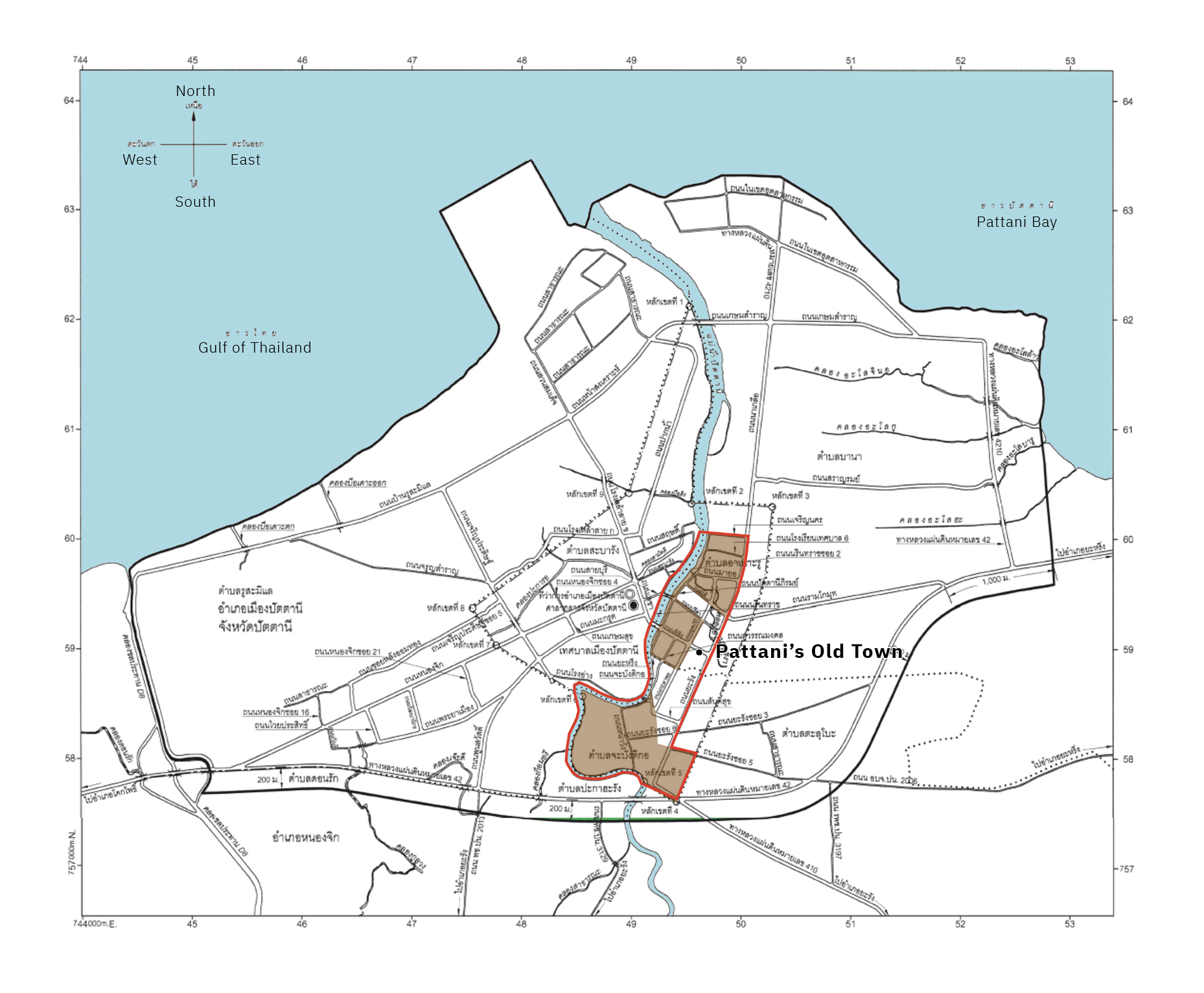
In recognition of its historical and cultural significance, the Old Town of Pattani was officially designated as a historic city on March 10, 2015. This certification was issued by the Office of Natural Resources and Environmental Policy and Planning (ONEP), which acts as the Secretariat for the Committee for the Conservation and Development of Rattanakosin and Historic Towns. The designated historic area spans approximately 2.35 square kilometers and is divided into a core area and surrounding zones. Within this historic district, the Old Town serves as a hub of ethnic, religious, and cultural diversity. The unique cultural identity of this area is reflected not only in its architecture but also in the daily interactions and communal activities of its residents, revealing a tangible blend of traditions, beliefs, and lifestyles.
Despite its historical and cultural significance, the Old Town of Pattani has experienced a decline in vibrancy in recent years. Changes in local lifestyles and activities, urban expansion, and transportation patterns have led to the abandonment of many historic buildings. Some structures have been repurposed as swiftlet houses, while others have been demolished and replaced with commercial buildings. These changes pose a significant risk to the preservation of the area's historical significance and cultural identity.
This study aims to analyze and identify the spatial components of Pattani's city image based on Kevin Lynch's urban imagery framework, which includes edges, paths, nodes, districts, and landmarks. The research methodology involves a survey focusing on two main areas: (1) the physical characteristics and spatial context of the area, including neighborhood identity, activities, atmosphere, and circulation, and (2) the buildings in terms of their location, form, function, and utilization. The findings will be compared with relevant literature covering the history of Pattani's Old Town, its spatial and architectural features, urban imagery, identity, and multicultural society.
The study reveals that all five components of urban imagery are identifiable in the Old Town. Notable features include the Pattani River, an intricate system of canals and roads, various public spaces, and prominent cultural landmarks such as temples, mosques, shrines, and historic bridges. The core area comprises three principal ethnic communities: Thai Buddhists, Thai Chinese, and Thai Muslims. The surrounding areas include newly developed economic zones and the extended settlements of the Thai Chinese (in the upper section) and Thai Muslims (in the lower section).
These findings underscore the importance of informed urban planning, conservation strategies, and efforts to sustain Pattani's unique cultural and historical identity within a peaceful, multicultural framework. Scholars, urban planners, and cultural heritage professionals play crucial roles in this endeavor.
Downloads
Article Details

This work is licensed under a Creative Commons Attribution-NonCommercial-NoDerivatives 4.0 International License.
References
Arbibusta Dorloh. Kān phanūak rat Pattānī phān ratthammanūn dōi rat Thai [The Incorporation of the Patani State through the Constitution by the Thai State]. Accessed January 5, 2025. Available from https://deepsouthwatch.org/th/node/9567
Charnvit Kasetsiri. Hētkān khwām mai sangop nai čhangwat chāidǣn phāk tai kap prawattisāt bātphlǣ [History “Unrest in Thailand’s Southern Border Provinces” and “The History of Wounds”]. Accessed September 4, 2025. Available from https://www.silpa-mag.com/history/article_9119
Committee on Document Compilation and Archives under the Executive Committee for the Celebration in Honor of His Majesty the King. Watthanatham phatthanākān thāng prawattisāt ʻēkkalak læ phūmpanyā čhangwat Pattānī [Culture, Historical Development, Identity, and Wisdom of Pattani Province]. Bangkok: Committee on Document Compilation and Archives under the Executive Committee for the Celebration in Honor of His Majesty the King, 2000.
Consultants of Technology Company Limited. Phang mư̄̄ ang rūam Pattānī (prap prung khrang thī sām) kān prachum khanakammakān phičhāranā dān kān phangmư̄̄ ang khrang thī sām / sō̜̄ngphan hārō̜̄ihoksipčhet [Pattani Comprehensive Plan (Third Revision): Meeting of the Urban Planning Committee No. 3/2024]. Bangkok: Consultants of Technology Company Limited, 2024.
Ibrahim Syukri. Prawattisāt rātchaʻānāčhak Malāyū Pattānī [The History of the Malay Kingdom of Patani]. Chiang Mai: Silkworm Books, 2006.
“Kot krasūng hai chai bangkhap phangmư̄̄ a n g r ūa m mư̄̄ ang Pattānī Phō̜̄.Sō̜̄. sō̜̄ngphanhārō̜̄ihāsippǣt [Ministerial Regulation on the Enforcement of the Pattani Comprehensive City Plan, B.E. 2558 (2015)].” The Royal Thai Government Gazette, Vol. 132, part 79 Kor (August 24, 2015): 1-48.
LueCovery. Lue Podcast #2 pœ̄̄ t phongsāwadān yō̜̄n čhut kamnœ̄̄ t ʻānāčhak Pattānī læ kān khưn trong tō̜̄ Sayām mā tǣ khrang ʻa dīt [Lue Podcast #2, Revisiting the Chronicles: The Origins of the Pattani Kingdom and Its Historical Allegiance to Siam]. July 12, 2023. Video, 07:17. Available from https://www.youtube.com/watch?v=huagFM8w2vY
Lynch, Kevin. The Image of the City. Cambridge: The MIT Press, 1960.
Nutthakorn Thananun and Nopadon Thungsakul. “Kān thāithō̜̄t ʻattalak thō̜̄ngthin phān ngān sathāpattayakam rūamsamai kō̜̄ranī sưksā nai prathēt Thai læ phūmiphāk ʻĒchīa [Transferring of Local Identities Through Contemporary Architecture: Case Study in Thailand and Asia].” Built Environment Inquiry Journal 20, 1 (January-April 2021): 1-20.
Office of Natural Resources and Environmental Policy and Planning (ONEP), Ministry of Natural Resources and Environment. Khrōngkān kamnot khō̜̄pkhēt phư̄̄nthī mư̄̄ang kao mư̄̄ang kao Pattā nī [The Project for Defining the Boundaries of the Old Town, Pattani Old Town]. Bangkok: Office of Natural Resources and Environmental Policy and Planning (ONEP), 2012.
Papanin Kasettrata. Hāsip hētkān samkhan nai prawattisāt Thai [50 Important Events in Thai History]. Bangkok: Matichon, 2014.
Pioneer Consult Company Limited. Rāng rāingān kānsưksā chabap sutthāi chumchon mư̄̄ ang Pattānī čhangwat Pattānī [Draft, Final Report on the Pattani Urban Community, Pattani Province]. Bangkok: Pioneer Consult Company Limited, 2023.
Prawat Pattānī [The History of Pattani]. Accessed April 24, 2024. Available from https://archive.oas.psu.ac.th/pn/images/stories/pnHistory/pnArchive0003.pdf
Prawattisāt čhangwat Pattānī [A History of Pattani Province]. Accessed January 5, 2025. Available from http://www.pattani.go.th/content/history.pdf
Prince of Songkla University. Phǣnthī mō̜̄radok thāng watthanatham mư̄̄ ang kao Pattānī (Cultural Atlas) khrōngkān čhat tham phǣn mǣbot læ phang mǣbot kānʻanurak læ phatthanā bō̜̄riwēn mư̄̄ ang kao Pattānī [Cultural Heritage Map of Pattani Old Town (Cultural Atlas), Master Plan and Conservation Plan Project for the Preservation and Development of Pattani Old Town]. Songkhla: Prince of Songkla University, 2020.
Ross, Michael. Planning and the Heritage: Policy and Procedures. 2nd ed. London: Routledge Press, 1996.
Vimolsiddhi Horayangkura. Phrưttikam manut kap saphāp wǣtlō̜̄m mūnlathān thāng phrưttikam phư̄̄ a kānʻō̜̄kbǣp læ wāngphǣn [Human Behavior and the Environment: Behavioral Foundations for Design and Planning]. 5th ed. Bangkok: Chulalongkorn University Press, 1998.
Worskett, Roy. The Character of Town: An Approach to Conservation. London: Architectural Press, 1969.
