
The History and Meanings of the Replication of Phra That Phanom Stupa
Article Sidebar
Main Article Content
Abstract
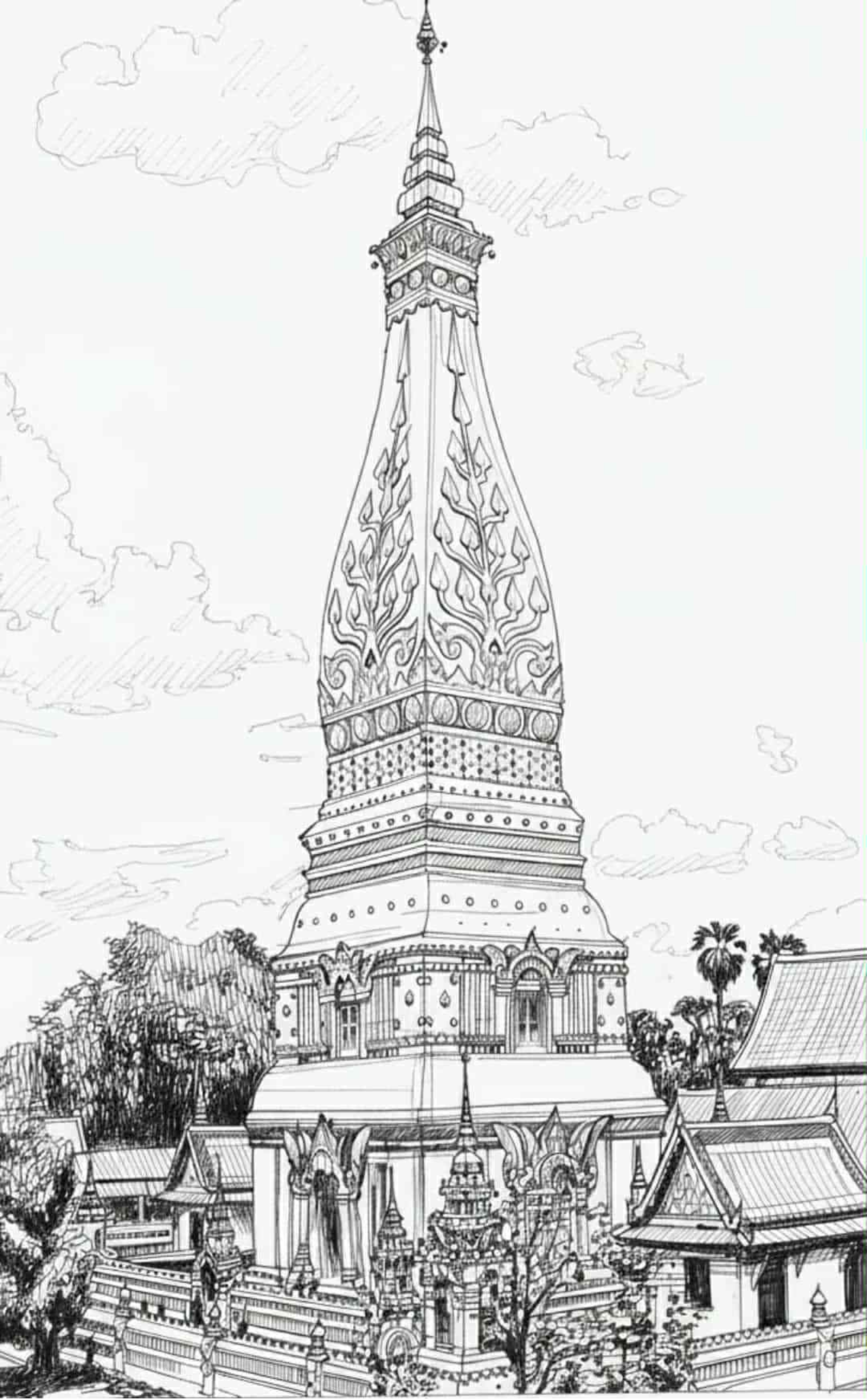
Given the historical significance of Phra That Phanom in Thai-Lao culture, it has consistently attracted academic interest. This importance has led to its architectural design becoming a model that has been replicated in various contexts. This article aims to investigate the meanings underlying the replication of Phra That Phanom by adopting theoretical approaches in architectural history as a framework for interpreting the development of architectural symbolic systems, constituting a history of meanings and symbolic forms. The study employs historical contextual analysis to examine and interpret the intentions and purposes embedded in the replication of these symbolic forms.
The study reveals that Phra That Phanom has unique characteristics. The replication of its design began during the reigns of King Rama III-King Rama IV to represent the culture of Lan Xang, extending beyond the boundaries of the Lan Xang civilization. Subsequently, between 1911 and 1916, the architectural form of Phra That Phanom began to be adopted as a representative model for stupas enshrining the Buddha’s relics at Phra That Tha Uthen, and it was further linked to the cycle of the Chronicle of Urangkhathat at Phra Phutthabat Bua Bok. At the same time, administrative reforms in the Mekong provincial regions led to the construction of replicas of Phra That Phanom, which came to embody the status of city stupas in Renu Nakhon and Nakhon Phanom.
In 1940, the government redesigned Phra That Phanom to make it taller and incorporate a Thai-style aesthetic. This design became the standard for Phra That Phanom and remained until its collapse in 1975. The Thai government subsequently rebuilt Phra That Phanom and initiated annual celebrations. The newly constructed Phra That Phanom now represented the original Phra That Phanom, located at Phu Kham Phra, as outlined in the Chronicle of Urangkhathat. Meanwhile, the original design of Phra That Phanom transitioned to symbolize Phra That Renu, Phra That Tha Uthen, and Phra That Nakhon.
Thus, a physical structure occupying a sacred space for an extended period would naturally evolve into a symbol of that sacred place. Subsequent replicas of Phra That Phanom did not necessarily represent Phu Kham Phra, where Phra That Phanom is located, but rather served to connect with the original Phra That Phanom within the broader context of the Isan region, which is linked to Lan Xang culture and the Chronicle of Urangkhathat.
Downloads
Article Details

This work is licensed under a Creative Commons Attribution-NonCommercial-NoDerivatives 4.0 International License.
References
Damrong Rajanubhab, Prince. Nithān bōrānnakhadī [Ancient Tales]. 5th ed. Bangkok: Prae Pittaya, 1975.
Damrong Rajanubhab, Prince. Tamnān phra phutthačhēdī [A History of Buddhist Monuments]. Bangkok: Rung Watthana, 1971.
Damrong Rajanubhab, Prince. Tamnān Wangnā [Legend of the Front Palace]. 8th ed. Bangkok: Saengdao, 2010.
Diskul Foundation. Som det... krom phrayā Damrong rāchānuphāp sadet pai trūat rātchakān monthon Nakhō̜̜n Rātchasīmā læ monthon ʻUdō̜̜n ʻĪsān Rō̜̜. Sō̜̜. nưngrō̜̜iyīsiphā [His Royal Highness Prince Damrong Rajanubhab inspected the Nakhon Ratchasima and Udon Provinces in the Northeast, R.S. 125]. Bangkok: Watcharin Printing, 1987.
Fine Arts Department. Chotmāihēt kān būrana patisangkhō̜̜n ʻong Phra Thāt Phanom na wat Phra Thāt Phanom wō̜̜ramahāwihān ʻamphœ̄̄ Thāt Phanom čhangwat Nakhō̜̜n Phanom Phō̜̜.Sō̜̜. sō̜̜ngphanhārō̜̜isippǣt thưng sō̜̜ngphanhārō̜̜iyīsipsō̜̜ng [Record of the Restoration of Phra That Phanom at Wat Phra That Phanom Woramahawihan, That Phanom District, Nakhon Phanom Province, 1975-1979]. Bangkok: Fine Arts Department, 1979.
Fine Arts Department. Phra Pin Klao: ʻān khīan rīan Farang rūthao than tawantok [King Pinklao Reads, Writes, and Learns from the "Westerners" to Understand the West]. Bangkok: Fine Arts Department, 2011.
Griswold, A. B. “The Holyland Transported: Replicas of the Mahabodhi Shrine in Siam and Elsewhere.” In Paranavitana Felicitation Volume, edited by N. A. Jayawickrama. Colombo: M. D. Gunasena, 1965.
Jumpon Poemsaengsuwan. Khati kānsāng phra thāt čhēdī bǣp Lānchāng nai khēt phāk tawanʻō̜̜k chīang nư̄̄a khō̜̜ng prathēt Thai [Design Concept of Langchang Style Stupas in North Eastern Thailand]. Mahasarakham: Mahasarakham University, 2006.
Kesinee Sriwongsa. “Kānsưksā khwāmsamkhan khō̜̜ng Phra Thāt Phanom phān kān čhamlō̜̜ng bǣp [The Study of Importance of Phra That Phanom through its Replica].” Ph.D. Dissertation, Silpakorn University, 2019.
Kesinee Sriwongsa. “Phra Thāt Phanom čhamlō̜̜ng nai ʻĪsān kap sanyalak hǣng ʻamnāt Sayām kao læ Sayām mai [The Phra That Phanom Replicas in Isan with the Power Symbols of Old Siam and New Siam].” Journal of Isan Arts and Culture 3, 1 (January-June 2022): 57-72.
Le May, Reginald. The Culture of South-East Asia: The Heritage of India. London: George Allen & Unwin, 1954.
Luangphor Viriyang Sirintharo. Prawat Phra ʻā čhān Man Phūri that ta thēra (chabap sombūn) læ tai sāmansamnưk [Biography of Phra Ajahn Man Phurithatto (Complete Edition) and Under Common Sense]. 4th ed. Bangkok: Phikanee Company Limited, 1982.
Norberg-Schulz, Christian. Meaning in Western Architecture. New York: Rizzoli, 1980.
Phra Thammarachanuwat. U rang kha nithān: tamnān Phra Thāt Phanom (phitsadān) [Urankanitan: The Legend of Phra That Phanom (Comprehensive)]. 13th ed. Bangkok: Ninnara Printing, 1994.
Phra Thāt Phanom [Phra That Phanom], edited by Srisak Wanlipodom. Bangkok: Muang Boran, 1975.
Sakchai Saising. “Čhēdī nai sinlapa Lāo-Lānchāng [Stupasin Lao-Lan Xang Art].” In Čhēdī nai prathēt Thai rūpbǣp phatthanākān læ phalang satthā [Stupas in Thailand: Form, Development and Faith Power]. Nonthaburi: Muang Boran, 2017.
Sakchai Saising. Čhēdī phraphuttharūp Hūptǣm Sim sinlapa Lāo læ ʻĪsān [Stupas, Buddha Images, Murals, Ordination Halls - Lao and Isan Art]. Nonthaburi: Museum Press, 2012.
Sirisak Aphisakmontri and Phloengsuriyathep Ramangkun Na Khotapura. Nai tamnān Phra Thāt Phanom [The Legend of Phra That Phanom]. Nonthaburi: Sripanya Publishing, 2023.
Snodgrass, Adrian. The Symbolism of the Stupa. New York: Cornell University, 1985.
Somchat Manichot. “Phra Thāt Phanom: Sātsanasathān saksit nai miti dān sanyalak thāng sangkhom watthanatham [Phra That Phanom: A Sacred Religious Site in Terms of Socio-cultural Symbolism].” Ph.D. Dissertation, Mahasarakham University, 2011.
Somkid Jiratatsanakul. Ngān ʻō̜̜kbǣp sathāpattayakam Thai fīphrahat somdet... čhaofā kromphrayā Narisrānuwattiwong [The Architectural Works of H.R.H. Prince Narisaranuvattiwongse]. Bangkok: Chalermprakiat Institute of Thai Art and Architecture, Silpakorn University, 2013.
Thawin Thongsawangrat. Prawat phū Thai læ chāo phū Thai mư̄̄ang Rēnu Nakhō̜̜n [History of the Tai people and the Tai people of Renu Nakhon]. Bangkok: Sriananta Printing, 1984.
Thiphakorawong, Chaophraya. Phrarātchaphongsāwadān krung Rattanakōsin chabap hō̜̜samut hǣng chāt [The Royal Chronicles of Rattanakosin, National Library Edition]. Phra Nakhon: Khlang Witthaya, 1963.
Wat Phrathat Phanom Woramahawihan. Pramūan phāp pra watt is āt Phra Thāt Phanom læ phāp bōrānwatthu khā mahāsān nai kru Phra Thāt Phanom [A Collection of Historical Images of Phra That Phanom and Images of Valuable Antiquities in the Phra That Phanom Crypt]. Bangkok: June Publishing, 1979.
