
Architectural Integration within the Buddhavasa Area during the Rattanakosin Period: From the Reign of King Rama V to the Present (1877–2024)
Article Sidebar
Main Article Content
Abstract
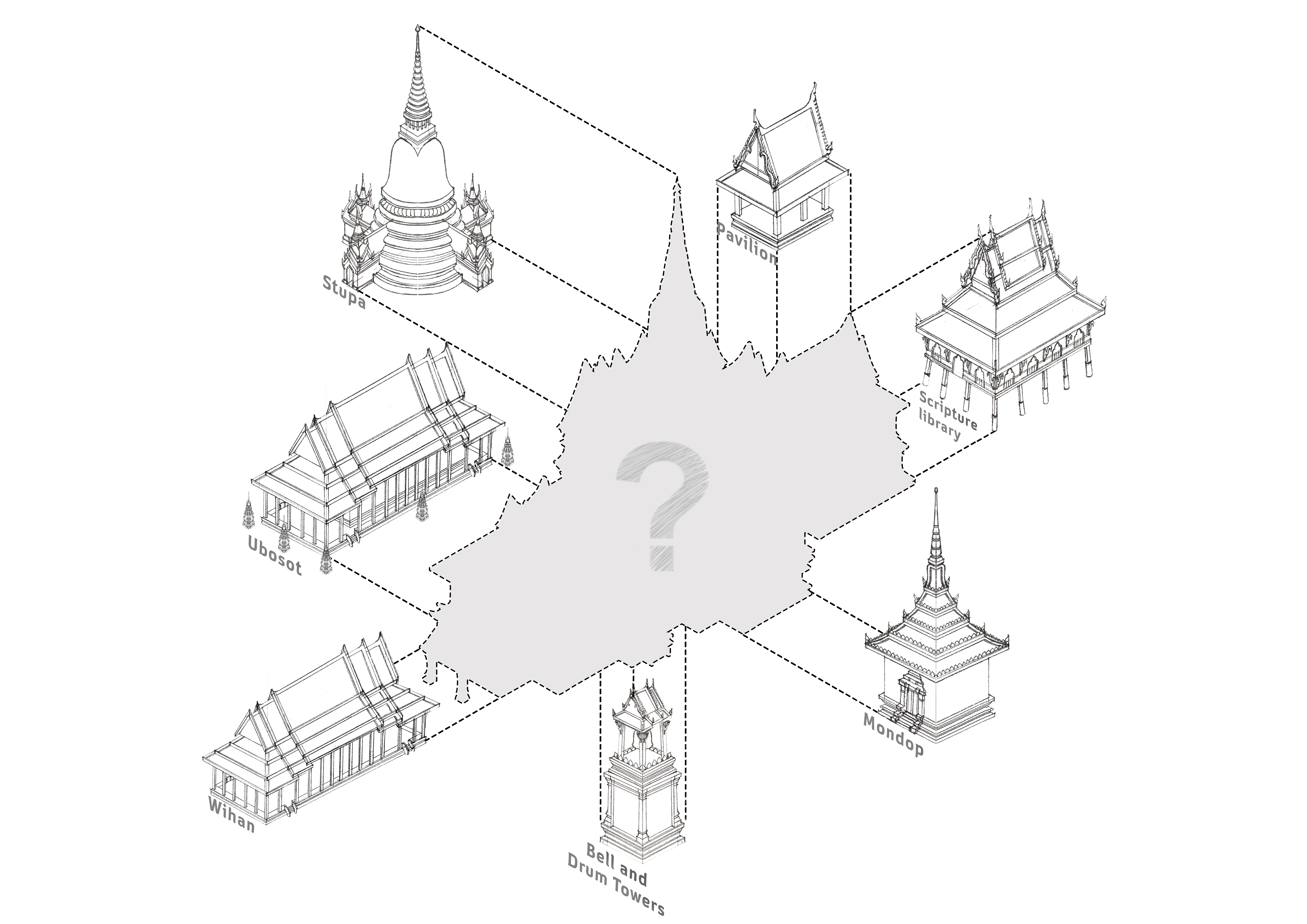
This article examines the integration of buildings within the Buddhavasa (sacred precinct) of Buddhist temples during the Rattanakosin period, from the reign of King Chulalongkorn (Rama V) to the present (1877–2024). The research employs historical document review and field surveys as its primary methodologies. The findings indicate that, prior to the reign of King Rama V, buildings within the Buddhavasa were designed as independent architectural entities with distinct functions, such as the ordination hall (ubosot), assembly hall (wihan), and stupa (chedi). However, the analysis identified twenty-five buildings constructed during the study period in which different architectural forms and functions were integrated into a single structure, departing from the conventional layout traditionally found within the Buddhavasa. The study found that between two and five building types were combined in various configurations. These integrated buildings can be categorized into four groups: 1) horizontal-axis integration, 2) vertical-axis integration, 3) combined horizontal-vertical axis integration, and 4) combined horizontal-vertical axis integration on an elevated platform. The connections were achieved through transitional spaces or circulation areas, such as circumambulatory terraces, as well as through architectural elements including subsidiary roof projections, direct building-to-building connections, or sequential arrangements reflecting hierarchical importance. Six case studies were selected based on their clear architectural transformations and well-documented historical backgrounds: the ordination halls of Wat Niwet Thammaprawat, Wat Atsadang Nimit, Wat Samphanthawongsaram, Wat Sothon Wararam Worawihan, Wat Thang Sai, and Wat Pa Thammakhiri.
The evolution of building integration within the Buddhavasa can be divided into two phases. The first phase occurred during the reign of King Rama V, when architectural forms began to diverge from traditional conventions under the influence of Western architecture, resulting in the integration of only two building types. During the reigns of King Rama VI to King Rama VIII, no significant examples of integrated buildings were identified, as temple development focused primarily on restoring and conserving existing religious structures. The second phase emerged during the reigns of King Rama IX and King Rama X, when the functional and spatial organization of the Buddhavasa underwent substantial transformation. Buildings increasingly incorporated more than two architectural types, while multipurpose spaces became widely integrated into the sacred precinct. These developments resulted from external factors, including social and economic influences, alongside the adoption of foreign artistic and technological knowledge. Internal factors also played a role, such as site constraints, visual considerations, and the intentions of patrons and designers. Building integration within the Buddhavasa can therefore be understood as an adaptive response to the changing needs and contexts of modern society. It reflects an architectural approach that seeks to reconcile traditional Thai architectural aesthetics with contemporary functional requirements, resulting in greater flexibility in the use of sacred spaces and a broader range of spatial experiences and perceptions.
Downloads
Article Details

This work is licensed under a Creative Commons Attribution-NonCommercial-NoDerivatives 4.0 International License.
References
Artitaya Sripraiphan. “ʻUbōsot kap kān kō̜̜ sāng pen ʻākhān lāi chan nai sangkhom Thai [Ubosoth: The Multi Tired Building in Thai Society].” Master’s Thesis, Silpakorn University, 2009.
Chatri Prakitnonthakan. Kamnoē̄ t wichāchīp sathāpanik Thai: kham sap læ kānsāng tūa ton nai sangkhom samai mai (nưng) [The Emergence of the Thai Architectural Profession: Terminology and Identity Formation in Modern Society, Part I]. Accessed August 28, 2025. Available from https://www.matichon.co.th/weekly/column/article_583980
Choti Kalyanamitra. Photčhanānukrom sathāpattayakam læ sinlapa kīeo nư̄̄ ang [Dictionary of Architecture and Related Arts]. Bangkok: Muang Boran, 2005.
Choti Kalyanamitra. Sathāpattayakam bǣp Thai doē̄ m [Traditional Thai Architecture]. 2nd ed. Bangkok: The Association of Siamese Architects under Royal Patronage, 1996.
Čhotmāihēt phrarātchawang Bāng Pa ʻIn læ wat Niwēt Thammaprawat [Archives of Bang Pa-In Royal Palace and Wat Niwet Tammaprawat]. Bangkok: Amarin Printing and Publishing, 1994.
Department of Architecture, Chulalongkorn University. Sư̄̄ p sān sathāpattayakam Thai hā [Continuing Thai Architecture, Volume 5]. Bangkok: Department of Architecture, Chulalongkorn University, 2005.
Department of Cultural Promotion. Kao sathāpat sin phra Phūmin ʻakkhara sinlapin Sayām [9 Architecture and the Supreme Artist of Siam]. Bangkok: Department of Cultural Promotion, 2012.
Naengnoi Saksri and Watanyu Thephatthi. Chāng lūang: phon ngān sathāpattayakam Thai khō̜̜ng mō̜̜mrātchawong Mitrarun Kasemsri [Royal Craftsmen: Thai Architectural Works of Mom Rajawongse Mitrarun Kasemsri]. Bangkok: The Association of Siamese Architects UnderRoyal Patronage, 1996.
Napat Kwanmuang. “Ubōsot Čhēdī: phutthasinlapa sathā pattayakam rūpbǣp mai samai phra bāt somdet phra Čhunlačhō̜̜mklao čhao yū hūa [The Pagoda-hall: A New Form of Buddhist Architecture in the Reign of King Rama V].” Journal of Thai Studies 9, 2 (August 2013-January 2014): 41-71.
Netnapis Nakavachara, Piyanart Bunnag, and Julthusana Byachranonda. Wat nai Krung Thēp: kān plīanplǣng nai rō̜̜p sō̜̜ngrō̜̜i pī (Phō̜̜.Sō̜̜.sō̜̜ngphansāmrō̜̜iyīsiphā thưng sō̜̜ngphanhārō̜̜iyīsiphā) [Temples in Bangkok: Changes over 200 Years (1782–1982)]. Bangkok: Chulalongkorn University, 1982.
Office of Contemporary Art and Culture, Ministry of Culture. Sư̄̄p sān sin nai phǣndin Phra Song Tham [Preserving Artistic Heritage in the Land of the Righteous King]. Nakhon Pathom: Rungsilp Printing 1977 Company Limited, 2017.
Pratima Nimsamer. “Phutthasin sathāpanik [Buddhist Art Architect].” In Sūčhibat nithatsakān sathāpattayakam Thai chaloē̄ m phra kīat [Exhibition Catalog of the Royal Commemorative Exhibition of Thai Architecture]. Bangkok: Amarin Printing and Publishing, 2005.
Phra Khru Chaiyaphatthanathorn. “Phatthanākān khō̜̜ ng wat nai sangkhom Thai [Development of Temples in Thai Society].” Journal of Nakhonratchasima College (Humanities and Social Sciences) 15, 1 (January–April 2021): 319-333.
Prawat wat Samphanthawongsaram khēt Samphanthawong Krung Thēp Mahā Nakhō̜̜n [History of Samphantha wongsaram Temple, Samphanthawong District, Bangkok]. Bangkok: Amarin Printing and Publishing, 2018.
Pussadee Tiptus. Chāng Farang nai krung Sayām [Western Craftsmen in Siam]. Bangkok: Chulalongkorn University Press, 1998.
Pymporn Chaiyaporn. “Phatthanākān nǣokhit læ rūpbǣp sathāpattayakam læ ʻongprakō̜̜p nai khēt Phutthāwāt: kō̜̜ranī sưksā phon ngān ʻō̜̜k bǣp khō̜̜ng sathāpanik yuk bukboē̄ k (Phō̜̜.Sō̜̜. sō̜̜ngphanhārō̜̜ikao thưng sō̜̜ngphan hārō̜̜ihāsipsām) [The Development of Concept and Style of Architecture and Related Elements in Buddhavas Area: The Case Studies Designed by Pioneer Architects (1966 A.D. – 2010 A.D.)].” Ph.D. Dissertation, Chulalongkorn University, 2018.
Santana Piromkeat. “Kān wāng phang bō̜̜riwēn phutthasathān samai Sukhōthai bō̜̜riwēn mư̄̄ang kao Sukhōthai [The Lay-out of the Buddish Architecture in the Sukhothai Period at the Old Sukhothai City].” Master’s Thesis, Silpakorn University, 2002.
Somkid Jiratatsanakul. Wat: phutthasātsana sathāpattayakam Thai [Temples: Thai Buddhist Architecture]. Bangkok: Thammasat University Press, 2001.
Thada Sutthitham and Wiroj Srisuro. Sathāpattayakam wat phuttha sātsanā nai prathēt Thai: wat phāk nư̄̄ a læ phāk klāng [Buddhist Temple Architecture in Thailand: Temples of the Northern and Central Regions]. Bangkok: Princess Maha Chakri Sirindhorn Anthropology Centre, 2002.
Wanida Puengsunthorn. Phutthasinlapa sathāpattayakam Thai: rabīap withīkān ʻō̜̜k bǣp sathāpattayakam Thai praphēnī nai patčhuban [The Art of Designing Contemporary Thai Buddhist Style Architecture]. Bangkok: Chalermprakiat Institute of Thai Art and Architecture, Silpakorn University, 2021.
