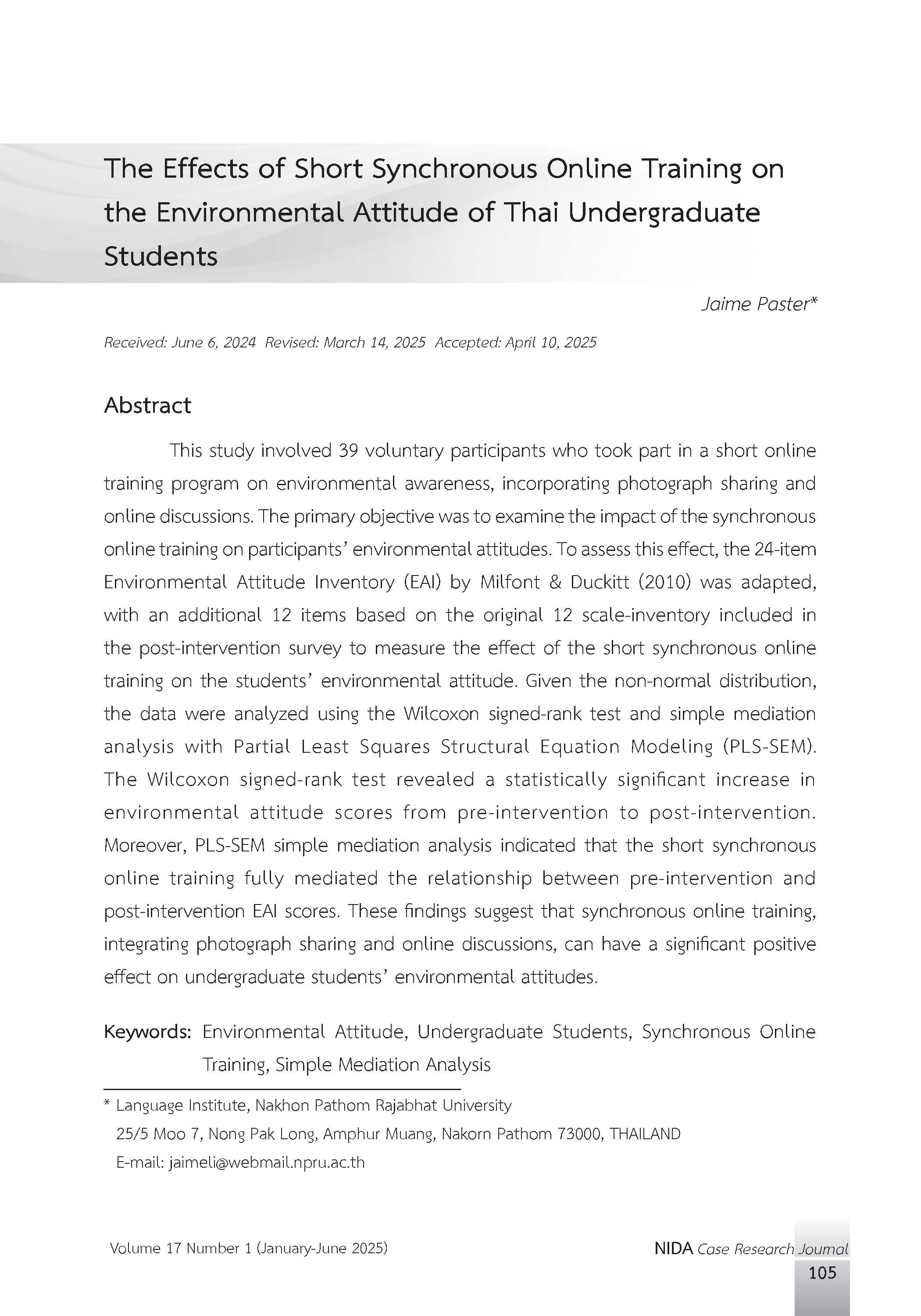
The Effects of Short Synchronous Online Training onthe Environmental Attitude of Thai Undergraduate Students
DOI:
https://doi.org/10.14456/ncrj.2025.4Keywords:
Environmental Attitude, Undergraduate Students, Synchronous Online Training, Simple Mediation AnalysisAbstract
This study involved 39 voluntary participants who took part in a short online training program on environmental awareness, incorporating photograph sharing and online discussions. The primary objective was to examine the impact of the synchronous online training on participants’ environmental attitudes. To assess this effect, the 24-item Environmental Attitude Inventory (EAI) by Milfont & Duckitt (2010) was adapted, with an additional 12 items based on the original 12 scale-inventory included in the post-intervention survey to measure the effect of the short synchronous online training on the students’ environmental attitude. Given the non-normal distribution, the data were analyzed using the Wilcoxon signed-rank test and simple mediationanalysis with Partial Least Squares Structural Equation Modeling (PLS-SEM). The Wilcoxon signed-rank test revealed a statistically significant increase inenvironmental attitude scores from pre-intervention to post-intervention.Moreover, PLS-SEM simple mediation analysis indicated that the short synchronousonline training fully mediated the relationship between pre-intervention and post-intervention EAI scores. These findings suggest that synchronous online training, integrating photograph sharing and online discussions, can have a significant positive effect on undergraduate students’ environmental attitudes.
References
Ajdukovic, I., Gilibert, D., & Fointiat. V. (2019). Structural confirmation of the 24-item environmental attitude inventory/Confirmation of structural confirmation of Inventario de Actitudes Ambientales of 24 items, Psyecology. https://doi.org/10. 1080/21711976.2019.1586140
Ali, W. (2020). Online and remote learning in higher education institutes: A necessity in light of COVID-19 pandemic. Higher Education Studies, 10(3), 16. https://doi.org/10.5539/hes.v10n3p16
Ardoin, N. M., DiGiano, M., Bundy, J., Chang, S., Holthuis, N., & O'Connor, K. (2013). Using digital photography and journaling in evaluation of field-based environmental education programs. Studies in Educational Evaluation, 41, 68-76. https://doi.org/10.1016/j.stueduc.2013.09.009
Cheung, G. W. & Lau, R. S. (2008). Testing mediation and suppression effects of latent variables: Bootstrapping with structural equation models. Organizational Research Methods. 11(2), pp. 296-325. https://doi.org/10.1177/1094428107300343
Chin, W. W., Marcolin, B. L., & Newsted, P. R. (2003). A partial least squares latent variable modeling approach for measuring interaction effects: Results from a Monte Carlo simulation study and an electronic-mail emotion/adoption study. Information Systems Research, 14(2), 189-217. https://pubsonline.informs.org/doi/10.1287/isre.14.2.189.16018
Cottrell, S. P. (2003). Influence of sociodemographics and environmental attitudes on general responsible environmental behavior among recreational boaters. Environment and Behavior, 35, 347-375. https://doi.org/10.1177/0013916503035003003
Dhawan, S. (2020). Online learning: a panacea in the time of COVID-19 crisis. Journal of Educational Technology Systems, 49(1), 5-22. https://doi.org/10.1177/0047239520934018
De Koff, J. P. (2020). Utilizing teaching technologies for higher education in a post COVID-19 environment. Natural Sciences Education, 50(1). https://doi.org/10.1002/nse2.20032
Dunlap, R. E., & Jones, R. E. (2002). Environmental concern: conceptual and measurement issues. In R. E. Dunlap, & W. Michelson (Eds.), Handbook of environmental sociology (pp. 482-524). Greenwood Press. http://www.kia.hu/konyvtar/tartalom/t108.htm
Fabrigar, L. R., MacDonald, T. K., & Wegener, D. T. (2005). The structure of attitudes. In D. Albarracın, B. T. Johnson, & M. P. Zanna (Eds.), The handbook of attitudes. Mahwah, NJ: Lawrence Erlbaum. https://www.routledgehandbooks.com/doi/10.4324/9781410612823.ch3
Farnsworth, B. E. (2011). Conservation photography as environmental education: focus on the pedagogues. Environmental Education Research, 17(6), 769-787. https://doi.org/10.1080/13504622.2011.618627
Hair, J. F., Hult, G. T. M., Ringle, C. M. & Sarstedt, M. (2016). A primer on partial least squares structural equation modeling (PLS-SEM). Sage.
Hair, J. F., Hult, G. T. M., Ringle, C. M., & Sarstedt, M. (2017). A primer on partial least squares structural equation modeling (PLS-SEM). (2nd Ed.). Sage.
Hair, J.F., Risher, J.J., Sarstedt, M. and Ringle, C.M. (2019). When to use and how to report the results of PLS-SEM, European Business Review, 31(1), pp. 2-24. https://doi.org/10.1108/EBR-11-2018-0203
Hair, J. F., Hult, G. T. M., Ringle, C. M., & Sarstedt, M. (2022). A Primer on partial least squares structural equation modeling (PLS-SEM) (3e). Thousand Oaks, CA: Sage.
Husna, L. & Astria, W. J. (2021). A case study of students' ability to speak in EFL classroom. Edukatif: Jurnal Ilmu Pendidikan. https://doi.org/10.31004/edukatif.v3i5.957
Jones, C. M., & Baldwin, C. (2009). Using emotion eliciting photographs to inspire awareness and attitudinal change: A user-centered case study. In Proceedings of the 21st Annual Conference of the Australian Computer-Human Interaction Special Interest Group: Design: Open 24/7 (pp. 201-207). ACM. https://doi.org/10.1145/1738826.1738859
Kaiser, F. G., Wolfing, S., & Fuhler, U. (1999). Environmental attitude and ecological behaviour. Journal of Environmental Psychology, 19, 1-19. https://doi.org/10.1006/jevp.1998.0107
Milfont, T. L. (2007). Psychology of environmental attitudes: A cross-cultural study of their content and structure. Unpublished doctoral dissertation, University of Auckland, http://www.milfont.com/publications/
Milfont, T. L., & Duckitt, J. (2010). The environmental attitudes inventory: A valid and reliable measure to assess the structure of environmental attitudes. Journal of Environmental Psychology. 30(1), 80-94. https://doi.org/10.1016/j.jenvp.2009.09.001
Morgan, H. (2022). Alleviating the challenges with remote learning during a pandemic. Education Sciences. 2022; 12(2):109. https://doi.org/10.3390/educsci12020109
Murairwa, S. (2015). Voluntary sampling design. International Journal of Advanced Research in Management and Social Sciences, 4(2), 185-200. http://www. garph.co.uk/IJARMSS/Feb2015/18.pdf
Nitzl, C., Roldán, J. L., & Cepeda-Carrión, G. (2016). Mediation analysis in partial least squares path modeling: Helping researchers discuss more sophisticated models. Industrial Management & Data Systems, 116(9), 1849-1864. https://doi.org/10.1108/IMDS-07-2015-0302
Ringle, Christian M., Wende, Sven, & Becker, Jan-Michael. (2022). SmartPLS 4. boenningstedt: SmartPLS. https://www.smartpls.com
Rigdon, E. E., Sarstedt, M., & Ringle, C. M. (2017). On comparing results from CB-SEM and PLS-SEM: Five perspectives and five recommendations. Marketing: ZFP -Journal of Research and Management, 39(3), 4-16. https://www.beck-elibrary.de/10.15358/0344-1369-2017-3-4
Ruiz-Mallen, I., Barraza, L., Bodenhorn, B., & Reyes-García, V. (2009) Evaluating the impact of an environmental education programme: An empirical study in Mexico. Environmental Education Research, 15(3), 371-387. https://doi. org/10.1080/13504620902906766
Sarstedt, M., Hair, J.F., Ringle, C.M., Thiele, K.O. & Gudergan, S.P. (2016b), Estimation issues with PLS and CBSEM: where the bias lies!, Journal of Business Research, 69(10), 3998-4010. https://doi.org/10.1016/j.jbusres.2016.06.007
Squire, K. D. (2021). From virtual to participatory learning with technology during COVID-19. Article information. E-learning & Digital Media. https://journals. sagepub.com/doi/10.1177/20427530211022926
UNESCO. (2021). Learn for our planet: a global review of how environmental issues are integrated in education. https://unesdoc.unesco.org/ark:/48223/pf0000377362
Yamagata-Lynch, L. (2014). Blending online asynchronous and synchronous learning. International Review of Research in Open and Distributed Learning, 15(2), 189-212. https://doi.org/10.19173/irrodl.v15i2.1778
Zhao, X., Lynch, J. G., & Chen, Q. (2010). Reconsidering Baron and Kenny: Myths and truths about mediation analysis. Journal of Consumer Research, 37(2), 197-206. https://doi.org/10.1086/651257
Downloads
Published
How to Cite
Issue
Section
License
Copyright (c) 2025 NIDA Case Research Journal

This work is licensed under a Creative Commons Attribution-NonCommercial-NoDerivatives 4.0 International License.