ผลของการอบรมออนไลน์ระยะสั้นแบบประสานเวลา เรื่อง ทัศนคติด้านสิ่งแวดล้อมของนักศึกษาระดับปริญญาตรี
DOI:
https://doi.org/10.14456/ncrj.2025.4คำสำคัญ:
ทัศนคติด้านสิ่งแวดล้อม, นักศึกษาระดับปริญญาตรี, การอบรมออนไลน์แบบประสานเวลา, การวิเคราะห์ตัวแบบความสัมพันธ์แทรกกลางอย่างง่ายบทคัดย่อ
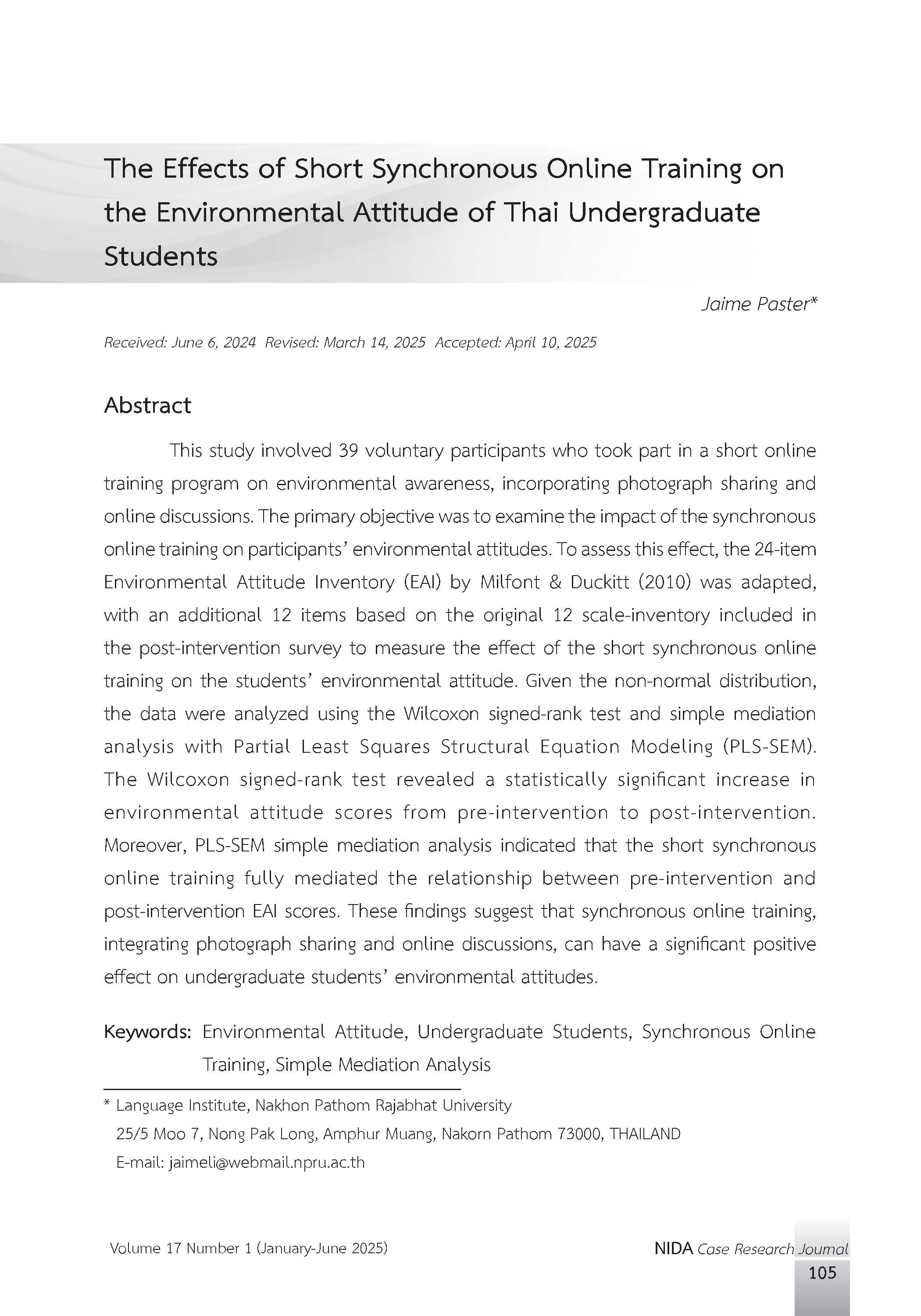
งานวิจัยนี้มีกลุ่มตัวอย่าง 39 คน ที่เข้าร่วมการอบรมออนไลน์ระยะสั้น เรื่องการตระหนักรู้ ด้านสิ่งแวดล้อม ด้วยการแบ่งปันรูปภาพและการอภิปรายออนไลน์ร่วมกัน ทั้งนี้มีวัตถุประสงค์หลัก เพื่อศึกษาผลกระทบของการอบรมออนไลน์แบบประสานเวลาที่มีต่อทัศนคติด้านสิ่งแวดล้อมของกลุ่ม ตัวอย่าง โดยใช้มาตรวัดทัศนคติด้านสิ่งแวดล้อมจำนวน 24 ข้อ ที่ดัดแปลงจากมาตรวัดของ Milfont & Duckitt (2010) ทั้งนี้เป็นการเพิ่มคำถาม 12 ข้อ ซึ่งเติมจากต้นฉบับที่มี 12 ข้อ ไว้ในแบบสำรวจ หลังการแทรกแซง เพื่อวัดผลของการอบรมออนไลน์ระยะสั้นแบบประสานเวลา เรื่องทัศนคติ ด้านสิ่งแวดล้อมของนักศึกษา ทั้งนี้เนื่องจากมีผลการแจกแจงที่ไม่เป็นปกติ จึงวิเคราะห์ข้อมูล โดยการทดสอบอันดับ ที่มีเครื่องหมายกำกับของวิลคอกซอน (Wilcoxon signed-rank test) และ การวิเคราะห์ตัวแบบความสัมพันธ์แทรงกลางอย่างง่าย ร่วมกับสมการ โครงสร้างกำลังสองน้อยที่สุด บางส่วน (Partial Least Square Structural Equation Modeling - PLS-SEM) ทั้งนี้การทดสอบ อันดับที่มีเครื่องหมายกำกับของวิลคอกซอนแสดงให้เห็นว่า คะแนนทัศนคติ ด้านสิ่งแวดล้อมก่อนและ หลังการแทรกแซงสูงขึ้นอย่างมีนัยสำคัญ นอกจากนี้ ผลจากสมการโครงสร้างกำลังสอง น้อยที่สุด บางส่วนและการวิเคราะห์ตัวแบบความสัมพันธ์แทรกกลางอย่างง่าย แสดงให้เห็นว่าการอบรมออนไลน์ ระยะสั้นแบบประสานเวลา มีอิทธิพลส่งผ่านโดยสิ้นเชิงต่อความสัมพันธ์ระหว่างคะแนนทัศนคติ ด้านสิ่งแวดล้อม ก่อนและหลังการแทรกแซง ผลการวิจัยนี้แสดงให้ทราบว่าการอบรมออนไลน์แบบ ประสานเวลา การแลกเปลี่ยน ผ่านการอภิปรายออนไลน์ ส่งผลกระทบเชิงบวกอย่างมีนัยสำคัญต่อทัศนคติ ด้านสิ่งแวดล้อมของนักศึกษา ระดับปริญญาตรี
เอกสารอ้างอิง
Ajdukovic, I., Gilibert, D., & Fointiat. V. (2019). Structural confirmation of the 24-item environmental attitude inventory/Confirmation of structural confirmation of Inventario de Actitudes Ambientales of 24 items, Psyecology. https://doi.org/10. 1080/21711976.2019.1586140
Ali, W. (2020). Online and remote learning in higher education institutes: A necessity in light of COVID-19 pandemic. Higher Education Studies, 10(3), 16. https://doi.org/10.5539/hes.v10n3p16
Ardoin, N. M., DiGiano, M., Bundy, J., Chang, S., Holthuis, N., & O'Connor, K. (2013). Using digital photography and journaling in evaluation of field-based environmental education programs. Studies in Educational Evaluation, 41, 68-76. https://doi.org/10.1016/j.stueduc.2013.09.009
Cheung, G. W. & Lau, R. S. (2008). Testing mediation and suppression effects of latent variables: Bootstrapping with structural equation models. Organizational Research Methods. 11(2), pp. 296-325. https://doi.org/10.1177/1094428107300343
Chin, W. W., Marcolin, B. L., & Newsted, P. R. (2003). A partial least squares latent variable modeling approach for measuring interaction effects: Results from a Monte Carlo simulation study and an electronic-mail emotion/adoption study. Information Systems Research, 14(2), 189-217. https://pubsonline.informs.org/doi/10.1287/isre.14.2.189.16018
Cottrell, S. P. (2003). Influence of sociodemographics and environmental attitudes on general responsible environmental behavior among recreational boaters. Environment and Behavior, 35, 347-375. https://doi.org/10.1177/0013916503035003003
Dhawan, S. (2020). Online learning: a panacea in the time of COVID-19 crisis. Journal of Educational Technology Systems, 49(1), 5-22. https://doi.org/10.1177/0047239520934018
De Koff, J. P. (2020). Utilizing teaching technologies for higher education in a post COVID-19 environment. Natural Sciences Education, 50(1). https://doi.org/10.1002/nse2.20032
Dunlap, R. E., & Jones, R. E. (2002). Environmental concern: conceptual and measurement issues. In R. E. Dunlap, & W. Michelson (Eds.), Handbook of environmental sociology (pp. 482-524). Greenwood Press. http://www.kia.hu/konyvtar/tartalom/t108.htm
Fabrigar, L. R., MacDonald, T. K., & Wegener, D. T. (2005). The structure of attitudes. In D. Albarracın, B. T. Johnson, & M. P. Zanna (Eds.), The handbook of attitudes. Mahwah, NJ: Lawrence Erlbaum. https://www.routledgehandbooks.com/doi/10.4324/9781410612823.ch3
Farnsworth, B. E. (2011). Conservation photography as environmental education: focus on the pedagogues. Environmental Education Research, 17(6), 769-787. https://doi.org/10.1080/13504622.2011.618627
Hair, J. F., Hult, G. T. M., Ringle, C. M. & Sarstedt, M. (2016). A primer on partial least squares structural equation modeling (PLS-SEM). Sage.
Hair, J. F., Hult, G. T. M., Ringle, C. M., & Sarstedt, M. (2017). A primer on partial least squares structural equation modeling (PLS-SEM). (2nd Ed.). Sage.
Hair, J.F., Risher, J.J., Sarstedt, M. and Ringle, C.M. (2019). When to use and how to report the results of PLS-SEM, European Business Review, 31(1), pp. 2-24. https://doi.org/10.1108/EBR-11-2018-0203
Hair, J. F., Hult, G. T. M., Ringle, C. M., & Sarstedt, M. (2022). A Primer on partial least squares structural equation modeling (PLS-SEM) (3e). Thousand Oaks, CA: Sage.
Husna, L. & Astria, W. J. (2021). A case study of students' ability to speak in EFL classroom. Edukatif: Jurnal Ilmu Pendidikan. https://doi.org/10.31004/edukatif.v3i5.957
Jones, C. M., & Baldwin, C. (2009). Using emotion eliciting photographs to inspire awareness and attitudinal change: A user-centered case study. In Proceedings of the 21st Annual Conference of the Australian Computer-Human Interaction Special Interest Group: Design: Open 24/7 (pp. 201-207). ACM. https://doi.org/10.1145/1738826.1738859
Kaiser, F. G., Wolfing, S., & Fuhler, U. (1999). Environmental attitude and ecological behaviour. Journal of Environmental Psychology, 19, 1-19. https://doi.org/10.1006/jevp.1998.0107
Milfont, T. L. (2007). Psychology of environmental attitudes: A cross-cultural study of their content and structure. Unpublished doctoral dissertation, University of Auckland, http://www.milfont.com/publications/
Milfont, T. L., & Duckitt, J. (2010). The environmental attitudes inventory: A valid and reliable measure to assess the structure of environmental attitudes. Journal of Environmental Psychology. 30(1), 80-94. https://doi.org/10.1016/j.jenvp.2009.09.001
Morgan, H. (2022). Alleviating the challenges with remote learning during a pandemic. Education Sciences. 2022; 12(2):109. https://doi.org/10.3390/educsci12020109
Murairwa, S. (2015). Voluntary sampling design. International Journal of Advanced Research in Management and Social Sciences, 4(2), 185-200. http://www. garph.co.uk/IJARMSS/Feb2015/18.pdf
Nitzl, C., Roldán, J. L., & Cepeda-Carrión, G. (2016). Mediation analysis in partial least squares path modeling: Helping researchers discuss more sophisticated models. Industrial Management & Data Systems, 116(9), 1849-1864. https://doi.org/10.1108/IMDS-07-2015-0302
Ringle, Christian M., Wende, Sven, & Becker, Jan-Michael. (2022). SmartPLS 4. boenningstedt: SmartPLS. https://www.smartpls.com
Rigdon, E. E., Sarstedt, M., & Ringle, C. M. (2017). On comparing results from CB-SEM and PLS-SEM: Five perspectives and five recommendations. Marketing: ZFP -Journal of Research and Management, 39(3), 4-16. https://www.beck-elibrary.de/10.15358/0344-1369-2017-3-4
Ruiz-Mallen, I., Barraza, L., Bodenhorn, B., & Reyes-García, V. (2009) Evaluating the impact of an environmental education programme: An empirical study in Mexico. Environmental Education Research, 15(3), 371-387. https://doi. org/10.1080/13504620902906766
Sarstedt, M., Hair, J.F., Ringle, C.M., Thiele, K.O. & Gudergan, S.P. (2016b), Estimation issues with PLS and CBSEM: where the bias lies!, Journal of Business Research, 69(10), 3998-4010. https://doi.org/10.1016/j.jbusres.2016.06.007
Squire, K. D. (2021). From virtual to participatory learning with technology during COVID-19. Article information. E-learning & Digital Media. https://journals. sagepub.com/doi/10.1177/20427530211022926
UNESCO. (2021). Learn for our planet: a global review of how environmental issues are integrated in education. https://unesdoc.unesco.org/ark:/48223/pf0000377362
Yamagata-Lynch, L. (2014). Blending online asynchronous and synchronous learning. International Review of Research in Open and Distributed Learning, 15(2), 189-212. https://doi.org/10.19173/irrodl.v15i2.1778
Zhao, X., Lynch, J. G., & Chen, Q. (2010). Reconsidering Baron and Kenny: Myths and truths about mediation analysis. Journal of Consumer Research, 37(2), 197-206. https://doi.org/10.1086/651257
ดาวน์โหลด
เผยแพร่แล้ว
รูปแบบการอ้างอิง
ฉบับ
ประเภทบทความ
สัญญาอนุญาต
ลิขสิทธิ์ (c) 2025 NIDA Case Research Journal

อนุญาตภายใต้เงื่อนไข Creative Commons Attribution-NonCommercial-NoDerivatives 4.0 International License.