
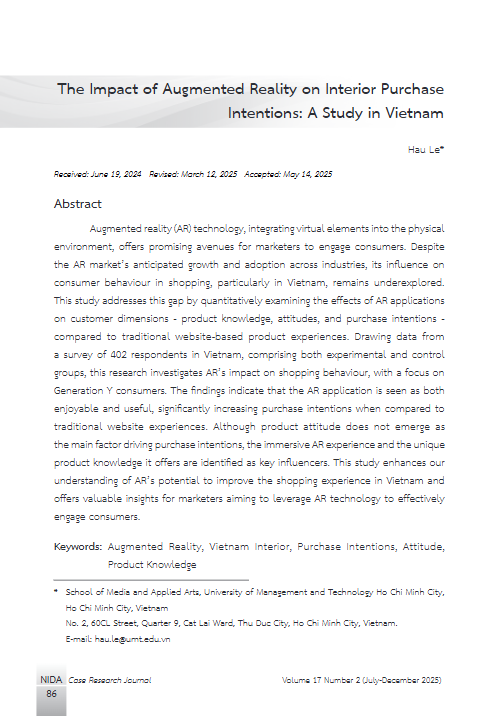
The Impact of Augmented Reality on Interior Purchase Intentions: A Study in Vietnam
DOI:
https://doi.org/10.14456/ncrj.2025.8Keywords:
Augmented Reality, Vietnam Interior, Purchase Intentions, Attitude, Product KnowledgeAbstract
Augmented reality (AR) technology, integrating virtual elements into the physical environment, offers promising avenues for marketers to engage consumers. Despit the AR market’s anticipated growth and adoption across industries, its influence on consumer behaviour in shopping, particularly in Vietnam, remains underexplored. This study addresses this gap by quantitatively examining the effects of AR applications on customer dimensions - product knowledge, attitudes, and purchase intentions-compared to traditional website-based product experiences. Drawing data from a survey of 402 respondents in Vietnam, comprising both experimental and control groups, this research investigates AR’s impact on shopping behaviour, with a focus on Generation Y consumers. The findings indicate that the AR application is seen as both enjoyable and useful, significantly increasing purchase intentions when compared to traditional website experiences. Although product attitude does not emerge as the main factor driving purchase intentions, the immersive AR experience and the unique product knowledge it offers are identified as key influencers. This study enhances our understanding of AR’s potential to improve the shopping experience in Vietnam and offers valuable insights for marketers aiming to leverage AR technology to effectively engage consumers.
References
Ajzen, I. (1991). The theory of planned behavior. Organizational Behavior and Human Decision Processes, 50(2), 179–211. https://doi.org/10.1016/0749-5978(91)90020-T
Aslam, S. (2024, Juanuary 10). Snapchat by the Numbers: Stats, Demographics & Fun Facts. https://www.omnicoreagency.com/snapchat-statistics/
Baron, R. M., & Kenny, D. A. (1986). The moderator–mediator variable distinction in social psychological research: Conceptual, strategic, and statistical considerations. Journal of Personality and Social Psychology, 51(6), 1173–1182. https://doi.org/10.1037/0022-3514.51.6.1173
Bell, E., Harley, B., & Bryman, A. (2022). Business research methods. Oxford university press.
Bilgili Sülük, S., & Aydin, K. (2019). Marketing Communications and Experiential Marketing in the Context of Augmented Reality Contemporary issues in behavioral finance (pp. 153–162). Emerald Publishinch. https://doi.org/10.1108/S1569-375920190000101010
Birks, D. F., & Malhotra, N. K. (2006). Marketing Research: An applied approach. Pearson Education UK.
Bower, M., Howe, C., McCredie, N., Robinson, A., & Grover, D. (2014). Augmented Reality in education – cases, places and potentials. Educational Media International, 51(1), 1–15. https://doi.org/10.1080/09523987.2014.889400
Carmigniani, J., Furht, B., Anisetti, M., Ceravolo, P., Damiani, E., & Ivkovic, M. (2011). Augmented reality technologies, systems and applications. Multimedia Tools and Applications, 51(1), 341–377. https://doi.org/10.1007/s11042-010-0660-6
Chiu, C., Wang, E. T. G., Fang, Y., & Huang, H. (2014). Understanding customers’repeat purchase intentions in B2C e-commerce: the roles of utilitarian value, hedonic value and perceived risk. Information Systems Journal, 24(1), 85–114. https://doi.org/10.1111/j.1365-2575.2012.00407.x
Cohen, J. (2013a). Statistical power analysis for the behavioral sciences. routledge.
Cohen, J. (2013b). Statistical power analysis for the behavioral sciences. routledge.
Constine, J. (2017). Facebook launches augmented reality Camera Effects developer platform. Techcruch https://techcrunch.com/2017/04/18/facebook-cameraeffects-platform/
Davis, F. D. (1989). Perceived Usefulness, Perceived Ease of Use, and User Acceptance of Information Technology. MIS Quarterly, 13(3), 319. https://doi.org/10.2307/249008
Deater-Deckard, K., Chang, M., & Evans, M. E. (2013). Engagement states and learning from educational games. New Directions for Child and Adolescent Development, 2013(139), 21–30. https://doi.org/10.1002/cad.20028
Dennis, C., Morgan, A., Wright, L. T., & Jayawardhena, C. (2010). The influences of social e-shopping in enhancing young women’s online shopping behaviour. Journal of Customer Behaviour, 9(2), 151–174. https://doi.org/10.1362/147539210X511353
Do, H.-N., Shih, W., & Ha, Q.-A. (2020). Effects of mobile augmented reality apps on impulse buying behavior: An investigation in the tourism field. Heliyon, 6(8), e04667. https://doi.org/10.1016/j.heliyon.2020.e04667
Etikan, I. (2016). Comparison of Convenience Sampling and Purposive Sampling. American Journal of Theoretical and Applied Statistics, 5(1), 1. https://doi.org/10.11648/j.ajtas.20160501.11
Fadhilah, I., & Aruan, D. T. H. (2023). Understanding consumer adoption and actual usage of digital payment instruments: Comparison between Generation Y and Generation Z. International Journal of Electronic Marketing and Retailing, 14(1), 39. https://doi.org/10.1504/IJEMR.2023.127272
Fedko, D. (2023). Top 16 examples of augmented reality ads. https://wear-studio.com/top-examples-of-augmented-reality-ads/
Fink, A. (2024). How to conduct surveys: A step-by-step guide. SAGE Publications.
Fiore, A. M., Kim, J., & Lee, H.-H. (2005). Effect of image interactivity technology on consumer responses toward the online retailer. Journal of Interactive Marketing, 19(3), 38–53. https://doi.org/10.1002/dir.20042
Hopp, T., & Gangadharbatla, H. (2016). Novelty Effects in Augmented Reality Advertising Environments: The Influence of Exposure Time and Self-Efficacy. Journal of Current Issues & Research in Advertising, 37(2), 113–130. https://doi.org/10.1080/10641734.2016.1171179
Huang, L., Clarke, A., Heldsinger, N., & Tian, W. (2019). The communication role of social media in social marketing: A study of the community sustainability knowledge dissemination on LinkedIn and Twitter. Journal of Marketing Analytics, 7(2), 64–75. https://doi.org/10.1057/s41270-019-00053-8
Huang, T.-L., & Liao, S. (2015). A model of acceptance of augmented-reality interactive technology: The moderating role of cognitive innovativeness. Electronic Commerce Research, 15(2), 269–295. https://doi.org/10.1007/s10660-014-9163-2
Jager, J., Putnick, D. L., & Bornstein, M. H. (2017). II. More Than Just Convenient: The Scientific Merits of Homogeneous Convenience Samples. Monographs of the Society for Research in Child Development, 82(2), 13–30. https://doi.org/10.1111/mono.12296
Jamil, M. (2019). Augmented Reality for Historic Storytelling and Preserving Artifacts in Pakistan. IJASOS- International E-Journal of Advances in Social Sciences, 998–1004. https://doi.org/10.18769/ijasos.592732
Javornik, A. (2014). [Poster] classifications of augmented reality uses in marketing. 2014 IEEE International Symposium on Mixed and Augmented Reality - Media, Art, Social Science, Humanities and Design (IMSAR-MASH’D), 67–68. https://doi.org/10.1109/ISMAR-AMH.2014.6935441
Javornik, A. (2016). Augmented reality: Research agenda for studying the impact of its media characteristics on consumer behaviour. Journal of Retailing and Consumer Services, 30, 252–261. https://doi.org/10.1016/j.jretconser.2016.02.004
Javornik, A., Rogers, Y., Gander, D., & Moutinho, A. (2017). MagicFace. Proceedings of the 2017 CHI Conference on Human Factors in Computing Systems, 4838–4849. https://doi.org/10.1145/3025453.3025722
Jung, T., Chung, N., & Leue, M. C. (2015). The determinants of recommendations to use augmented reality technologies: The case of a Korean theme park. Tourism Management, 49, 75–86. https://doi.org/10.1016/j.tourman.2015.02.013
Kalantari, M., & Rauschnabel, P. (2018). Exploring the Early Adopters of Augmented Reality Smart Glasses: The Case of Microsoft HoloLens. In Aeg mented and virtual Reality (pp. 229–245). https://doi.org/10.1007/978-3-319-64027-3_16
Kim, J., & Forsythe, S. (2010). Factors affecting adoption of product virtualization technology for online consumer electronics shopping. International Journal of Retail & Distribution Management, 38(3), 190–204. https://doi.org/10.1108/09590551011027122
Kogan, L., Hellyer, P., Duncan, C., & Schoenfeld-Tacher, R. (2017). A pilot investigation of the physical and psychological benefits of playing Pokémon GO for dog owners. Computers in Human Behavior, 76, 431–437. https://doi.org/10.1016/j.chb.2017.07.043
Li, H., Daugherty, T., & Biocca, F. (2002). Impact of 3-D Advertising on Product Knowledge, Brand Attitude, and Purchase Intention: The Mediating Role of Presence. Journal of Advertising, 31(3), 43–57. https://doi.org/10.1080/00913367.2002.10673675
Liao, T. (2015). Augmented or admented reality? The influence of marketing on augmented reality technologies. Information, Communication & Society, 18(3), 310–326. https://doi.org/10.1080/1369118X.2014.989252
Liou, H.-H., Yang, S. J. H., Chen, S. Y., & Tarng, W. (2017). The influences of the 2D image-based augmented reality and virtual reality on student learning. Journal of Educational Technology & Society, 20(3), 110–121.
Lu, Y., & Smith, S. (2007). Augmented reality r-commerce assistant system: Trying while shopping. In J. A. Jacko (Ed.), Human-computer interaction. Interaction platforms and techniques (pp. 643–652). Springer Berlin Heidelberg. https://doi.org/10.1007/978-3-540-73107-8_72
M. Kang, J.-Y. (2014). Augmented reality and motion capture apparel e-shopping values and usage intention. International Journal of Clothing Science and Technology, 26(6), 486–499. https://doi.org/10.1108/IJCST-05-2013-0055
Mallinson, H. (2017). “New year, new resolutions”: Provocative anti-smoking billboard advert “coughs” whenever it senses cigarette smoke. https://www.dailymail.co.uk/news/article-4102944/New-year-new-resolutions-Provocative-antismoking-billboard-advert-coughs-senses-cigarette-smoke.html
Marr, B. (2021). 10 Best Examples Of Augmented And Virtual Reality In Retail. https://www.forbes.com/sites/bernardmarr/2021/09/13/10-best-examples-ofaugmented-and-virtual-reality-in-retail/
Martínez, H., Skournetou, D., Hyppölä, J., Laukkanen, S., & Heikkilä, A. (2014). Drivers and Bottlenecks in the Adoption of Augmented Reality Applications. Journal of Multimedia Theory and Applications. https://doi.org/10.11159/jmta.2014.004
McDowell, W. C., Wilson, R. C., & Kile, C. O. (2016). An examination of retail website design and conversion rate. Journal of Business Research, 69(11), 4837–4842. https://doi.org/10.1016/j.jbusres.2016.04.040
Michaelidou, N., & Dibb, S. (2006). Product involvement: An application in clothing. Journal of Consumer Behaviour, 5(5), 442–453. https://doi.org/10.1002/cb.192
Mollen, A., & Wilson, H. (2010). Engagement, telepresence and interactivity in online consumer experience: Reconciling scholastic and managerial perspectives. Journal of Business Research, 63(9–10), 919–925. https://doi.org/10.1016/j.jbusres.2009.05.014
Nunnally, J. C., & Bernstein, I. (1978). Psychometric theory.
Olsson, T., & Salo, M. (2011). Online user survey on current mobile augmented reality applications. 2011 10th IEEE International Symposium on Mixed and Augmented Reality, 75–84. https://doi.org/10.1109/ISMAR.2011.6092372
Owyang, J. (2010). Disruptive technology–The new reality will be augmented. Customer Relationship Management Magazine, 23(2), 32–33.
Palinkas, L. A., Horwitz, S. M., Green, C. A., Wisdom, J. P., Duan, N., & Hoagwood, K. (2015). Purposeful Sampling for Qualitative Data Collection and Analysis in Mixed Method Implementation Research. Administration and Policy in Mental Health and Mental Health Services Research, 42(5), 533–544. https://doi.org/10.1007/s10488-013-0528-y
Pallant, J. (2020). SPSS survival manual: A step by step guide to data analysis using IBM SPSS. Routledge.
Papagiannidis, S., See-To, E., & Bourlakis, M. (2014). Virtual test-driving: The impact of simulated products on purchase intention. Journal of Retailing and Consumer Services, 21(5), 877–887. https://doi.org/10.1016/j.jretconser.2014.02.010
Reidsma, D., Haruhiro, K., & Nijholt, A. (2013). Advances in computer entertainment: 10th International Conference, ACE 2013, Boekelo, The Netherlands, November 12-15, 2013. Proceedings (Vol. 8253). Springer.
Rowinski, D. (2012). Who Are The Savviest Mobile Users? Generation Y. Readwrite. https://readwrite.com/who-are-the-savviest-mobile-users-generation-y/
Saleem, T., Talpur, Q., Ishaq, M. I., Raza, A., & Junaid, M. (2024). Exploring the effect of telepresence and escapism on consumer post-purchase intention in an immersive virtual reality environment. Journal of Retailing and Consumer Services, 81, 104014. https://doi.org/10.1016/j.jretconser.2024.104014
Saunders, M., Lewis, P., & Thornhill, A. (2003). Research methods for business students. Prentice Hall: Financial Times.
Scholz, J., & Smith, A. N. (2016). Augmented reality: Designing immersive experiences that maximize consumer engagement. Business Horizons, 59(2), 149–161. https://doi.org/10.1016/j.bushor.2015.10.003
Schwartz, A. M. (2011). Augmenting purchase intent: An empirical study on the effects of utilizing augmented reality in online shopping. University of California, Riverside.
Seitz, P. (2016). “Pokemon Go” Fires Starting Gun For Augmented Reality. Invester.com https://www.investors.com/news/technology/pokemon-go-fires-starting-gunfor-augmented-reality/
Sihi, D. (2018). Home sweet virtual home. Journal of Research in Interactive Marketing, 12(4), 398–417. https://doi.org/10.1108/JRIM-01-2018-0019
Smith, R. E., & Swinyard, W. R. (1983). Attitude-behavior consistency: The impact of product trial versus advertising. Journal of Marketing Research, 20(3), 257–267. https://doi.org/10.1177/002224378302000304
Statt, N. (2014). Wearables with augmented reality are mind-blowing -- and an ethical nightmare. CNET. https://www.cnet.com/culture/wearables-withaugmented-reality-are-mind-blowing-and-an-ethical-nightmare/
Stratten, S., & Kramer, A. (2013). QR codes kill kittens: How to alienate customers, dishearten employees, and drive your business into the ground. John Wiley & Sons.
Suh, K.-S., & Chang, S. (2006). User interfaces and consumer perceptions of online stores: The role of telepresence. Behaviour & Information Technology, 25(2), 99–113. https://doi.org/10.1080/01449290500330398
Sun, C., Fang, Y., Kong, M., Chen, X., & Liu, Y. (2022). Influence of augmented reality product display on consumers’ product attitudes: A product uncertainty reduction perspective. Journal of Retailing and Consumer Services, 64, 102828. https://doi.org/10.1016/j.jretconser.2021.102828
Sung, J., & Cho, K. (2012). User Experiences with Augmented Reality Advertising Applications: Focusing on Perceived Values and Telepresence Based on the Experiential Learning Theory (pp. 9–15). https://doi.org/10.1007/978-94-007-5086-9_2
Tan, Y.-C., Chandukala, S. R., & Reddy, S. K. (2022). Augmented reality in retail and lts impact on sales. Journal of Marketing, 86(1), 48–66. https://doi.org/10.1177/0022242921995449
van Krevelen, D. W. F., & Poelman, R. (2010). A Survey of Augmented Reality Technologies, Applications and Limitations. The International Journal of Virtual Reality, 9(2), 1–20.
Venkatesh, V., Morris., MG., Davis, G.B., & Davis. F.D. (2003). User acceptance of information technology: toward a unified view. MIS Quarterly, 27(3), 425. https://doi.org/10.2307/30036540
Vogels, E. A. (2019). Millennials stand out for their technology use, but older generations also embrace digital life. Pew Research Center. https://www.pewresearch.org/short-reads/2019/09/09/us-generations-technology-use/
Vonkeman, C., Verhagen, T., & van Dolen, W. (2017). Role of local presence in online impulse buying. Information & Management, 54(8), 1038–1048. https://doi.org/10.1016/j.im.2017.02.008
Whang, J. Bin, Song, J. H., Choi, B., & Lee, J.-H. (2021). The effect of augmented reality on purchase intention of beauty products: The roles of consumers’ control. Journal of Business Research, 133, 275–284. https://doi.org/10.1016/j.jbusres.2021.04.057
Xu, X., Jia, Q., & Tayyab, S. M. U. (2023). The exploration of customization in augmented reality from the affordance lens: A three-stage hybrid approach. Technological Forecasting and Social Change, 194, 122729. https://doi.org/10.1016/j.techfore.2023.122729
Yaoyuneyong, G., Foster, J., Johnson, E., & Johnson, D. (2016). Augmented reality marketing: Consumer preferences and attitudes toward hypermedia print ads. Journal of Interactive Advertising, 16(1), 16–30. https://doi.org/10.1080/15252019.2015.1125316
Downloads
Published
How to Cite
Issue
Section
License
Copyright (c) 2025 NIDA Case Research Journal

This work is licensed under a Creative Commons Attribution-NonCommercial-NoDerivatives 4.0 International License.