
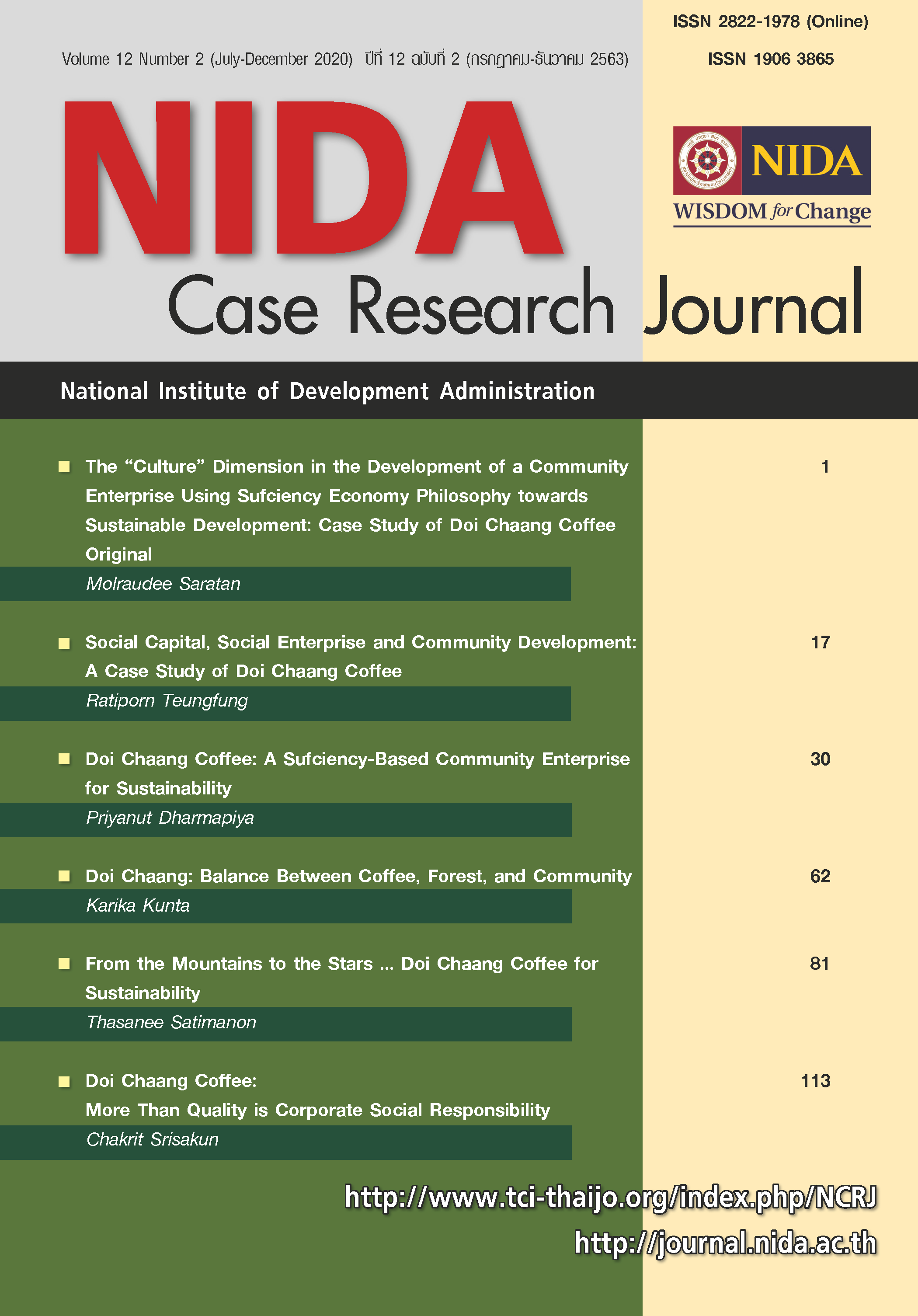
ดอยช้าง: ความสมดุลของกาแฟ ป่า และชุมชน
คำสำคัญ:
การท่องเที่ยวเชิงนิเวศ, เกษตรอินทรีย์, ดอยช้าง, การท่องเที่ยวกาแฟ, ป่าไม้บทคัดย่อ
ดอยช้างตั้งอยู่ในอำเภอวาวี จังหวัดเชียงราย บนยอดเขา เป็นต้นน้ำ เป็นบ้านของชาวเขาเผ่าอาข่าและลีซอ ในอดีตมีการทำไร่เลื่อนลอยจึงทำให้เกิดการตัดไม้ทำลายป่าและทรัพยากรธรรมชาติเสื่อมโทรม ในปี 2512 ในรัชกาลที่ 9 ทรงริเริ่มโครงการพัฒนาชุมชน เพื่อลดการผลิตฝิ่นและลดการทำไร่เลื่อนลอย ส่งเสริมให้ชาวเขาปลูกพืชเศรษฐกิจร่วมกับไม้ยืนต้น ชาวเขาเริ่มปลูกกาแฟอาราบิก้า จนถึงขณะนี้กลายเป็นพืชส่วนใหญ่บนดอยช้างครอบคลุมพื้นที่ 30,000 ไร่ รวมถึงป่าที่กลับมาอุดมบูรณ์อีกครั้ง ในปี 2533 “บริษัท กาแฟดอยช้างออริจินัล จำกัด” ถูกก่อตั้งขึ้นต่อมาพัฒนาเป็นกาแฟระดับโลก ผู้บริหารของบริษัทถูกยอมรับทั้งจากภาคธุรกิจและชุมชน เนื่องจากการเปลี่ยนรูปแบบเกษตรกรรมและป่าที่อุดมสมบูรณ์ สุขกมล เทพอิณ วัยรุ่นดอยช้างอาข่าและทำงานในไร่กาแฟอินทรีย์ของครอบครัวที่เขารัก อย่างไรก็ตามเขาเห็นโอกาส สำหรับการท่องเที่ยวชุมชน หรือ "การท่องเที่ยวกาแฟ" โดย Doi Chaang Academy เป็นจุดสนใจ ทั้งยังมีธรรมชาติสวยงาม สวนกาแฟและชุมชนที่เป็นมิตร สุขกมลต้องพิจารณาผลกระทบทางเศรษฐกิจสัง ทางสิ่งแวดล้อมและการยอมรับอย่างถี่ถ้วน ครอบครัวสุขกมลเป็นสมาชิกของบริษัท ในวันที่ 30 มิถุนายน 2563 เขาจึงต้องนำเสนอแนวคิดดังกล่าวต่อคณะกรรมการบริษัท และสมาชิกชุมชน เพื่อหาทุนสำหรับการพัฒนาการท่องเที่ยวกาแฟเอกสารอ้างอิง
Angkasith, P. (2001). Coffee Production Status and Potential of Organic Arabica Coffee in Thailand. Paper presented at the First Asian Regional Roundtable on Sustainable, Organic and Specialty Coffee Production, Processing and Marketing, Feb 26-28, 2001, Chiang Mai, Thailand.
Daengtuy, C., Kornochalert, S. & Manoruang, W. (2017). Effect of Coffee Ground and Coffee Husk Bio-extracts on Growth of Brassica rapa L. Phranakhon Rajabhat Research Journal (Science and Technology), 18(2), 54 -63. (in Thai)
Chase, L.C., Stewart, M., Schilling, B., Smith, B. & Walk, M. (2018). Agritourism: Toward a Conceptual Framework for Industry Analysis. Journal of Agriculture, Food Systems, and Community Development, 8(1), 13–19.
Department of Intellectual Property. (2014). About the issue: Doi Tung Coffee and Doi Chaang Coffee progress in registered GI in Europe. 1P Journal 10, 3-4.
Diyah Setiyorini, H.P. (2018). Coffee Tourism Development Potential: Benefit and Consequences. Advances in Social Science, Education and Humanities Research, 259, 154-157.
FAO. (2017). Conservation Agriculture.
Jha, S., Bacon, C., Philpott, S., Rice, R., Méndez, V.E. & Läderach, P. (2011). A Review of Ecosystem Services, Farmer Livelihoods, and Value Chains in Shade Coffee Agroecosystems. In Integrating Agriculture, Conservation and Ecotourism: Examples from the Field, 141–208.
Jolliffe, L. (2010). Coffee Culture, Destination, and Tourism. Bristol: Channel View.
Klein, A., Steffan-Dewenter, I. & Tscharntke, T. (2003a). Pollination of Coffea canephora in relation to local and regional agroforestry management. Journal of Applied Ecology, 40, 837-845.
Klein, A., Steffan-Dewenter, I. & Tscharntke, T. (2003b). Fruit set of highland coffee increases with the diversity of pollinating bees. Proceedings of the Royal Society of London, 270, 955-961.
Ministry of Tourism and Sports. (2017). Tourism Economic Review, 7 (January – March). Available at: www.mots.go.th/ewt_dl_link.php?nid=8265 (accessed 10 February 2020).
Prachachat Business, 30 August 2017. The production of Arabica coffee in Chiang Rai skyrocketed by 4 thousand tons. Doi Chaang pushes "premium geisha" coffee at 8 thousand per kilogram! Access at: https://www.prachachat.net/local-economy/news-31135
Perdergrast, M. 2015. How One Small Coffee Company Helped Transform a Hillside Village in Thailand: Beyond Fair Trade. Vancouver: Greystone Books.
Pinthukas, N. & Angkasith, P. (2017). Arabica Coffee Farming Extension Pattern and Process in Royal Project and Highland Development Project Using Royal Project System. KHON KAEN AGR. Journal 45(1), 521 – 526.
Ritpreecha, O. (2011). Doi Chaang Coffee Original 2. Chiang Mai: Pongsawas Printing. (in Thai)
Smith, N., Suhtitakon, N., Guthawatvichai, T. & Karnjanakit, S. (2019a). Creating a coffee tourism network in the north of Thailand. Local Economy, 34(7), 718-729.
Smith, N., Suhtitakon, N., Guthawatvichai, T. & Karnjanakit, S. (2019b). The Circumstances Pertaining to the Behaviors, Demands and Gratification in Tourist Engagement in Coffee Tourism. PSAKU International Journal of Interdisciplinary Research, 8(1), 211-233.
Suwanwisolkit, P. (2008). Production Efficiency of Arabica Coffee in Northern Thailand. Chiang Mai: Highland Research and Training Center. (in Thai)
Tan, C.C., Sitikan, B., Anomasiri, S. & Pathan, A. (2018). A Social and Cybernetic Psychological Model for the Social Entrepreneurship-driven Community-based Tourism (CBT) Development in Chiang Rai, Thailand. International Journal of the Science and Innovative Technology, 1(1), 44-61.
ดาวน์โหลด
เผยแพร่แล้ว
รูปแบบการอ้างอิง
ฉบับ
ประเภทบทความ
สัญญาอนุญาต
ลิขสิทธิ์ (c) 2024 NIDA Case Research Journal

อนุญาตภายใต้เงื่อนไข Creative Commons Attribution-NonCommercial-NoDerivatives 4.0 International License.