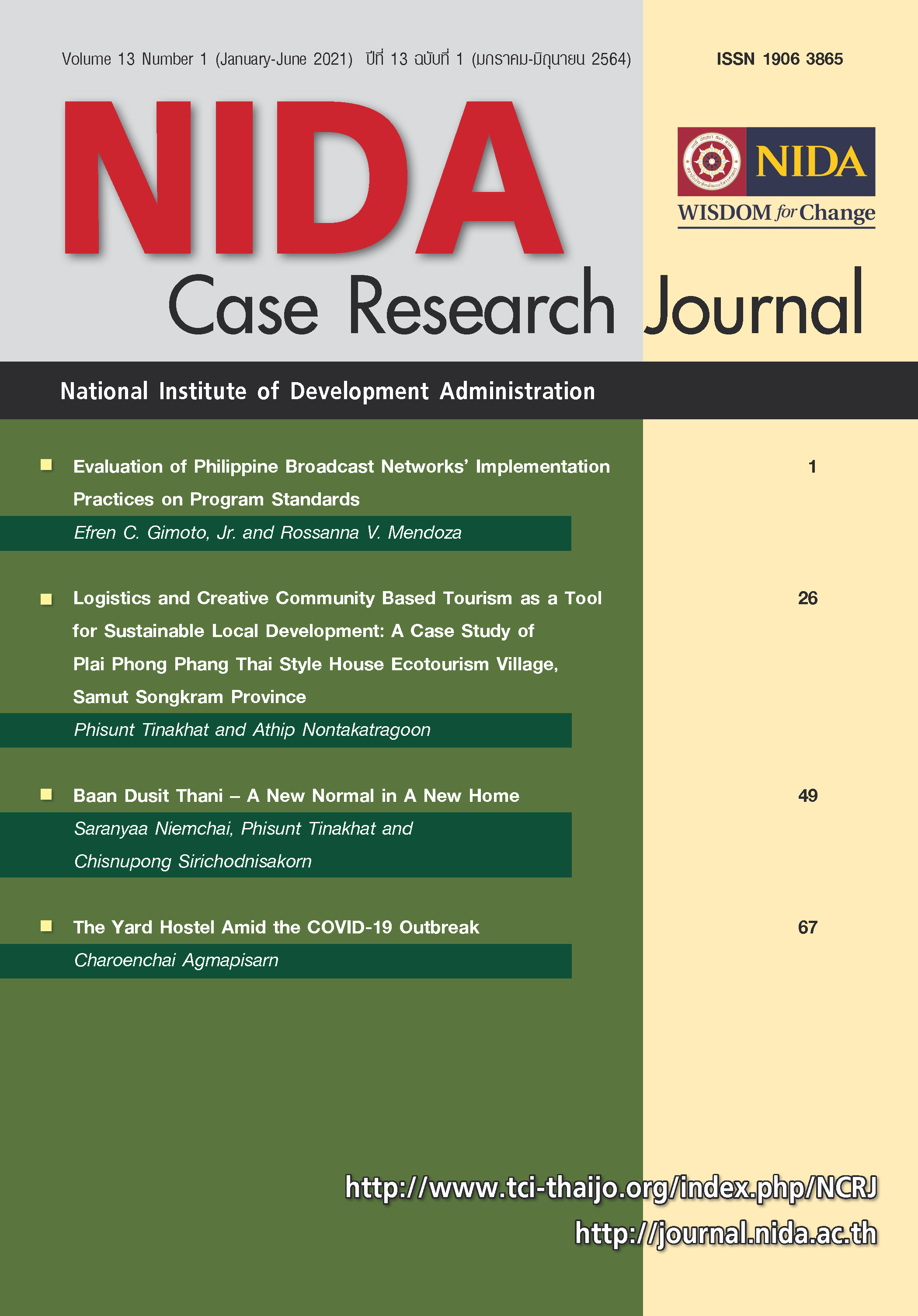
โลจิสติกส์และการท่องเที่ยวโดยชุมชนเชิงสร้างสรรค์ในการเป็นเครื่องมือการพัฒนาท้องถิ่นอย่างยั่งยืน: กรณีศึกษาหมู่บ้านท่องเที่ยวเชิงอนุรักษ์บ้านทรงไทย ปลายโพงพาง จังหวัดสมุทรสงคราม
คำสำคัญ:
การจัดการโลจิสติกส์ , การท่องเที่ยวโดยชุมชน , การท่องเที่ยวเชิงสร้างสรรค์ , การพัฒนาอย่างยั่งยืนบทคัดย่อ
การจัดการการท่องเที่ยวโดยชุมชนก่อให้เกิดประโยชน์ต่อการท่องเที่ยวเป็นอย่างมาก ไม่ว่าจะเป็นการสนับสนุนการพัฒนาเศรษฐกิจในท้องถิ่นผ่านการจ้างงานที่มีความหลากหลาย จนทำให้ชุมชนมีความมั่นคงทางการเงินอันจะนำไปสู่ความเท่าเทียมกันในชุมชนที่จะช่วยลดการทำลายทรัพยากรของชุมชน นอกจากนั้นยังเป็นการช่วยอนุรักษ์และส่งเสริมมรดกทางวัฒนธรรมผ่านการให้ความรู้กับนักท่องเที่ยวในเรื่องของวัฒนธรรมและสิ่งแวดล้อม โดยมุ่งหวังให้เกิดความสงบสุขและความปลอดภัยในชุมชนทั้งแก่เจ้าบ้านและนักท่องเที่ยว
การนำการจัดการโลจิสติกส์มาใช้ในอุตสาหกรรมการท่องเที่ยวสามารถช่วยให้ผู้มีส่วนได้ส่วนเสียในการท่องเที่ยวสามารถเตรียมข้อมูลที่จำเป็นเพื่อให้บริการนักท่องเที่ยว ซึ่งจะส่งผลโดยตรงต่อความพึงพอใจ ความไว้วางใจ ความภักดี และความสำเร็จในระยะยาวของสถานที่ท่องเที่ยวและผู้มีส่วนได้ส่วนเสียในการท่องเที่ยวทั้งหมด ดังนั้นจึงเป็นเรื่องที่น่าสนใจที่จะศึกษาว่าการจัดการโลจิสติกส์สามารถบูรณาการการท่องเที่ยวโดยชุมชนเชิงสร้างสรรค์เพื่อเป็นเครื่องมือในการพัฒนาท้องถิ่นอย่างยั่งยืนได้อย่างไร ผู้ที่เกี่ยวข้องในการให้บริการแก่นักท่องเที่ยวทั้งภาครัฐและเอกชนสามารถนำข้อเสนอแนะที่ได้จากการศึกษาไปปรับปรุงการดำเนินงานด้านโลจิสติกส์การท่องเที่ยวเพื่อเพิ่มความพึงพอใจของนักท่องเที่ยว
เอกสารอ้างอิง
Antaramian, S. (2017). The importance of very high life satisfaction for students’ academic success. Cogent Education, 4(1).
Babu, D. E., Kaur, A., & Rajendran, C. (2018). Sustainability practices in tourism supply chain. Benchmarking: An International Journal, 25(4), 1148–1170.
Bakas, F. E., Duxbury, N., & de Castro, T. V. (2019). Creative tourism: catalysing artisan entrepreneur networks in rural Portugal. International Journal of Entrepreneurial Behavior & Research, 25(4), 731-752.
Büyüközkan, G., & Göçer, F. (2018). Digital supply chain: literature review and a proposed framework for future research. Computers in Industry, 97, 157-177.
Charoensit, J., & Emphandhu, D. (2018). Analyzing research gap on community based tourism in Thailand. Damrong Journal of The Faculty of Archaeology Silpakorn University, 17(1), 175-204.
Chatchawanchanchanakij, P. (2021). Management of logistics elements affecting the satisfaction of community-based tourism Case Study of Ban Koh Samet, Chumphon Province, Thailand. Psychology and Education Journal, 58(4), 1912-1916.
Crespi-Vallbona, M., & Smith, S. G. (2020). Managing sociocultural sustainability in public heritage spaces. Tourism Planning & Development, 17(6), 636-654.
Della Corte, V., D’Andrea, C., Savastano, I., & Zamparelli, P. (2017). Smart cities and destination management: Impacts and opportunities for tourism competitiveness. European Journal of Tourism Research, 17, 7-27.
Dias, Á., González-Rodríguez, M. R., & Patuleia, M. (2020). Developing poor communities through creative tourism. Journal of Tourism and Cultural Change, 1-21.
Duxbury, N., Silva, S., & Castro, T. D. (2019). Creative tourism development in small cities and rural areas in Portugal: Insights from start-up activities. Creating and managing experiences in cultural tourism, 291-304.
Edgell, D. L. (2019). Managing sustainable tourism: A legacy for the future. Routledge.
Ezeuduji, I. O. (2017). Change management for sub-Saharan Africa's rural tourism development. Current Issues in Tourism, 20(9), 946-959.
Fahmi, F. Z., McCann, P., & Koster, S. (2017). Creative economy policy in developing countries: The case of Indonesia. Urban Studies, 54(6), 1367-1384.
Ferreira, J., Sousa, B. M., & Gonçalves, F. (2019). Encouraging the subsistence artisan entrepreneurship in handicraft and creative contexts. Journal of Enterprising Communities: People and Places in the Global Economy, 13(1-2), 64-83.
Ghazi, E. L., & Goede, M. (2017). Creative economy assessment: a case study of Kish Island. International Journal of Social Economics, 44(12), 1940-1956.
Goh, H. C. (2017). Nature and Community-based tourism (CBT) for poverty alleviation: A case study of Lower Kinabatangan, East Malaysia. Geografia-Malaysian Journal of Society and Space, 11(3), 42-53.
Goulding, C., Kelemen, M., & Kiyomiya, T. (2018). Community based response to the Japanese tsunami: A bottom-up approach. European Journal of Operational Research, 268(3), 887-903.
Hakim, L., Siswanto, D., & Makagoshi, N. (2017). Mangrove conservation in East Java: the ecotourism development perspectives. Journal of Tropical Life Science, 7(3), 277-285.
Hudson, S., & Hudson, L. (2017). Marketing for tourism, hospitality & events: a global & digital approach. Sage.
Ikram, A., Su, Q., Fiaz, M., & Rehman, R. U. (2018). Cluster strategy and supply chain management: The road to competitiveness for emerging economies. Benchmarking: An International Journal.
Ikram, A., Su, Q., Fiaz, M. and Rehman, R.U. (2018). Cluster strategy and supply chain management: The road to competitiveness for emerging economies. Benchmarking: An International Journal, 25(5), 1302-1318.
Jere-Jakulin, T. (2017). Systems approach as a creative driving force for a tourism destination. In Driving tourism through creative destinations and activities (pp. 1-19). IGI Global.
Jessop, B. (2018). The Entrepreneurial City: Re-imaging localities, redesigning economic governance, or restructuring capital? 1. In Transforming cities (pp. 28-41). Routledge.
Khan, H. U. R., Zaman, K., Shoukry, A. M., Sharkawy, M. A., Gani, S., Sasmoko, ... & Hishan, S. S. (2019). Tourism logistics management through financial and regulatory measures: evidence from a panel of countries. Asia Pacific Journal of Tourism Research, 24(5), 443-458.
Khartishvili, L., Mitrofanenko, T., Muhar, A., & Penker, M. (2020). Issues with Applying the Concept of Community-Based Tourism in the Caucasus. Mountain Research and Development, 40(1), R11.
Lara, C. S., Crispín, A. F., & Téllez, M. C. L. (2018). Participatory rural appraisal as an educational tool to empower sustainable community processes. Journal of Cleaner Production, 172, 4254-4262.
Lee, T. H., & Jan, F. H. (2019). Can community-based tourism contribute to sustainable development? Evidence from residents’ perceptions of the sustainability. Tourism Management, 70, 368-380.
Martiskainen, M. (2017). The role of community leadership in the development of grassroots innovations. Environmental Innovation and Societal Transitions, 22, 78-89.
Matilainen, A., Suutari, T., Lähdesmäki, M., & Koski, P. (2018). Management by boundaries– Insights into the role of boundary objects in a community-based tourism development project. Tourism Management, 67, 284-296.
Ministry of Tourism and Sports (2017). The Second National Tourism Development Plan, 2017–2021; MOTS: Bangkok, Thailand, 2017
Mtapuri, O., & Giampiccoli, A. (2019). Tourism, community-based tourism and ecotourism: a definitional problematic. South African Geographical Journal, 101(1), 22-35.
Musavengane, R. (2019). Using the systemic-resilience thinking approach to enhance participatory collaborative management of natural resources in tribal communities: Toward inclusive land reform-led outdoor tourism. Journal of Outdoor Recreation and Tourism, 25, 45-56.
Office of the National Economic and Social Development Council. (2020). Thailand’s Logistics Report 2019. Retrieved June 20, 2021, from https://www.nesdc.go.th/ewt_dl_link.php?nid=10791
Palang, D., & Tippayawong, K. Y. (2019). Performance evaluation of tourism supply chain management: the case of Thailand. Business Process Management Journal, 25(6), 1193- 1207.
Richards, G. (2018). Cultural tourism: A review of recent research and trends. Journal of Hospitality and Tourism Management, 36, 12-21.
Schönsleben, P. (2018). Integral logistics management: operations and supply chain management within and across companies. CRC Press.
Tinakhat, P. (2020). A Study of Tourist Motivation toward Destination Loyalty: Targeting European Tourists Travelling to Phuket. Thammasat Review, 23(2), 22-46.
Topolšek, D., Čižiūnienė, K., & Ojsteršek, T. C. (2018). Defining transport logistics: a literature review and practitioner opinion based approach. Transport, 33(5), 1196-1203.
Tourism Economic Review. (2017). Community-based Tourism. Retrieved June 9, 2021, from http://cbtchiangmai.org/media_detail.php?id=11
Tseng, M. L., Lin, C., Lin, C. W. R., Wu, K. J., & Sriphon, T. (2019). Ecotourism development in Thailand: Community participation leads to the value of attractions using linguistic preferences. Journal of cleaner production, 231, 1319-1329.
Villamediana-Pedrosa, J. D., Vila-Lopez, N., & Küster-Boluda, I. (2020). Predictors of tourist engagement: Travel motives and tourism destination profiles. Journal of Destination Marketing & Management, 16, 100412.
Wang, J., Huang, X., Gong, Z., & Cao, K. (2020). Dynamic assessment of tourism carrying capacity and its impacts on tourism economic growth in urban tourism destinations in China. Journal of Destination Marketing & Management, 15, 100383.
Widjaja, D. C., Jokom, R., Kristanti, M., & Wijaya, S. (2020). Tourist behavioural intentions towards gastronomy destination: evidence from international tourists in Indonesia. Anatolia, 31(3), 376-392.
ดาวน์โหลด
เผยแพร่แล้ว
รูปแบบการอ้างอิง
ฉบับ
ประเภทบทความ
สัญญาอนุญาต
ลิขสิทธิ์ (c) 2022 NIDA Case Research Journal

อนุญาตภายใต้เงื่อนไข Creative Commons Attribution-NonCommercial-NoDerivatives 4.0 International License.