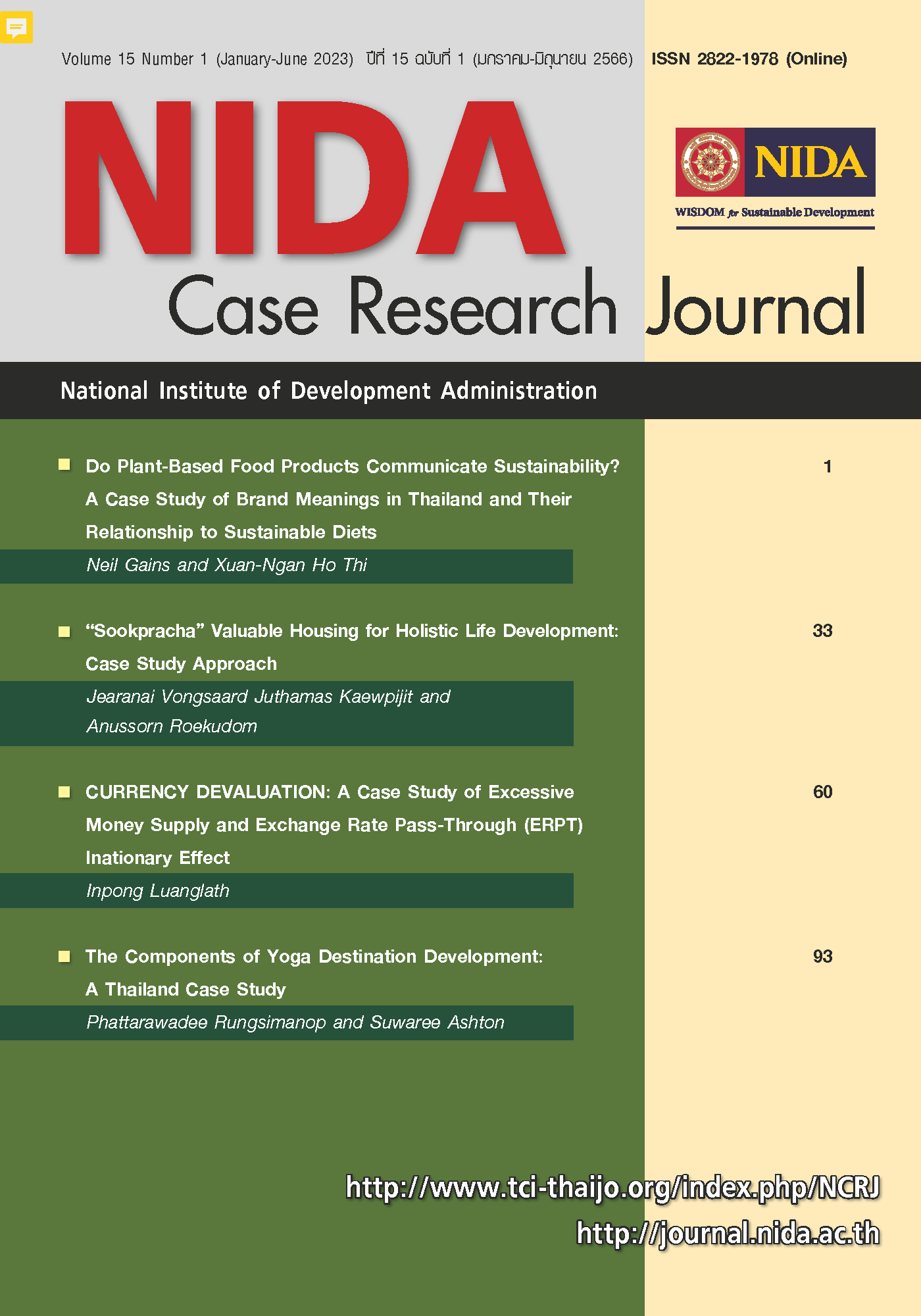
ผลิตภัณฑ์อาหารจากพืช (Plant-Based Food) สื่อสารถึงแนวคิดเรื่องความยั่งยืนได้หรือไม่? กรณีศึกษา
ความสัมพันธ์ของความหมายของแบรนด์ (Brand Meanings) ของบริษัทในประเทศไทยกับการบริโภคที่ยั่งยืน
DOI:
https://doi.org/10.14456/ncrj.2023.1คำสำคัญ:
ความยั่งยืน, ฉลากสิ่งแวดล้อม, อาหารจากโปรตีนพืช, การสื่อสาร, สัญศาสตร์บทคัดย่อ
การบริโภคเนื้อสัตว์เป็นสาเหตุสำคัญที่ทำให้เกิดภาวะโลกร้อน ดังนั้นการลดปริมาณการบริโภคเนื้อสัตว์จึงเป็นก้าวสำคัญในการบรรลุเป้าหมายการพัฒนาที่ยั่งยืนขององค์การสหประชาชาติ (Sustainable Development Goals - SDGs) และการลดภาวะโลกร้อน ถึงแม้ว่าคนจำนวนมากจะมีความเข้าใจโดยทั่วไปว่ารูปแบบการบริโภคอาหารสามารถส่งผลกระทบต่อความยั่งยืนได้ การรณรงค์ให้คนส่วนใหญ่หันมาปรับเปลี่ยนลักษณะนิสัยการบริโภคยังคงเป็นเรื่องยากและมีอุปสรรค มีหลักฐานแสดงให้เห็นว่าการใช้วิธีปรับพฤติกรรม (Nudge) ผ่านการใช้ภาพและการใช้ถ้อยคำเป็นการรณรงค์ให้เกิดการบริโภคที่ยั่งยืนที่มีประสิทธิภาพที่สุด บทความนี้เป็นการทบทวนการสื่อสารในรูปแบบภาพและการใช้ถ้อยคำของบริษัทผลิตอาหารจากพืชในประเทศไทย โดยมีวัตถุประสงค์เพื่อทำความเข้าใจว่าแนวคิดความยั่งยืนได้ถูกสื่อสารผ่านสื่อเหล่านั้นหรือไม่ จากการศึกษาพบว่าแนวคิดเรื่องความยั่งยืนนั้นสามารถสื่อสารออกมาได้อย่างเป็นระบบและต่อเนื่องผ่านการใช้ข้อความบางประเภทเพื่อรณรงค์ให้เกิดการบริโภคที่ยั่งยืน ถึงแม้ว่างานวิจัยอื่นจะพบว่ายังมีปัจจัยอื่นอีกหลายประการหลายที่ก่อให้เกิดแรงจูงใจในการเลือกบริโภคอาหารจากพืช ผลการศึกษานี้มุ่งนำเสนอรูปแบบการสื่อสารด้านความยั่งยืนที่กระตุ้นให้เกิดแรงจูงใจให้ผู้บริโภคหันมาบริโภคอาหารจากพืชมากยิ่งขึ้น
เอกสารอ้างอิง
Absolute Plant. (2022). Absolute Plant brand channel. YouTube, retrieved from https://www.youtube.com/@absoluteplant2280 (14 December 2022).
Arning, C. (2021). What makes modern Britain laugh? How semiotics helped the BBC bridge the Humor Gap. International Journal of Market Research, 63(3), 1-25.
Bangkok Post. (2022a). Plant-based meat innovations in demand (1 October 2022). Retrieved from https://www.bangkokpost.com/business/2404703/plant-based-meat-innovations-in-demand
Bangkok Post. (2022b). Plant-based food exports set to soar (25 October 2022). Retrieved from https://www.bangkokpost.com/business/2421903/plant-based-food-exports-set-to-soar
Barragan-Jason, G., de Mazancourt, C., Parmesan, C., Singer, M.C. & Loreau, M. (2022). Human-nature connectedness as a pathway to sustainability A global meta-analysis. Conservation Letters, 15(1), e12852.
Beyond Meat. (2022). Beyond Meat brand channel. YouTube, retrieved from https://www.youtube.com/@BeyondMeat (14 December 2022).
Bianchi, F., Dorsel, C., Garnett, E., Aveyard, P. & Jebb, S.A. (2018). Interventions targeting conscious determinants of human behaviour to reduce the demand for meat: a systematic review with qualitative comparative analysis. International Journal of Behavioural Nutrition and Physical Activity, 15(102), retrieved from https://doi.org/10.1.1186/s12966-018-0729-6.
Blackford, B. (2021). Nudging interventions on sustainable food consumption: a systematic review. The Journal of Population and Sustainability, 5(2), 17-62.
Born, D. (2019). Bearing Witness? Polar Bears as Icons for Climate Change Communication in National Geographic, Environmental Communication, 13:5, 649-663, doi: 10.1080/17524032.2018.1435557.
Bradford, A., Hancox, A., & Bryant, C. J. (2022, January 18). The way to a meat-eater’s heart is through their stomach: Exposure to more appealing vegan food increases preference for meat-free options, retrieved from https://doi.org/10.31219/osf.io/746jm.
Cambridge Dictionary. (2022). Definition of ‘semiotics’, in Cambridge Dictionary. Cambridge, UK: Cambridge University Press. Retrieved from https://dictionary.cambridge.org/dictionary/english/semiotics.
Catellani, A. (2011). Environmentalists NGOs and the construction of the culprit: semiotic analysis. Journal of Communication Management, 15(4), 280-297.
Catellani, A. (2015). Visual aspects of CSR reports: A semiotic and chronological case analysis. In: Ana Duarte Melo, Ian Somerville, Gisela Gonçalves (Eds.), Organisational and Strategic Communication Research: European Perspectives II, CECS - Centro de Estudos de Comunicação e Sociedade Universidade do Minho : Braga 2015, p. 129-149.
Chai, B.C., van der Voort, J.R., Grofelnik, K., Eliasdottir, H.G., Klöss, I. & Perez-Cueto, F.J.A. (2019). Which Diet Has the Least Environmental Impact on Our Planet? A Systematic Review of Vegan, Vegetarian and Omnivorous Diets. Sustainability, 11, 4110, retrieved from doi:10.3390/su11154110.
Chernev, A., Böckenholt, U. & Goodman, J. (2015). Choice overload: A conceptual review and meta-analysis. Journal of Consumer Psychology, 25(2), 333-358.
Christiano, A. & Neimand, A. (2017). Stop raising awareness already. Stanford Social Innovation Review, Spring 2017.
Cox, M.J. (2008). Sustainable Communication: A Study of Green Advertising and Audience Reception within the Growing Arena of Corporate Social Responsibility. Case Study: British Petroleum. Earth & E-nvironment, 3, 32-51.
de Boer, J., Schösler, H. & Boersema, J.J. (2013). Climate change and meat eating: An inconvenient couple?. Journal of Environmental Psychology, 33, 1-8.
de Boer, J., Schösler, H. & Aiking, H. (2014). “Meatless days” or “Less but better”? Exploring strategies to adapt Western meat consumption to health and sustainability challenges. Appetite, 76, 120-128.
De-loyde, K., Pilling, M.A., Thornton, A., Spencer, G. & Maynard, O.M. (2022). Promoting sustainable diets using eco-labelling and social nudges: A randomised online experiment. Behavioural Public Policy, 1–17
Ensaff H. (2021). A nudge in the right direction: The role of food choice architecture in changing populations’ diets. Proceedings of the Nutrition Society, 2021 (2), 195–206. Retrieved from https://doi.org/10.1017/s0029665120007983.
First Pride. (2022). First Pride brand channel. YouTube, retrieved from https://www.youtube.com/@firstpridebrand6241 (14 December 2022).
Gains, N. (2014). Brand esSense: Using Sense, Symbol and Story to Design Brand Identity. London: Kogan Page.
González-García, S.; Esteve-llorens, X.; Moreira, M.T. & Feijoo, G. (2018). Carbon footprint and nutritional quality of different human dietary choices. Science of the Total Environment. 2018, 644, 77–94.
Granato, G., Fischer, A.R.H. & van Trijp, H.C.M. (2022). A meaningful reminder on sustainability: When explicit and implicit packaging cues meet. Journal of Environmental Psychology, 79, 101724. Retrieved from https://doi.org/10.1016/j.jenvp.2021.101724.
Hansen, A. & Machin, D. (2008). Visually branding the environment: climate change as a marketing opportunity. Discourse Studies, 10(6), 777-794.
Hansen, A. & Machin, D. (2013). Researching Visual Environmental Communication. Environmental Communication: A Journal of Nature and Culture, 7:2, 151-168 Retrieved at DOI: 10.1080/17524032.2013.785441
IPCC (2022) Climate Change 2022: Mitigation of Climate Change. Contribution of Working Group III to the Sixth Assessment Report of the Intergovernmental Panel on Climate Change [P.R. Shukla, J. Skea, R. Slade, A. Al Khourdajie, R. van Diemen, D. McCollum,...J. Malley, (Eds.)]. Cambridge, UK: Cambridge University Press. Retrieved from doi: 10.1017/9781009157926.
Jones, W.J. (2014). Political semiotics of national campaign posters and pictorial representation: Thailand’s 2011 general elections. Semiotica, 199, 269-296.
Lawes, R. (2002). Demystifying semiotics: Some key questions answered. International Journal of Market Research, 44, 251-264.
Lawes, R. (2018). Science and semiotics: What’s the relationship? International Journal of Market Research, 60(6), 1-16.
Let’s Plant Meat. (2022). Let’s Plant Meat brand channel. YouTube, retrieved from https://www.youtube.com/@LetsPlantMeat (14 December 2022).
Mackay, C.M.L. & Schmitt, M.T. (2019). Do people who feel more connected to nature do more to protect it? A meta-analysis. Journal of Environmental Psychology, 65, 101323.
Marketbuzzz. (2022). August 2022 Study of Thai Eating Habits. Personal Communication.
Meat Zero. (2022). Meat Zero brand channel. YouTube, retrieved from https://www.youtube.com/@meatzero (14 December 2022).
Mintel. (2022). Mintel Consulting Sustainability Barometer. Mintel Group Ltd., retrieved from https://www.mintel.com/consumer-sustainability-barometer (15 December 2022),
OMG Meat. (2022). OMG Meat The Flexible Me. YouTube, retrieved from https://www.youtube.com/watch?v=xNHL7rbS3q4 (14 December 2022).
Ottersen, I.S., Benningstad, N.D.G. & Kunst, J.R. (2022). Daily reminders about the animal-welfare, environmental and health consequences of meat and their main and moderated effects on meat consumption. Cleaner and Responsible Consumption, 5, June 2022, 100068.
Peverini, P. (2014). Environmental issue in unconventional social advertising: A semiotic perspective. Semiotica, 199, 219-246.
Potter, C., Bastounis, A., Hartmann-Boyce, J., Stewart, C., Frie, K., Tudor, K., …Jebb, S.A. (2021). The effects of environmental sustainability labels on selection, purchase, and consumption of food and drink products: A systematic review. Environment and Behavior, 53(8), 891-925.
PWC. (2021). PWC June 2021 Global Consumer Insights Pulse Survey. PWC, retrieved from https://www.pwc.com/gx/en/industries/consumer-markets/consumer-insights-survey.html.
Rakuten. (2022). Plant-based food alternatives: Future or Present? Rakuten Insight, retrieved from https://insight.rakuten.com/report-plant-based-food-alternatives/ (15 December 2022).
Ritchie, H., Reay, D.S. & Higgins, P. (2018). Potential of meat substitutes for climate change mitigation and improved human health in high-income markets. Frontiers in Sustainable Food Systems, 2:16, retrieved from doi: 10.3389/fsusf.2018.00016.
Robertson, M. (2019). Communicating Sustainability. London, UK: Routledge.
Rosi, A.; Mena, P.; Pellegrini, N.; Turroni, S.; Neviani, E.; Cagno, R.D.I. …Scazzina, F. (2017). Environmental impact of omnivorous, ovo-lacto-vegetarian, and vegan diet. Scientific Reports, 7, 6105.
Scarborough, P., Appleby, P., Mizdrak, A., Briggs, A.M., Travis, R.C., Bradbury, K. & Key, T. (2014). Dietary greenhouse gas emissions of meat-eaters, fish-eaters, vegetarians and vegans in the UK. Climatic Change, 125, 179–192.
Sheehan, P. & Webb, T.L. (2016). The Intention-Behavior Gap. Social and Personality Psychology Compass, 10/9, 503-518.
Sparkman, G. & Walton, G.M. (2017a). Cut Back or Give It Up. Norms Promote Sustainable Behavior, Even if It Is Counternormative. Psychological Science, 28 (1), 1663-1674.
Sparkman, G. & Walton, G.M. (2017b). Dynamic Norms Promote Sustainable Behavior, Even if It Is Counternormative. Psychological Science, 28 (1), 1663-1674.
Springmann, M., Clark, M., Mason-d’Croz, D., Wiebe, K., Bodirsky, B.L., Lassaletta, L. …Willett, W. (2018). Options for keeping the food system within environmental limits. Nature, 562, 519-525.
Starke, A.D., Willemsen, M.C. & Trattner, C. (2021). Nudging Healthy Choices in Food Search Through Visual Attractiveness. Frontiers in Artificial Intelligence, 4: 621743, doi: 10.3389/frai.2021.621743.
Stehfest, E., Bouwman, L., van Vuuren, D.P., den Elzen, M.G.J., Eickhout, B. & Kabat, P. (2009). Climate benefits of changing diet. Climatic Change, 95, 83-102.
Thaler, R. & Sunstein, C.S. (2021). Nudge: The Final Edition. London, UK: Penguin.
Turnwald, B.P., Boles, D.Z. & Crum, A.J. (2017). Association between Indulgent Descriptions and Vegetable Consumption: Twisted Carrots and Dynamic Beets. JAMA Internal Medicine, 177(8), 1216-1218.
Turnwald, B.P., Bertoldo, J.D., Perry, M.A., Policastro, P., Timmons, M., Bosso, C. …Crum, A.J. (2019). Increasing Vegetable Intake by Emphasizing Tasty and Enjoyable Attributes: A Randomized Controlled Multisite Intervention for Taste-Focused Labelling. Psychological Science, 30(11), 1603-1615.
Turnwald, B. P., & Crum, A. J. (2019). Smart food policy for healthy food labeling: Leading with taste, not healthiness, to shift consumption and enjoyment of healthy foods. Preventive Medicine, 119, 7–13.
Turnwald, B.P. & Crum, A.J. (2021). The Taste-Focused-Labeling Intervention: Emphasizing the Tasty and Enjoyable Attributes of Healthy Foods. In G.M. Walton & A.J. Crum (Eds.), Handbook of Wise Interventions: How Social Psychology Can Help People Change (pp. 301-317). New York: The Guilford Press.
Willett, W., Rockström, J., Loken, B., Springmann, M., Lang, T., Vermeulen, S. …Murray, C.J.L. (2019). Food in the Anthropocene: The EAT-Lancet commission on healthy diets from sustainable food systems. Lancet, 393: 447–92.
Williamson, J. (1978). Decoding advertisements: Ideology and Meaning in Advertising. London, UK: Marion Boyars.
Yekini, K.C., Omoteso, K. & Adegbite, E. (2021). CSR Communication Research: A Theoretical-cum-Methodological Perspective from Semiotics. Business & Society, 60(4), 876-908.
ดาวน์โหลด
เผยแพร่แล้ว
รูปแบบการอ้างอิง
ฉบับ
ประเภทบทความ
สัญญาอนุญาต
ลิขสิทธิ์ (c) 2023 NIDA Case Research Journal

อนุญาตภายใต้เงื่อนไข Creative Commons Attribution-NonCommercial-NoDerivatives 4.0 International License.