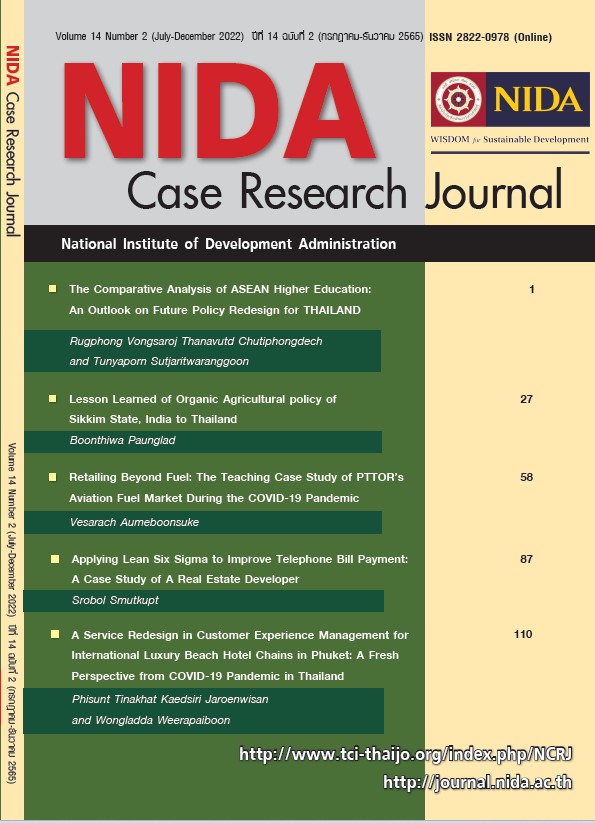
การวิเคราะห์การอุดมศึกษาเชิงเปรียบเทียบของประเทศในกลุ่มอาเซียน : มุมมองเพื่อออกแบบนโยบายอุดมศึกษาใหม่สำหรับประเทศไทย
DOI:
https://doi.org/10.14456/ncrj.2022.1คำสำคัญ:
นโยบายอุดมศึกษา, การออกแบบนโยบายใหม่, กลุ่มประเทศอาเซียน, อนาคตศึกษา, ประเทศไทยบทคัดย่อ
บทความวิจัยนี้วัตถุประสงค์ในการนำเสนอแนวทางการออกแบบนโยบายอุดมศึกษาใหม่สำหรับประเทศไทยผ่านการวิจัยเชิงเอกสารเพื่อถอดบทเรียนการพัฒนานโยบายการอุดมศึกษาของประเทศสิงคโปร์ และมาเลเซียซึ่งกลุ่มประเทศตัวอย่างที่ดีในอาเซียนตามการจัดอันดับของ World Economic Forum ผลการศึกษาจากการวิเคราะห์เชิงเปรียบเทียบพบว่า กลุ่มประเทศตัวอย่างที่ดีใช้การอุดมศึกษาเป็นเครื่องมือในการสร้างทุนมนุษย์เพื่อสร้างขีดความสามารถทางการแข่งขันให้กับประเทศผ่านการจัดทำแผนพัฒนาอุดมศึกษาและแพลตฟอร์มการเรียนรู้ตลอดชีวิตที่เป็นรูปธรรม มีสัดส่วนของงบประมาณแผ่นดินที่เกี่ยวข้องกับการอุดมศึกษาและการลงทุนทางด้านการวิจัยของประเทศในระดับสูง ให้ความสำคัญกับการพัฒนาทักษะผู้เรียนผ่านการสร้างเครือข่ายกับผู้มีส่วนได้เสียในระบบอุดมศึกษา และมีการดำเนินนโยบายการพัฒนาการอุดมศึกษาที่มีความชัดเจนและต่อเนื่อง
เอกสารอ้างอิง
Andreescu, L., Gheorghiu, R., Zulean, M., & Curaj, A. (2012). Systemic foresight for Romanian higher education. In European higher education at the crossroads (pp. 995-1017). Springer.
Bowen, Glenn. (2009). Document analysis as a qualitative research method. Qualitative Research Journal, 9(2), 27-40.
Dobbins, M., Knill, C., & Vögtle, E. M. (2011). An analytical framework for the cross-country comparison of higher education governance. Higher education, 62(5), 665-683.
El-Azar, Diana & Nelson, Ben. (2020). How will higher education be different in 2030? https://www.britishcouncil.org/voices-magazine/future-higher-education
Harmsen, R., & Braband, G. (2021). The OECD and higher education policy: Agenda-setting, organizational dynamics and the construction of convening authority. Higher Education Policy, 34(3), 582-602.
Karran, T., & Mallinson, L. (2019). Academic freedom and world-class universities: A virtuous circle? Higher Education Policy, 32(3), 397-417.
KPMG. (2020). The future of higher education in a disruptive world. KPMG International.
McKinsey & Company. (2021). How to transform higher-education institutions for the long term.https://www.mckinsey.com/industries/education
Ministry of Education. (2019). Singapore’s education system: An overview.https://www.moe.gov.sg/
Mintz, Steven. (2020). K-12 trends and the future of higher education. https://www.insidehighered.com/blogs
Nasruddin, E., Bustami, R., & Inayatullah, S. (2012). Transformative foresight: Universiti Sains Malaysia leads the way. Futures, 44(1), 36-45.
Piirainen, K. A., Andersen, A. D., & Andersen, P. D. (2016). Foresight and the third mission of universities: The case for innovation system foresight. Foresight, 18(1), 24-40.
Ratanawaraha, Apiwat. (2020). Future studies (2nd ed.). Thailand Science Research and Innovation.
Sanders, J. S. (2020). Comprehensive internationalization in the pursuit of ‘World-Class’ status: A cross-case analysis of Singapore’s two flagship universities. Higher education policy, 33(4), 753-775.
SEAMEO. (2017). Guidebook to education systems and reforms in Southeast Asia and China. ASEAN-China Centre.
Shamsir, M. S., Krauss, S. E., Ismail, I. A., Ab Jalil, H., Johar, M. A., & Rahman, I. A. (2021). Development of a Haddon matrix framework for higher education pandemic preparedness: Scoping review and experiences of Malaysian universities during the COVID-19 Pandemic. Higher Education Policy, 1-40.
Stolze, A., & Sailer, K. (2021). An international foresight reflection on entrepreneurial pathways for higher education institutions. Industry and Higher Education, 35(6), 700-712.
UNESSCO. (2014). Education systems in ASEAN+6 countries: A comparative analysis of selected educational issues. UNESCO Bangkok Office.
UNESCO. (2021). Report on the futures of higher education envisions collective and holistic responses to global challenges. https://www.iesalc.unesco.org/en
Vongsaroj, Rugphong. (2020). Higher-education policy redesign in ASEAN+3 countries. Thailand Science Research and Innovation.
Voros, Joseph. (2003). A generic foresight process framework. Foresight, 5(3), 10–21.
World Bank (2021). 5th pillar higher education and training, value. https://tcdata360.worldbank.org/indicators
Wu, S. J., Chang, D. F., & Hu, H. (2019). Detecting the issue of higher education over-expanded under declining enrollment times. Higher Education Policy, 1-24.
Yin, K. Robert. (2011). Qualitative research from start to finish. The Guilford Press
Ziguras, C. (2016). Globalization and the transformation of Asian higher education. In C. S. Collins, M. N. N. Lee, J. N. Hawkins, & D. E. Neubauer (Eds.), The Palgrave handbook of Asia Pacific higher education (pp. 73-88). Palgrave Macmillan US.
ดาวน์โหลด
เผยแพร่แล้ว
รูปแบบการอ้างอิง
ฉบับ
ประเภทบทความ
สัญญาอนุญาต
ลิขสิทธิ์ (c) 2023 NIDA Case Research Journal

อนุญาตภายใต้เงื่อนไข Creative Commons Attribution-NonCommercial-NoDerivatives 4.0 International License.