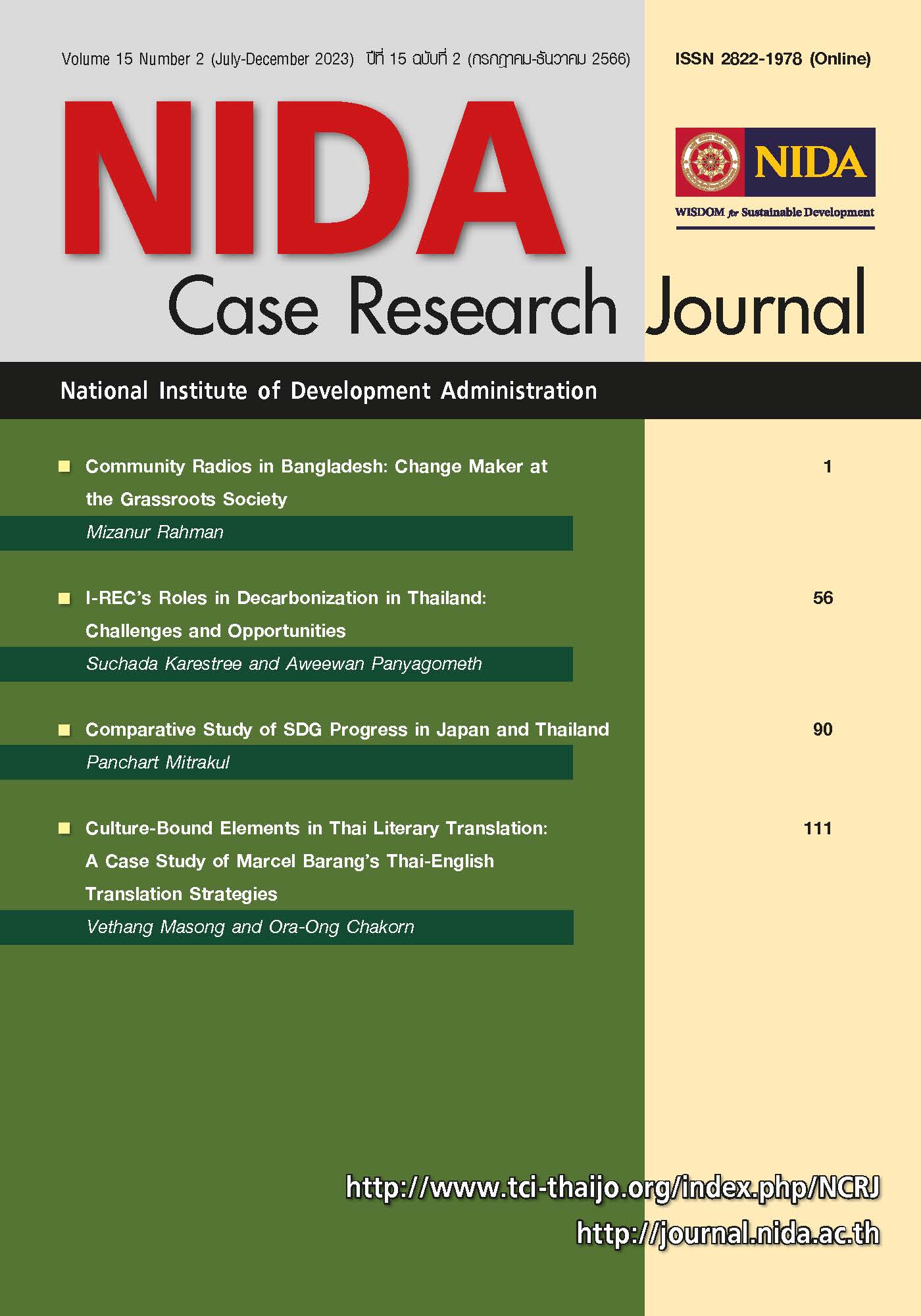
ชุมชนวิทยุใบบังกลาเทศ ผู้เปลี่ยนแปลงสังคมชั้นรากหญ้าของสังคม
Introduction
DOI:
https://doi.org/10.14456/ncrj.2023.5คำสำคัญ:
ชุมชนวิทยุ, โปรไฟล์, ผู้ฟัง, กระจายเสียง, ประเทศบังกลาเทศบทคัดย่อ
ชุมชนวิทยุมีบทบาทสำคัญต่อความเปลี่ยนแปลงในสังคมชั้นรากหญ้าและการพัฒนาด้านต่างๆ โดยที่ในยุคโลกาภิวัฒน์ สื่อกระแสหลักมีบทบาทสำคัญ ต่อการจัดทำข่าว สารสนเทศและการบันเทิง นอกจากนี้ในประเทศบังกลาเทศ ชุมชนวิทยุ (หรือ ซีอาร์) ส่งเสริมให้มีการเปลี่ยนแปลงเชิงบวกในการปกครองระดับรากหญ้าและการพัฒนาตามรากฐานของความเป็นจริง วิจัยนี้มี วัตถุประสงค์ เพื่อ 1) ศึกษาภาพรวมของโปรไฟล์ชุมชนวิทยุของ ประเทศบังกลาเทศ 2) นำเสนอโปรไฟล์โดยสังเขปของซีอาร์ ในประเทศ บังกลาเทศ และ 3) ประเมิน บทบาทของซีอาร์ ในการเปลี่ยนแปลงและ การพัฒนาในระดับรากหญ้า ทั้งนี้มุ่งหวังให้เกิดเป็นวิธีกรณีตัวอย่าง โดยใช้ข้อมูลเชิงคุณภาพ วิเคราะห์ตามวัตถุประสงค์เพื่อยืนยันข้อมูลเชิงคุณภาพ มีการใช้เครื่องมืออื่นๆ เช่น การสนทนากลุ่ม (FGD) การวิเคราะห์ เนื้อหาและการสังเกตการณ์ ผลการวิจัยแสดงให้เห็นว่า มี 18 ชุมชนวิทยุในประเทศบังกลาเทศ โดยส่วนใหญ่อยู่ในพื้นที่ห่างไกล และทำหน้าที่ให้ข้อมูลการพัฒนาต่างๆ ต่อคนระดับรากหญ้า โดยชุมชมวิทยุดังกล่าวสามารถแจ้งสมาคมผู้ฟังที่ประกอบไปด้วยนักเรียนจำนวนมาก ได้มีช่องทางในการมีส่วนร่วม ในการแสดงความคิดสร้างสรรค์ ทั้งนี้ชุมชมรายย่อยเช่น ชาวประมง สตรี ชาวสวนหมู่บ้าน ชุมชนยากจนห่างไกล ชนพื้นเมือง ยังได้รับบริการ ด้านการพัฒนาจากชุมชนวิทยุด้วย ดังนั้นจึงเป็นปัจจัยหนึ่งที่ก่อให้เกิด ความเปลี่ยนแปลง การพัฒนาและการแปรสภาพ ของสังคมระดับรากหญ้า เป็นอย่างมาก
เอกสารอ้างอิง
AMARC. (2010). AMARC. [En línea] http://www.amarc.org.
Asaduzzaman, A. S. M., & Khatun, M. (2019). Community Radio and Development: Participation of Community Radio in Bangladesh (In Bangla), Dhaka vishwavidyalaya patrika (Bangla Journal of the University of Dhaka), No. 100, Dec. 2019.
Bangladesh NGO Network for Radio and Communication (BNNRC, 2010) Handbook of community radio. Dhaka: BNNRC.
Bora, A., & Lakhendra, B. (2012). Community Radio Movement in India – Few Aspects Requiring Attention. Mediterranean journal of social sciences, Vol. 3 (1), January 2012.
Dahal, S. & Aram, I.A. (2011). Crafting a community radio 'friendly' broadcast policy in Nepal, Observatorio journal, 5(4), 69-91.
Ely, M., Anzul, M., Friedman, T., Garner, D., & Steinmetz, A. C. (1991). Doing qualitative research: Circles within circles. New York: Falmer Press.
Erlandson, D. A., Harris, E. L., Skiper, B. L., & Allen, S. D. (1993). Doing naturalistic inquiry: A guide to methods. Newbury Park, CA: Sage.
Erzberger, C., & Prein, G. (1997). Triangulation: Validity and empirically-based hypothesis construction. Quality & Quantity. 31(2): 141–154.
Fleming, Carole. (2002). The radio handbook, Routledge; 2nd Edition, pg. 176.
Fraser, C., & Estrada, S. R. (2001). Community radio handbook. Paris: UNESCO.
Glesne, C., & Peshkin, A. (1992). Becoming qualitative researchers: An introduction. White Plains, NY: Longman.
Harun, I. B., & Mahamud, T. (2014). The Position and the Role of Intermediaries in Information Flows: A Study on Sharonkhola Upazila of Bagerhat District in Bangladesh, Stamford journal of media, communication and culture, 3, 1-12.
Huq, T., & Uddin, M. M. (2018). An Analysis of the Contents of the Community Radios in Achieving Sustainable Developing Goals: A Review (In Bangla). Social science patrica (Journal of Social Sciences), (Dhaka University Studies, Part D). 12(12), 141-157.
Jewel, G. N. (2006). Community radio: Ready to launch in Bangladesh. Dhaka: Bangladesh NGOs Network for Radio and Communication.
Khan, M. A. A., Khan, M. M. R., Hasan, M., Ahmed, F., & Haque, S. M. R. (2017). Role of Community Radio for Community Development in Bangladesh. The international technology management review, 6(3), 94-102.
Lincoln, Y. S., & Guba, E. G. (1985). Naturalistic inquiry. Beverly Hills, CA: Sage.
McChesney, R. W. (1999). Rich media, poor democracy: communication politics in dubious times. Champaign, USA: University of Illinois Press.
Merrium, S. (1988). Case study research in education: A qualitative approach. San Francisco: Jossey-Bass.
Miles, B. M., & Huberman, A. M. (1994). Qualitative data analysis-An expended source book (2nd ed.). Thousand Oaks, CA: Sage.
Myers, M. (2011). Voices for villages: Community radio in the developing world. Washington, D.C.: The Centre for International Media Assistance (SIMA).
Nandakumar S., & Sridharraj, G. (2015). Community Radio: Strengthen Women's Role and Changing Rural Society, through its programme content creation. International journal of informative futuristic research. 2(5):1442-8.
Nirmala Y. (2015). The Role of Community Radio in Empowering Women in India. Media Asia, 42(1-2), 41-46.
Obaid, I. S. (Ed.) (2019). Radio in Bangladesh: Evolution. Dhaka: UNESCO.
Patil, D. A. (2010). A Voice for the Voiceless: The Role of Community Radio in the Development of the Rural Poor. International journal of rural studies (IJRS), 17(3), 1-9.
Patton, M. Q. (1980). Qualitative evaluation methods. Beverly Hills, CA: Sage.
Patton, M. Q. (1990). Qualitative evaluation and research methods. Newbury Park, CA: Sage.
Pringle, I. & B. Subba (2007). Ten years on: The state of community radio in Nepal, New Delhi: UNESCO.
Rajana, V., Prasad, K. K. L., & Madhavi, B. D. (2020). Is Community Radio an Effective Tool for Health Education? Perceptions of Stakeholders of a Community Radio Project in North Coastal Andhra Pradesh. International journal of community medicine and public health. Apr. 7(4), 1522-1527.
Record, D., Sherbrooke Q., Nov Q. Community radio plays a key role in community. Journal of future research innovation. 2008: 5-6.
Reza, S. M. (2014, May 3). Free Media and Good Governance: Engaging Citizens, Protecting Journalists and Revisiting Development Goals. Keynote Paper presented on the occasion of World Press Freedom Day, organized by Mass Line Media Centre, held at CIRDAP, Dhaka, 3 May 2014.
Schramm, W. (1964). Mass media and national development: The role of information in the developing countries. California: Stanford University Press.
Seneviratne, K. (2011). Community Radio Via Public Service Broadcasting: The Kothmale Model. Journal of radio & audio media, 18(1): 129-138.
Sterling, S. R., O'Brien J., & Bennett J. K. (2009). Advancement through Interactive Radio. Information system front. 11(2), 145-154.
Ullah, M. S., & Ferdous, R. (2007). Status and Challenges for Community Radio in Bangladesh. Social science review [The Dhaka University Studies, Part-D], 24(1), 53-65.
UNESCO. (2002). How to do community radio. New Delhi: UNESCO, Asia-Pacific Bureau for Communication and Information.
Wadia, Angela. (2007) Broadcast management in India: Major guidelines and policy frameworks, Kanishka Publishers Distributors, India.
Waters, D., James, R., & Darby, J. (2011). Health-promoting Community Radio in Rural Bali: An Impact Evaluation. Rural remote health. 11(1), 1-10.
Yeasmin, S., & Rahman, K. F. (2012). 'Triangulation' research method as the tool of social science research. BUP journal, Volume 1, Issue 1, September 2012. PP. 154-163.
ดาวน์โหลด
เผยแพร่แล้ว
รูปแบบการอ้างอิง
ฉบับ
ประเภทบทความ
สัญญาอนุญาต
ลิขสิทธิ์ (c) 2023 NIDA Case Research Journal

อนุญาตภายใต้เงื่อนไข Creative Commons Attribution-NonCommercial-NoDerivatives 4.0 International License.