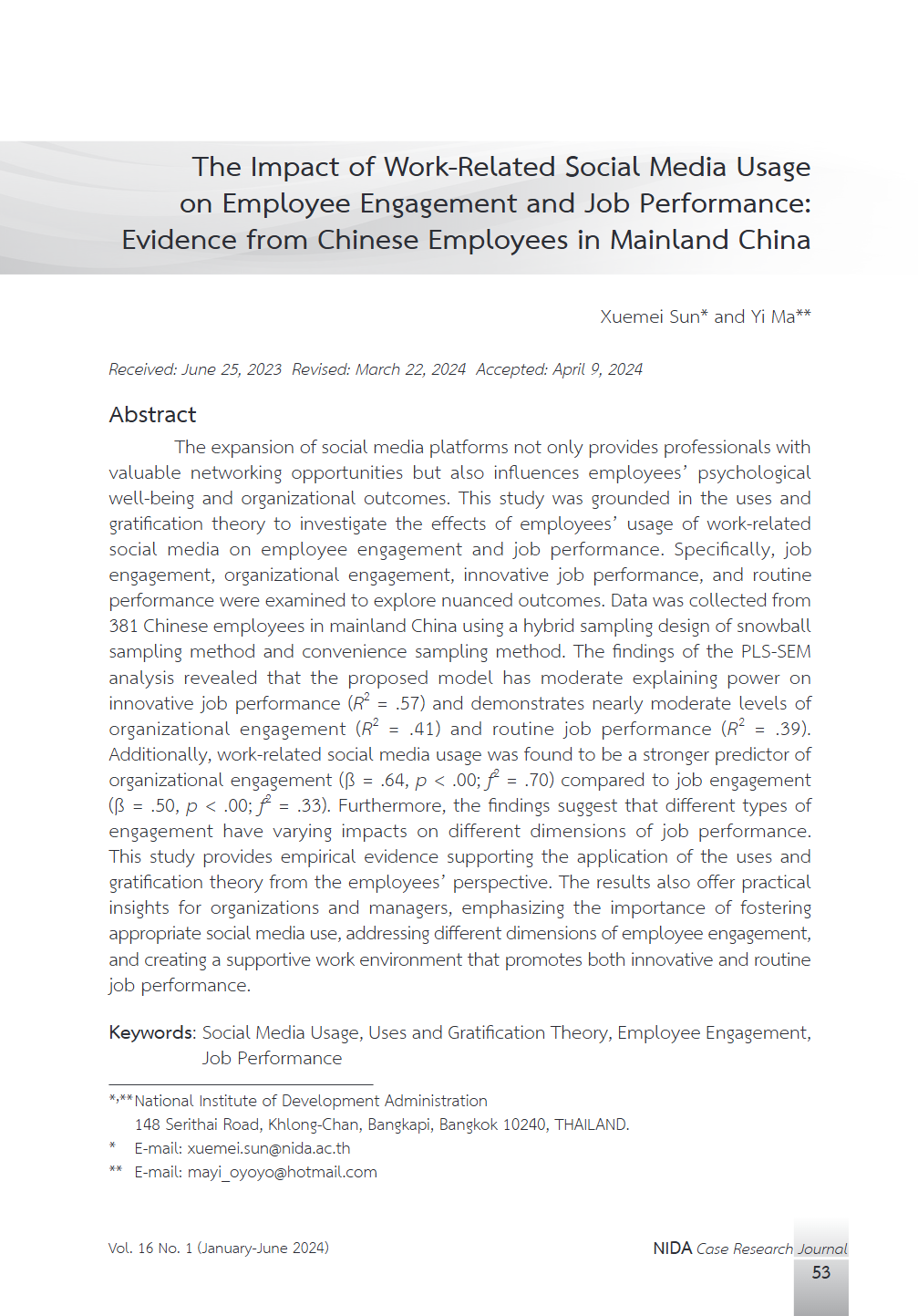
The Impact of Work-Related Social Media Usage on Employee Engagement and Job Performance: Evidence from Chinese Employees in Mainland China
DOI:
https://doi.org/10.14456/ncrj.2024.3Keywords:
Social Media Usage, Uses And Gratification Theory, Employee Engagement, Job PerformanceAbstract
The expansion of social media platforms not only provides professionals with valuable networking opportunities but also influences employees’ psychological well-being and organizational outcomes. This study was grounded in the uses and gratification theory to investigate the effects of employees’ usage of work-related social media on employee engagement and job performance. Specifically, job engagement, organizational engagement, innovative job performance, and routine performance were examined to explore nuanced outcomes. Data was collected from 381 Chinese employees in mainland China using a hybrid sampling design of snowball sampling method and convenience sampling method. The findings of the PLS-SEM analysis revealed that the proposed model has moderate explaining power on innovative job performance (R2 = .57) and demonstrates nearly moderate levels of organizational engagement (R2 = .41) and routine job performance (R2 = . 3 9 ) . Additionally, work-related social media usage was found to be a stronger predictor of organizational engagement (ß = .64, p < .00; f2 = .70) compared to job engagement (ß = .50, p < .00; f2 = .33). Furthermore, the findings suggest that different types of engagement have varying impacts on different dimensions of job performance. This study provides empirical evidence supporting the application of the uses and gratification theory from the employees’ perspective. The results also offer practical insights for organizations and managers, emphasizing the importance of fostering appropriate social media use, addressing different dimensions of employee engagement, and creating a supportive work environment that promotes both innovative and routine job performance.
References
Ali-Hassan, H., Nevo, D., & Wade, M. (2015). Linking dimensions of social media use to job performance: The role of social capital. The Journal of Strategic Information Systems, 24(2), 65-89. https://doi.org/10.1016/j.jsis.2015.03.001
Ahmad, S. Z., Abu Bakar, A. R., & Ahmad, N. (2019). Social media adoption and its impact on firm performance: the case of the UAE. International Journal of Entrepreneurial Behavior & Research, 25(1), 84-111. https://doi.org/10.1108/IJEBR-08-2017-0299
Ali, A., Bahadur, W., Wang, N., Luqman, A., & Khan, A. N. (2020). Improving team innovation performance: role of social media and team knowledge management capabilities. Technology in Society, 61, 101259. https://doi.org/10.1016/j.techsoc.2020.101259
Aung, Z. M., San Santoso, D., & Dodanwala, T. C. (2023). Effects of demotivational managerial practices on job satisfaction and job performance: Empirical evidence from Myanmar's construction industry. Journal of Engineering and Technology Management, 67, 101730. https://doi.org/10.1016/j.jengtecman. 2022.101730
Behr, D. (2017). Assessing the use of back translation: The shortcomings of back translation as a quality testing method. International Journal of Social Research Methodology, 20(6), 573-584. https://doi.org/10.1080/13645579.2016.1252188
Camilleri, M. A., & Falzon, L. (2021). Understanding motivations to use online streaming services: integrating the technology acceptance model (TAM) and the uses and gratifications theory (UGT). Spanish Journal of Marketing-ESIC, 25(2), 217-238. https://doi.org/10.1108/SJME-04-2020-0074
Carter, R. W., Nesbit, P. L., Badham, R. J., Parker, S. K., & Sung, L. (2018). The effects of employee engagement and self-efficacy on job performance: a longitudinal field study. The International Journal of Human Resource Management, 29(17), 2483-2502, doi: 10.1080/09585192.2016.1244096
Chen, X., & Wei, S. (2019). Enterprise social media use and overload: A curvilinear relationship. Journal of Information Technology, 34(1), 22-38. https://doi. org/10.1177/0268396218802728
Chen, X., Ou, C. X., & Davison, R. M. (2022). Internal or external social media? The effects of work-related and social-related use of social media on improving employee performance. Internet Research, 32(3), 680-707. https://doi. org/10.1108/INTR-03-2020-0159
Chen, X., Wei, S., Davison, R. M., & Rice, R. E. (2020). How do enterprise social media affordances affect social network ties and job performance?. Information Technology & People, 33(1), 361-388. https://doi.org/10.1108/ITP-11-2017-0408
Cropanzano, R., Anthony, E. L., Daniels, S. R., & Hall, A. V. (2017). Social exchange theory: A critical review with theoretical remedies. Academy of management annals, 11(1), 479-516. https://doi.org/10.5465/annals.2015.0099
Deng, H., Duan, S. X., & Wibowo, S. (2023). Digital technology driven knowledge sharing for job performance. Journal of Knowledge Management, 27(2), 404-425. https://doi.org/10.1108/JKM-08-2021-0637
Ferris, A. L., & Hollenbaugh, E. E. (2018). A uses and gratifications approach to exploring antecedents to Facebook dependency. Journal of Broadcasting & Electronic Media, 62(1), 51-70. https://doi.org/10.1080/08838151.2017.1375501
Ganguly, A., Talukdar, A., & Chatterjee, D. (2019). Evaluating the role of social capital, tacit knowledge sharing, knowledge quality and reciprocity in determining innovation capability of an organization. Journal of knowledge management, 23(6), 1105-1135. doi: 10.1108/JKM-03-2018-0190
Hair, J. F., Risher, J. J., Sarstedt, M., & Ringle, C. M. (2019). When to use and how to report the results of PLS-SEM. European Business Review, 31(1), 2-24. https://doi.org/10.1108/EBR-11-2018-0203
Hair, J. F., Hult, G. T. M., Ringle, C. M., Sarstedt, M., Danks, N. P., Ray, S. (2021). Mediation Analysis. In: Partial Least Squares Structural Equation Modeling (PLS-SEM) Using R. Classroom Companion: Business. Springer, Cham. https://doi. org/10.1007/978-3-030-80519-7_7
Howard, M. C., & Henderson, J. (2023). A review of exploratory factor analysis in tourism and hospitality research: Identifying current practices and avenues for improvement. Journal of Business Research, 154, 113328. https://doi. org/10.1016/j.jbusres.2022.113328
Hsu, C. L., Lin, J. C. C., & Miao, Y. F. (2020). Why are people loyal to live stream channels? The perspectives of uses and gratifications and media richness theories. Cyberpsychology, Behavior, and Social Networking, 23(5), 351-356. https://doi.org/10.1089/cyber.2019.0547
Hu, S., Gu, J., Liu, H., & Huang, Q. (2017). The moderating role of social media usage in the relationship among multicultural experiences, cultural intelligence, and individual creativity. Information Technology & People, 30(2), 265-281. https://doi.org/10.1108/ITP-04-2016-0099
Jung, H. S., Jung, Y. S., & Yoon, H. H. (2021). COVID-19: The effects of job insecurity on the job engagement and turnover intent of deluxe hotel employees and the moderating role of generational characteristics. International journal of hospitality management, 92, 102703. https://doi.org/10.1016/j.ijhm.2020.102703
Katz, D. (1964). The motivational basis of organizational behavior. Behavioral science, 9(2), 131-146. https://doi.org/10.1002/bs.3830090206
Katz, E. (1974). Utilization of mass communication by the individual. The Uses of Mass Communications Current Perspectives on Gratifications Research, 19-32.
Katz, E., Haas, H., & Gurevitch, M. (1973). On the use of the mass media for important things. American sociological review, 38(2), 164-181. https://doi.org/10.2307/2094393
Kock, F., Berbekova, A., & Assaf, A. G. (2021). Understanding and managing the threat of common method bias: Detection, prevention and control. Tourism Management, 86, 104330. https://doi.org/10.1016/j.tourman.2021.104330
Kuegler, M., Smolnik, S., & Kane, G. (2015). What's in IT for employees? Understanding the relationship between use and performance in enterprise social software. The Journal of Strategic Information Systems, 24(2), 90-112. https://doi. org/10.1016/j.jsis.2015.04.001
Kujur, F., & Singh, S. (2020). Visual communication and consumer-brand relationship on social networking sites-uses & gratifications theory perspective. Journal of theoretical and applied electronic commerce research, 15(1), 30-47. https://doi.org/10.4067/50718-18762020000100104
Lin, L. (2022a). Number of social media users in China 2018-2027. https://www. statista.com/statistics/277586/number-of-social-network-users-in-china/
Lin, L. (2022b). Average daily time spent on WeChat in China 2021. https://www. statista.com/statistics/668386/china-amount-of-time-users-spent-on-wechat-daily/
Lin, L. (2022c). WeChat user age distribution 2022. https://www.statista.com/statistics/387658/wechat-china-user-age/
Lin, L. (2023a). Most popular social media in China Q3 2022. https://www.statista.com/statistics/250546/leading-social-network-sites-in-china/
Lin, L. (2023b). Number of active WeChat messenger accounts Q2 2011-Q1 2023. https://www.statista.com/statistics/255778/number-of-active-wechat-messenger-accounts/
Lin, Y. H., & Chu, M. G. (2021). Online communication self-disclosure and intimacy development on Facebook: the perspective of uses and gratifications theory. Online Information Review, 45(6), 1167-1187. https://doi.org/10.1108/OIR-08-2020-0329
Liu, X., Min, Q., & Han, S. (2020). Understanding users' continuous content contribution behaviours on microblogs: An integrated perspective of uses and gratification theory and social influence theory. Behaviour & Information Technology, 39(5), 525-543. https://doi.org/10.1080/0144929X.2019.1603326
Luo, N., Guo, X., Lu, B., & Chen, G. (2018). Can non-work-related social media use benefit the company? A study on corporate blogging and affective organizational commitment. Computers in Human Behavior, 81, 84-92. https://doi. org/10.1016/j.chb.2017.12.004
Men, L. R., O'Neil, J., & Ewing, M. (2020). Examining the effects of internal social media usage on employee engagement. Public Relations Review, 46(2), 101880. https://doi.org/10.1016/j.pubrev.2020.101880
Nisar, T. M., Prabhakar, G., & Strakova, L. (2019). Social media information benefits, knowledge management and smart organizations. Journal of Business Research, 94, 264-272. https://doi.org/10.1016/j.jbusres.2018.05.005
Noda, H. (2020). Work-life balance and life satisfaction in OECD countries: A cross-sectional analysis. Journal of Happiness Studies, 21(4), 1325-1348. https://doi.org/10.1007/s10902-019-00131-9
Oksa, R., Kaakinen, M., Savela, N., Ellonen, N., & Oksanen, A. (2021). Professional social media usage: Work engagement perspective. New media & society, 23(8), 2303-2326. https://doi.org/10.1177/1461444820921938
Pandita, D., & Ray, S. (2018). Talent management and employee engagement-a meta-analysis of their impact on talent retention. Industrial and Commercial Training, 50(4), 185-199. https://doi.org/10.1108/ICT-09-2017-0073
Pekkala, K., & Van Zoonen, W. (2022). Work-related social media use: The mediating role of social media communication self-efficacy. European Management Journal, 40(1), 67-76. https://doi.org/10.1016/j.emj.2021.03.004
Pongton, P., & Suntrayuth, S. (2019). Communication satisfaction, employee engagement, job satisfaction, and job performance in higher education institutions. Abac Journal, 39(3), 90-110.
Rai, A., & Maheshwari, S. (2020). Exploring the mediating role of work engagement between the linkages of job characteristics with organizational engagement and job satisfaction. Management Research Review, 44(1), 133-157. https://doi.org/10.1108/MRR-10-2019-0442
Ringle, Christian M., Wende, Sven, & Becker, Jan-Michael. (2022). SmartPLS 4. Oststeinbek: SmartPLS. Retrieved from https://www.smartpls.com
Saks, A. M. (2019). Antecedents and consequences of employee engagement revisited. Journal of Organizational Effectiveness: People and Performance, 6(1), 19-38. https://doi.org/10.1108/JOEPP-06-2018-0034
Saks, A. M., Gruman, J. A., & Zhang, Q. (2022). Organization engagement: a review and comparison to job engagement. Journal of Organizational Effectiveness: People and Performance, 9(1), 20-49. https://doi.org/10.1108/JOEPP-12-2020-0253
Shen, W., & Joseph, D. L. (2021). Gender and leadership: A criterion-focused review and research agenda. Human Resource Management Review, 31(2), 100765. https://doi.org/10.1016/j.hrmr.2020.100765
Song, Q., Wang, Y., Chen, Y., Benitez, J., & Hu, J. (2019). Impact of the usage of social media in the workplace on team and employee performance. Information & Management, 56(8), 103160. https://doi.org/10.1016/j.im.2019.04.003
Sun, Y., Liu, Y., & Zhang, J. (2020). Excessive enterprise social media use behavior at work: role of communication visibility and perspective of uses and gratifications theory. IEEE Access, 8, 190989-191004. doi: 10.1109/ACCESS.2020.3032035.
Sun, Y., Shao, X., Li, X., Guo, Y., & Nie, K. (2019). How live streaming influences purchase intentions in social commerce: An IT affordance perspective. Electronic Commerce Research and Applications, 37, 100886. https://doi.org/10.1016/j.elerap.2019.100886
Tajudeen, F. P., Jaafar, N. I., & Ainin, S. (2018). Understanding the impact of social media usage among organizations. Information & Management, 55(3), 308-321. https://doi.org/10.1016/j.im.2017.08.004
Tajvidi, R., & Karami, A. (2021). The effect of social media on firm performance. Computers in Human Behavior, 115, 105174. https://doi.org/10.1016/j. chb.2017.09.026
Tetik, S., & Halil, Z. A. I. M. (2021). Effects of talent management practices on organizational engagement: A quasi-experimental study. Eurasian Journal of Business and Economics, 14(27), 91-109. https://doi.org/10.17015/ejbe.2021. 027.06
Tian, X. (2021). An interactional space of permanent observability: WeChat and reinforcing the power hierarchy in Chinese workplaces. Sociological Forum, 36(1), 51-69. https://doi.org/10.1111/socf.12662
Warr, P. (2020). Age and job performance. In Work and aging (pp. 309-325). CRC Press.
Webb, M., Autor, D., Bloom, N., Bresnahan, T., Brynjolfsson, E., Chetty, R., Coyle, D., Gentzkow, M., Hoxby, C., Jaravel, X., Jones, C., Klenow, P., Pistaferri, L., Rafey, W., Sorkin, I., Van Reenen, J., Agrawal, A., Connelly, T., Han, A.,...Thornton, G. (2019). The impact of artificial intelligence on the labor market. Available from papers.ssrn.com. https://ssrn.com/abstract=3482150
Yamane, Taro. (1967). Statistics: An Introductory Analysis. 2nd Edition. New York: Harper and Row.
Zhang, X., Ma, L., Xu, B., & Xu, F. (2019). How social media usage affects employees' job satisfaction and turnover intention: An empirical study in China. Information & Management, 56(6), 103136. https://doi.org/10.1016/j.im.2018.12.004
Zhao, J., Zhu, C., Peng, Z., Xu, X., & Liu, Y. (2018). User willingness toward knowledge sharing in social networks. Sustainability, 10(12), 4680. https://doi.org/10.3390/su10124680
Zhou, M., Huang, J., Wu, K., Huang, X., Kong, N., & Campy, K. S. (2021). Characterizing Chinese consumers' intention to use live e-commerce shopping. Technology in Society, 67, 101767. https://doi.org/10.1016/j.techsoc.2021.101767
Downloads
Published
How to Cite
Issue
Section
License
Copyright (c) 2024 NIDA Case Research Journal

This work is licensed under a Creative Commons Attribution-NonCommercial-NoDerivatives 4.0 International License.