
การปรับเปลี่ยนกระบวนทัศน์นโยบายการพัฒนาความเท่าเทียมทางเพศในประเทศไทย: ความเท่าเทียม vs. ความแตกต่าง
DOI:
https://doi.org/10.14456/ncrj.2025.5คำสำคัญ:
ความเท่าเทียมทางเพศ, การเสริมพลังสตรี, แผนปฏิบัติการระดับชาติ, การเปลี่ยนแปลงกระบวนทัศน์บทคัดย่อ
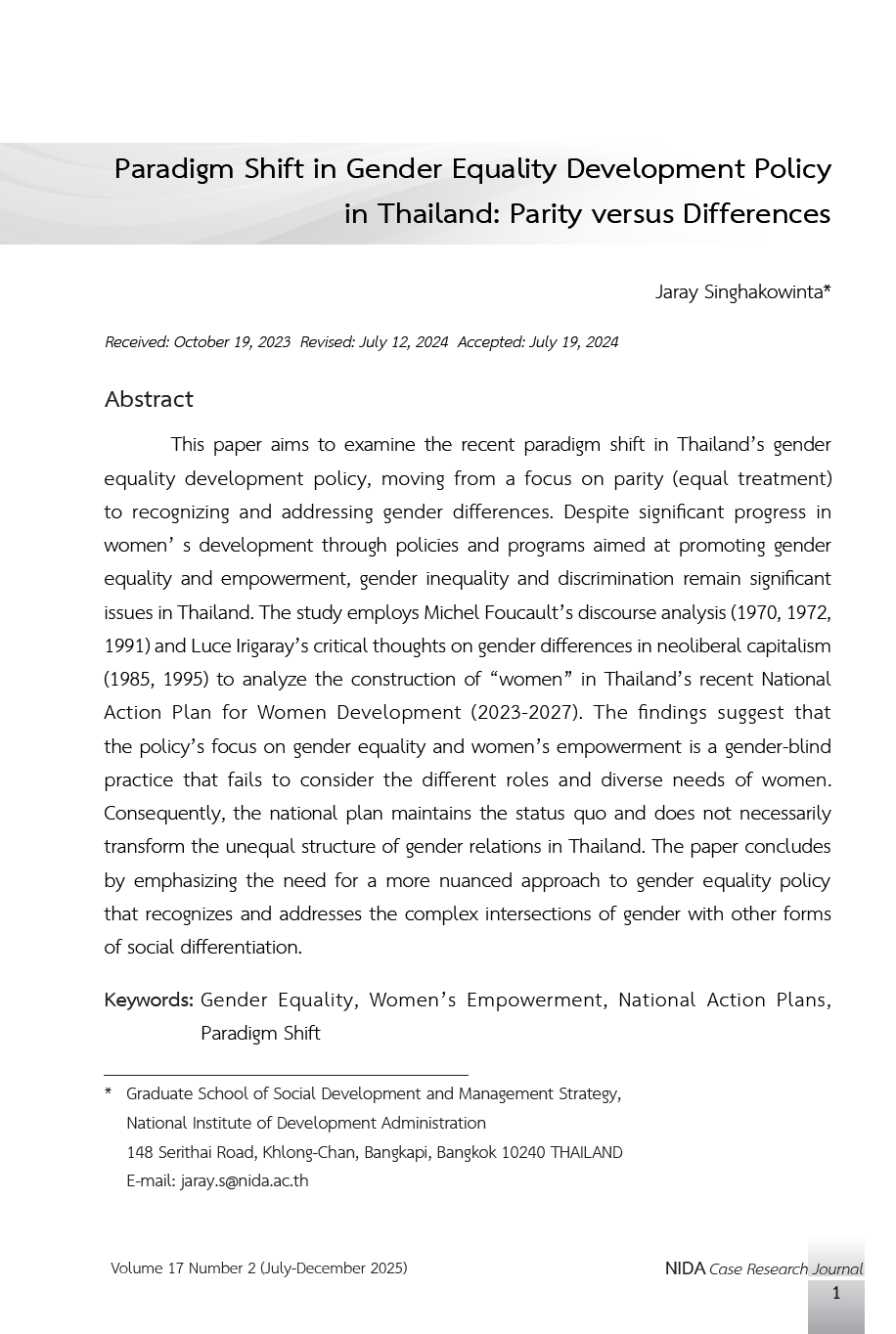
บทความนี้มีวัตถุประสงค์เพื่อศึกษาการเปลี่ยนแปลงกระบวนทัศน์ในนโยบายการพัฒนา ความเท่าเทียมทางเพศของประเทศไทย จากการมุ่งเน้นความเท่าเทียม (การปฏิบัติที่เท่าเทียมกัน) ไปสู่การตระหนักและจัดการกับความแตกต่างทางเพศ แม้จะมีความก้าวหน้าอย่างมีนัยสำคัญในการ พัฒนาสตรีผ่านนโยบายและโครงการที่มุ่งส่งเสริมความเสมอภาคทางเพศและการเสริมพลัง ความไม่เท่าเทียมทางเพศและการเลือกปฏิบัติยังคงเป็นปัญหาสำคัญในประเทศไทย การศึกษานี้ ใช้การวิเคราะห์วาทกรรมของ Michel Foucault (1970, 1972, 1991) และแนวคิดเชิงวิพากษ์ของ Luce Irrigaray เกี่ยวกับความแตกต่างทางเพศในระบบทุนนิยมเสรีนิยมใหม่ (1985, 1995) เพื่อวิเคราะห์การสร้างความหมายของ “ผู้หญิง” ในแผนปฏิบัติการระดับชาติว่าด้วยการพัฒนาสตรี (พ.ศ. 2566-2570) ของประเทศไทย ผลการศึกษาชี้ให้เห็นว่าการมุ่งเน้นความเสมอภาคทางเพศและ การเสริมพลังสตรีในนโยบายเป็นแนวปฏิบัติที่ไม่คำนึงถึงความแตกต่างทางเพศ ซึ่งไม่ได้พิจารณา ถึงบทบาทที่แตกต่างกันและความต้องการที่หลากหลายของผู้หญิง ส่งผลให้แผนระดับชาติยังคงรักษา สถานะเดิมและไม่ได้เปลี่ยนแปลงโครงสร้างความสัมพันธ์ทางเพศที่ไม่เท่าเทียมในประเทศไทย อย่างแท้จริง บทความนี้สรุปด้วยการเน้นย้ำถึงความจำเป็นในการใช้แนวทางที่ละเอียดอ่อนมากขึ้น ต่อนโยบายความเสมอภาคทางเพศ ซึ่งตระหนักและจัดการกับความซับซ้อนของการตัดกันระหว่าง เพศสภาพกับรูปแบบอื่น ๆ ของความแตกต่างทางสังคม
เอกสารอ้างอิง
Arribas-Ayllon, M., & Walkerdine, V. (2008). Foucauldian discourse analysis. In L. M. Given (Ed.), The Sage encyclopedia of qualitative research methods (pp. 110–123). SAGE Publications. https://doi.org/10.4135/9781412963909
Bacchi, C., & Eveline, J. (2009). Gender mainstreaming or diversity mainstreaming? The politics of “doing”. NORA–Nordic Journal of Feminist and Gender Research, 17(1), 2-17. https://doi.org/10.1080/08038740802689133
Balducci, M. (2023). Linking gender differences with gender equality: A systematicnarrative literature review of basic skills and personality. Frontiers in Psychology, 14:1105234. https://doi.org/10.3389/fpsyg.2023.1105234
Beauvoir, S. de. (2011). The second sex (C. Borde & S. Malovany-Chevallier, Trans.). Vintage Books. (Original work published 1949)
Binkley, S. (2009). The work of neoliberal governmentality: Temporality and ethical substance in the tale of two dads. Foucault Studies, 60-78. https://doi.org/10.22439/fs.v0i0.2472
Buranajaroenkij, D. (2017). Political feminism and the women’s movement in Thailand: Actors, debates and strategies. Friedrich-Ebert-Stiftung. Retrieved from https://library.fes.de/pdf-files/bueros/thailand/13363.pdf
Butler, J. (1999). Gender trouble: Feminism and the subversion of identity. Routledge. (Original work published 1990)
Cain, P. A. (1990). Feminism and the limits of equality. Georgia Law Review, 24(4), 803-848.
Caldwell, A. (2002). Transforming sacrifice: Irigaray and the politics of sexual difference. Hypatia, 17(4), 16–38. http://www.jstor.org/stable/3810907
Connell, R. (2009). Gender: In world perspective (2nd ed.). Polity Press.
Couch, K. A., Hersch, J., & Shinall, J. B. (2015). Fifty years later: The legacy of the civil rights act of 1964. Journal of Policy Analysis and Management, 34(2), 424–456. http://www.jstor.org/stable/43866378
Crenshaw, K. (1989). Demarginalizing the intersection of race and sex: A black feminist critique of antidiscrimination doctrine, feminist theory, and antiracist politics. University of Chicago Legal Forum, 1989(1), 139-167. Retrieved from http://chicagounbound.uchicago.edu/uclf/vol1989/iss1/8
Crenshaw, K. (1991). Mapping the margins: Intersectionality, identity politics, and violence against women of color. Stanford Law Review, 43(6), 1241-1299. https://doi.org/10.2307/1229039
Department of Disease Control, Ministry of Public Health. (2022, November 25). The department of disease control campaigns for international day for the elimination of violence against women for year 2022. Retrieved from https://datariskcom-ddc.moph.go.th/download/กรมควบคุมโรค-รณรงค์วันย/ Department of Women’s Affairs and Family Development, Ministry of Social
Development and Human Security, & Center for Philanthropy and Civil Society, National Institute of Development Administration. (2022). Action plan on women’s development (2023-2027). Retrieved from http://www.cpcs. nida.ac.th/home/pdf/allnewcover.pdf
Department of Women’s Affairs and Family Development, Ministry of Social Development and Human Security. (2020b). 3-year action plan on department of women’s affairs and family development (2020-2022). https://www.rattanapa.go.th/attach_forms/ 2c0dd90cb62d48a017e3794224bf92db.pdf
Department of Women’s Affairs and Family Development, Ministry of Social Development and Human Security. (2022a). Gender equality promotion action plans (2020-2022). Retrieved from https://www.dop.go.th/download/news/hr/th1648715849-251_0.pdf
Department of Women’s Affairs and Family Development, Ministry of Social Development and Human Security. (2022b). Towards gender equality: Good practices in Thai government. https://www.dop.go.th/download/news/hr/th1678867262-335_0.pdf
Department of Women’s Affairs and Family Development, Ministry of Social Development and Human Security, & Center for Philanthropy and Civil Society, National Institute of Development Administration. (2022). Action plan on women’s development (2023-2027). http://www.cpcs.nida.ac.th/home/pdf/allnewcover.pdf
Ferguson, S. (1999). The radical ideas of Mary Wollstonecraft. Canadian Journal of Political Science/Revue Canadienne de Science Politique, 32(3), 427–450. http://www.jstor.org/stable/3232731
Foucault, M. (1970). The order of things: An archaeology of the human sciences. Tavistock.
Foucault, M. (1972). The archaeology of knowledge & the discourse on language (A. M. Sheridan Smith, Trans.). Pantheon Books. (Original work published 1971)
Foucault, M. (1978). The history of sexuality volume 1: An introduction. Random House.
Foucault, M. (1980). Power/knowledge: Selected interviews and other writings 1972-1977. Pantheon Books.
Foucault, M. (1991). Politics and the study of discourse. In G. Burchell, C. Gordon, & P. Miller (Eds.), The Foucault effect: Studies in governmentality (pp.87-104). Harvester Wheatsheaf.
Foucault, M. (1995). Discipline and punish: The birth of the prison (A. M. Sheridan Smith, Trans.). Vintage Books. (Original work published 1977).
Foucault, M. (1991). Politics and the study of discourse. In G. Burchell, C. Gordon, & P. Miller (Eds.), The Foucault effect: Studies in governmentality (pp.87-104). Harvester Wheatsheaf.
Gilligan, C. (2003). In a different voice: Psychological theory and women’s development. Harvard University Press. (Original work published 1982)
Gopal, K. (2004). Janteloven, The antipathy to difference; Looking at Danish ideas of equality as sameness. Cambridge Anthropology, 24(3), 64–82. http://www.jstor.org/stable/23820669
Government of Thailand. (2020). The government of Thailand’s national review implementation of the Beijing declaration and platform for action (1995) and the outcomes of the twenty-third special session of the general assembly (2000) in the context of the twenty-fifth anniversary of the fourth world conference on women and the adoption of the Beijing declaration and platform for action. https://www.unwomen.org/sites/default/files/Headquarters/Attachments/Sections/CSW/64/National-reviews/Thailand-en.pdf
Hankivsky, O. (Ed.). (2012). An intersectionality-based policy analysis framework. Institute for Intersectionality Research and Policy, Simon Fraser University.
Hervías Parejo, V., & Radulović, B. (2023). Public policies on gender equality. In D. Vujadinović, M. Fröhlich, & T. Giegerich (Eds.), Gender-competent legal education (pp. 405-428). Springer.
Hochfeld, T., & Bassadien, S. R. (2007). Participation, values, and implementation: Three research challenges in developing gender-sensitive indicators. Gender and Development, 15(2), 217–230. http://www.jstor.org/stable/20461202
Irigaray, L. (1985). Speculum of the other woman. (G. C. Gill, Trans.). Cornell University Press. (Original work published 1974)
Irigaray, L., & Guynn, N. (1995). The question of the other. Yale French Studies, 87, 7–19. https://doi.org/10.2307/2930321
Jongwilaiwan, R., & Thompson, E. C. (2011). Thai wives in Singapore and transnational patriarchy. Gender, Place & Culture, 20(3), 363–381. https://doi.org/10.1080/0966369X.2011.624588
Kantavong, P., Nethanomsak, T., & Luang-Ungkool, N. (2012). Inclusive education in Thailand after 1999 National education Act: A review of a pre-service teacher education system. Procedia-Social and Behavioral Sciences, 69, 1043-1051. https://doi.org/10.1016/j.sbspro.2012.12.031
MacArthur, J., Carrard, N., Davila, F., Grant, M., Megaw, T., Willetts, J., & Winterford, K. (2022). Gender-transformative approaches in international development: A brief history and five uniting principles. Women’s Studies International Forum, 95, Article 102635. https://doi.org/10.1016/j.wsif.2022.102635
Manlosa, A., & Matias, D. M. (2018, March 5). From gender parity to gender equality: Changing women’s lived realities. The Current Column. German Development Institute / Deutsches Institut für Entwicklungspolitik (DIE). https://www.idosresearch.de/uploads/media/German_Development_Institute_Manlosa_Matias_05.03.2018.pdf
McNay, Lois (1992). Foucault and feminism: Power, gender and the self. Polity.
Mendoza, A. M. (2024, January 12). Advancing gender equality through gender-responsive public financial management. Development Asia. https://development.asia/insight/advancing-gender-equality-through-genderresponsive-public-financial-management
Mohajan, H. K. (2022). An overview on the feminism and its categories. Research and Advances in Education, 1(3), 11–26. https://doi.org/10.56397/RAE.2022.09.02
Moi, T. (1999). What is a woman? And other essays. Oxford University Press. Naldini, M. (2011). Introduction: Feminist views on social policy and gender equality. Sociologica, 1, 1-11. doi: 10.2383/34626
Narayan, U. (1998). Essence of culture and a sense of history: A feminist critique of cultural essentialism. Hypatia, 13(2), 86–106. http://www.jstor.org/stable/3810639
Office of the National Economic and Social Development Board, Office of the Prime Minister. Summary the twelfth national economic and social development plan (2017-2021). https://www.nesdc.go.th/ewt_dl_link.php?nid=9640
Organisation for Economic Co-operation and Development (2021, September 27), Policy framework for gender-sensitive public governance. https://www.oecd.org/mcm/Policy-Framework-for-Gender-Sensitive-Public-Governance.pdf
Paweenawat, S. W. (2021). Thailand - Country gender assessment (English). World Bank Group. http://documents.worldbank.org/curated/en/099246504212242722/IDU06d9b6f9b0cdb304e020b3fb0b386542c46f9
Poe, D. (2011). Can Luce Irigaray’s notion of sexual difference be applied to transsexual and transgender narratives?. In M. C. Rawlinson, S. L. Hom, & S. J. Khader (Eds.), Thinking with Irigaray (111-130). State University of New York Press
Ramirez, F. O., Soysal, Y., & Shanahan, S. (1997). The changing logic of political citizenship: Cross-national acquisition of women’s suffrage rights, 1890 to 1990. American Sociological Review, 62(5), 735–745. https://doi.org/10.2307/2657357
Razavi, T. B. (2023). Parity, paradigms, and possibilities: A constructive approach to advancing women’s equality. SN Social Sciences, 3(3), Article 49. https://doi.org/10.1007/s43545-023-00640-8
Scott, J. (1988). Gender and the politics of history. Columbia University Press.
Sopchokchai, O., Rukhamate, P., Nakosiri, P., Sriket, N., Amornkijsoontorn, R., & Sanpang, S. (2017). Women Development Strategy 2017-2021. Department of Women’s Affairs and Family Development, Ministry of Social Development and Human Security. https://rattanapa.go.th/attach_forms/320f5654d338ff1d6d9b79c3227743ff.pdf
Suksri, S. (2021). The implementation and effectiveness of the gender equality act (2015). King Prajadhipok Institute. https://www.kpi.ac.th/knowledge/research/data/1212
Thai Health Promotion Foundation. (2022, March 8). More than 7 Thai women are sexually abused or subjected to violence per day; Urgent promotion of gender equality and elimination of all forms of violence is needed. https://www.thaihealth.or.th/หญิงไทยถูกละเมิดทางเพศ/
Thai Health Promotion Foundation. (2021, August 31). Family Violence on the Rise During COVID: A Ticking Time Bomb. https://resourcecenter.thaihealth.or.th/article/ความรุนแรงในครอบครัวรอวันระเบิด-วิกฤตซ้ำซ้อนที่มีแนวโน้มเพิ่มขึ้นช่วงโควิด
The United Nations Population Fund. (2020). The covid-19 pandemic and violence against women in Asia and the pacific. https://www.unfpa.org/sites/default/files/resource-pdf/COVID19_impact_brief_for_UNFPA_24_April_2020_1.pdf
Unterhalter, E., Robinson, L., & Balsera, M. R. (2020). The politics, policies and practices of intersectionality: Making gender equality inclusive and equitable in and through education (Background paper prepared for the Global Education Monitoring Report Gender Report 2020: A new generation: 25 years of efforts for gender equality in education; Document code: ED/GEMR/MRT/2020/P1/30/REV). UNESCO.
United Nations Development Programme. (2006). Women’s right to a political voice in Thailand Millennium Development Goal 3: Promote gender equality and empower women. https://www.undp.org/sites/g/files/zskgke326/files/migration/th/MDG3-English.pdf
UN Women. (2015). Monitoring gender equality and the empowerment of women and girls in the 2030 agenda for sustainable development: Opportunities and challenges. https://www.unwomen.org/sites/default/files/Headquarters/Attachments/Sections/Library/Publications/2015/IndicatorPaper-EN-FINAL.pdf
UN Women. (2022). Handbook on gender mainstreaming for gender equality results. https://www.unwomen.org/sites/default/files/2022-02/Handbook-on-gendermainstreaming-for-gender-equality-results-en.pdf
Vantin, S. (2021). The prism of equality from legal feminist critiques to the digital era. Women’s Studies International Forum 86: 102469. https://doi.org/10.1016/j.wsif.2021.102469
Vichit-Vadakan, J. (1994). Women and the family in Thailand in the midst of social change. Law & Society Review, 28(3), 515–524. https://doi.org/10.2307/3054071
Walby, S. (2005). Gender mainstreaming: Productive tensions in theory and practice. Social Politics: International Studies in Gender, State & Society, 12(3), 321–343. https://doi.org/10.1093/sp/jxi018
Wasi, J. (2021). How gender equality belongs to us all? Lesson learned from empowerment based work with Thai grass root women. Social Justice and Inequality Journal, 2(2), 1-14.
Whitford, M. (1991). Luce Irigaray: Philosophy in the feminine (1st ed.). Routledge.
Xu, P. (1995). Irigaray’s mimicry and the problem of essentialism. Hypatia, 10(4), 76-89. https://doi.org/10.1111/j.1527-2001.1995.tb00999.x
ดาวน์โหลด
เผยแพร่แล้ว
รูปแบบการอ้างอิง
ฉบับ
ประเภทบทความ
สัญญาอนุญาต
ลิขสิทธิ์ (c) 2025 NIDA Case Research Journal

อนุญาตภายใต้เงื่อนไข Creative Commons Attribution-NonCommercial-NoDerivatives 4.0 International License.