
การจัดการความขัดแย้ง: กรณีศึกษาการพัฒนา โครงการโรงไฟฟ้าเชื้อเพลิงขยะ จังหวัดปทุมธานี
DOI:
https://doi.org/10.14456/ncrj.2024.6คำสำคัญ:
การจัดการความขัดแย้ง , โรงไฟฟ้าเชื้อเพลิงขยะ, จังหวัดปทุมธานี, การมีส่วนร่วมบทคัดย่อ
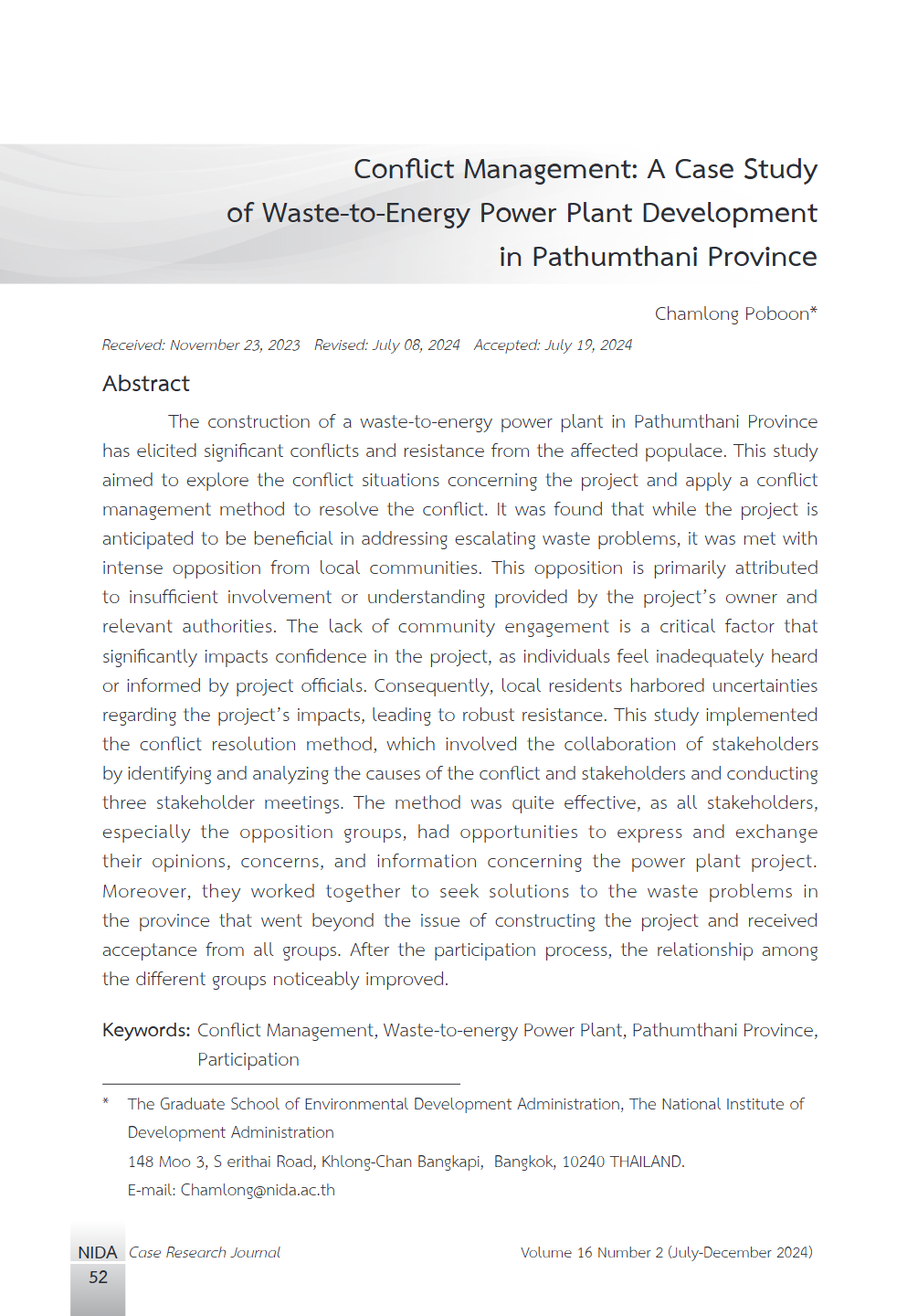
โครงการก่อสร้างโรงไฟฟ้าเชื้อเพลิงขยะในจังหวัดปทุมธานีนำไปสู่ความขัดแย้งและการต่อต้านจากประชาชนที่ได้รับผลกระทบอย่างรุนแรง การศึกษานี้มีวัตถุประสงค์เพื่อศึกษาวิเคราะห์สถานการณ์และสาเหตุของปัญหาความขัดแย้ง และประยุกต์วิธีการจัดการความขัดแย้งมาใช้แก้ไขปัญหา ผลการศึกษา พบว่า ถึงแม้ว่าโครงการนี้เกิดขึ้นเพื่อช่วยลดปัญหาขยะที่ทวีความรุนแรงมากขึ้นในทุก ๆ ปี แต่ปัญหาสำคัญ คือ การคัดค้านอย่างรุนแรงของประชาชนในพื้นที่ที่จะทำการก่อสร้าง
โครงการ สาเหตุสำคัญเกิดจากการที่หน่วยงานที่เกี่ยวข้องและเจ้าของโครงการนั้นไม่ได้มีการเปิดโอกาสให้ประชาชนมีส่วนร่วมหรือทำความเข้าใจในการดำเนินงานของโครงการอย่างเพียงพอ ทำให้ประชาชนขาดความเชื่อมั่นในตัวโครงการโดยเฉพาะอย่างผลกระทบจากโครงการ ประชาชนจึงเกิดการต่อต้านอย่างรุนแรง การศึกษานี้ได้ประยุกต์วิธีการจัดการความขัดแย้งมาใช้แก้ไขปัญหาโดยเลือกวิธีการสร้างความร่วมมือผ่านกระบวนการมีส่วนร่วมของผู้มีส่วนได้ส่วนเสีย ประกอบด้วยการระบุและวิเคราะห์สาเหตุของความขัดแย้งและผู้มีส่วนได้ส่วนเสีย และจัดการประชุมผู้มีส่วนได้ส่วนเสียจำนวน 3 ครั้ง ซึ่งการดำเนินการได้ผลค่อนข้างดีเนื่องจากผู้มีส่วนได้ส่วนเสียโดยเฉพาะอย่างยิ่งกลุ่มที่ต่อต้านโครงการได้มีโอกาสในการแสดงความคิดเห็นและแลกเปลี่ยนข้อมูลและความกังวลอย่างเต็มที่และยังได้มีโอกาสได้ร่วมกันพิจารณาหาทางออกสำหรับปัญหาขยะมูลฝอยของจังหวัดปทุมธานีซึ่งเป็นการพิจารณาทางออกในระดับสูงกว่าระดับโครงการและได้รับการยอมรับจากทุกฝ่ายหลังจากกระบวนการมีส่วนร่วมของผู้มีส่วนได้ส่วนเสียดังกล่าวความสัมพันธ์ระหว่างกลุ่มต่าง ๆ ดีขึ้น อย่างชัดเจน
เอกสารอ้างอิง
Astrup, T.F., Tonini, D., Turconi, R., & Boldrin, A. (2015). Life cycle assessment of thermal Waste-to-Energy technologies: Review and recommendations. Waste management, 37, 104-115.
Beierle,T. C., & Konisky, D. (2000). Values, conflict, and trust in participatory environmental planning. Journal of Policy Analysis and Management, 19, 587-602.
Cai, Y. (2008). Social conflicts and modes of action in China. The China Journal, 59, 89-109.
Chen, Q., Zhang, Y., & Ekroos, A. (2007). Comparison of China's environmental impact assessment (EIA) law with the European Union (EU) EIA directive. Environmental monitoring and assessment, 132, 53-65.
Eboh, F.C., Andersson, B. Å., & Richards, T. (2019). Economic evaluation of improvements in a waste-to-energy combined heat and power plant. Waste Management, 100, 75-83.
Freeman, R. E. (1984). Strategic management: A stakeholder approach. Boston: Pitman.
Griewald, Y. & Rauschmayer, F. (2014). Exploring an environmental conflict from a capability perspective. Ecological Economics, 100, 30-39.
Grosso, M., Motta, A., & Rigamonti, L. (2010). Efficiency of energy recovery from waste incineration, in the light of the new Waste Framework Directive. Waste Management, 30(7), 1238-1243.
Hajima, N. & Poboon, C. (2024). Lessons Learned from public participation process in strategic environmental assessment of electrical power development in Southern Thailand. Ph.D. in Social Sciences Journal. 14(1). 399-412.
Heikkila, T & Schlager, E. (2012). Addressing the Issues: The Choice of Environmental Conflict-Resolution Venues in the United States. American Journal of Political Science, 56(4), 773-1069.
Herrity, J. (2023). 5 Conflict Resolution Strategies: Steps, Benefits and Tips. Retrieved from https://www.indeed.com/career-advice/career-development/conflict-resolution-strategies
Hodge, R. A. (2014). Mining company performance and community conflict: moving beyond a seeming paradox. Journal of cleaner production, 84, 27-33.
Huailuek, K. (2020). Stakeholders Influence on Public Policy Process in Thailand: A Case study of Krabi Coal Power Plant. Journal of Politics and Governance, 10(2): 21-47.
Jaskoski, M. (2014). Environmental licensing and conflict in Peru's mining sector: a path-dependent analysis. World development, 64, 873-883.
Koppenjan, J. F. M., & Klijn, E. H. (2004). Managing uncertainties in networks: a network approach to problem solving and decision making. Psychology Press.
Li, Y., Homburg, V., De Jong, M., & Koppenjan, J. (2016). Government responses to environmental conflicts in urban China: the case of the Panyu waste incineration power plant in Guangzhou. Journal of Cleaner Production, 134, 354-361.
Mandell, M. (2001). Getting results through collaboration: Networks and network structures for public policy and management. Bloomsbury Publishing USA.
Menikpura, S. N. M., Sang-Arun, J., & Bengtsson, M. (2016). Assessment of environmental and economic performance of Waste-to-Energy facilities in Thai cities. Renewable Energy, 86, 576-584.
Moore, C.W. (1896). The mediation process, practical strategies for resolving conflict. Bass-Jossey Publishers, San Francisco. Pathumthani Provincial Office, 2022a. Pathumthani in Brief. Retrieved from http://www2.pathumthani.go.th/index.php.
Pathumthani Provincial Office, 2022b. Pathumthani Provincial Development Plan. Retrieved from http://www.pathumthani.go.th/new_web/webplan/index.html
Phantasen, A. (2000). Conflict from a mega industrial development project: A case study of Rayong industrial estate park project (Bankhai). (Master Degree), National Instituteof Development Administation, Bangkok.
Pierre, J. (Ed.). (2000). Debating governance: Authority, steering, and democracy. OUP Oxford.
Poboon, C., Phoochinda, W., & Chomphan, J. (2012). A study of the environment of public participation in the development of energy projects: A case study of Krabi province. Retrieved from http://consult.nida.ac.th/sites/default/files/fileseminarreport/SEA0.pdf
PCD (Pollution Control Department). (2014). Thailand State of Pollution Report 2014. 1-5.
Putnam, L. L. (2013). Definitions and approaches to confl ICT and Communication. In J. G. Oetzel & S. Ting Toomey (Eds.), The SAGE Handbook of Confl ICT Communication: Integrating theory, research, and practice (2nd ed.). Los Angeles, CA: Sage.
Raksasri, S. (2014). Community's knowledge management for solving conflicts between sahacogen green biomass power plant and villages of Pasak Subdistrict, Mueang District, Lamphun Province. (Master Degree Thesis), Chiangmai University, Chiangmai.
Sørensen, E., & Torfing, J. (2007). Theoretical approaches to democratic network gov ernance. In Theories of democratic network governance: 233-246. London: Palgrave Macmillan UK.
Santiso, C. (2001). Good Governance and Aid Effectiveness: The World Bank and Conditionality. The Geovgetown Public Policy Review, 7(1), 1-22.
Sriruang, J. (2019). Krabi Coal Power Plant Project: Dynamic and the Causes of Conflicts. Journal of Social Development, 21(1): 21-40.
Sukkamnerd, D. (2000). Health impact assessment for healthy public policy formation: Concepts, guidelines and practices. Nonthaburi: Public Health Systems Research Institute.
Tanityarat, K., Poboon, C. & Chomphan, C. (2018). Factor affecting public acceptance of the waste to energy plant Nongkham project, Bangkok. A paper presented to the International Conference on Environmental Management 2018.
National Institute of Development Administration, Bangkok, September 16.
Tristancho, C. (2023). Conflict Resolution: Process, Strategies & Skills. Retrieved from https://www.projectmanager.com/blog/conflict-resolution-strategies
Van Rooij, B. (2010). The people vs. pollution: understanding citizen action against pollution in China. Journal of contemporary China, 19(63), 55-77.
Wankaew, C. B. (2004). Basic understanding of peaceful means and the nature of conflict in Thai society. Bangkok: King Prajadhipok's Institute.
Wattanasap, W. (2007). Conflict: Principles and tools for solving problems (3rd Ed.). Nonthaburi: King Prajadhipok's Institute.
Wilmot, W. W., & Hocker, J. L. (2001). Interpersonal confl ICT (6th ed.). New York, NY: McGraw-Hill Higher Education.
World Energy Council, (2016). World Energy Resources 2016. Cornhill, London, United Kingdom.
ดาวน์โหลด
เผยแพร่แล้ว
รูปแบบการอ้างอิง
ฉบับ
ประเภทบทความ
สัญญาอนุญาต
ลิขสิทธิ์ (c) 2025 NIDA Case Research Journal

อนุญาตภายใต้เงื่อนไข Creative Commons Attribution-NonCommercial-NoDerivatives 4.0 International License.