Online Integrated Platform for Self-Development: Thai Teachers in Remote Area Case
DOI:
https://doi.org/10.14456/ncrj.2024.1Keywords:
Development, Online, Platform , Teacher , TechnologyAbstract
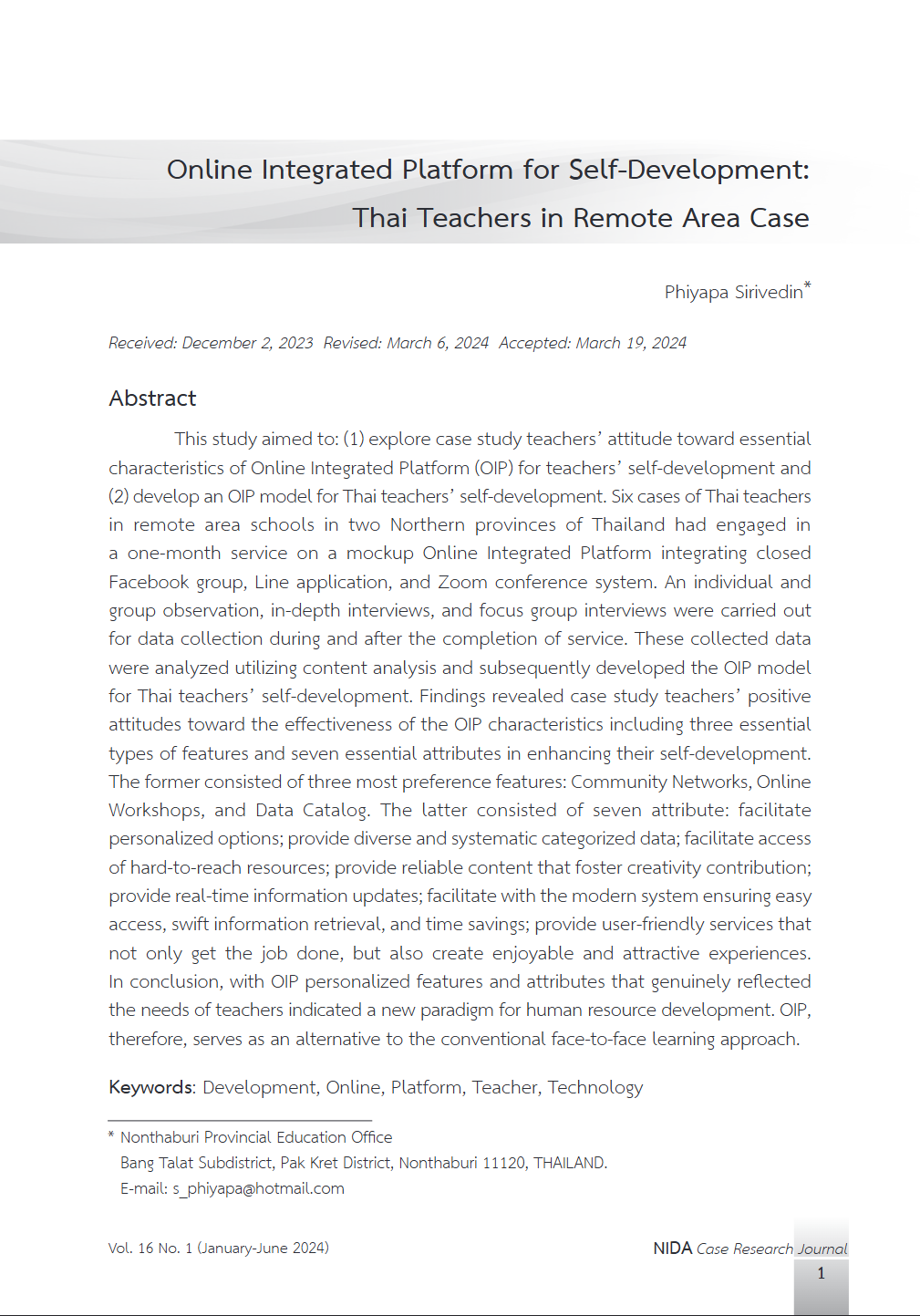
This study aimed to: (1) explore case study teachers’ attitude toward essential characteristics of Online Integrated Platform (OIP) for teachers’ self-development and (2) develop an OIP model for Thai teachers’ self-development. Six cases of Thai teachers in remote area schools in two Northern provinces of Thailand had engaged in a one-month service on a mockup Online Integrated Platform integrating closed Facebook group, Line application, and Zoom conference system. An individual and group observation, in-depth interviews, and focus group interviews were carried out for data collection during and after the completion of service. These collected data were analyzed utilizing content analysis and subsequently developed the OIP model for Thai teachers’ self-development. Findings revealed case study teachers’ positive attitudes toward the effectiveness of the OIP characteristics including three essential types of features and seven essential attributes in enhancing their self-development. The former consisted of three most preference features: Community Networks, Online Workshops, and Data Catalog. The latter consisted of seven attribute: facilitate personalized options; provide diverse and systematic categorized data; facilitate access of hard-to-reach resources; provide reliable content that foster creativity contribution; provide real-time information updates; facilitate with the modern system ensuring easy access, swift information retrieval, and time savings; provide user-friendly services that not only get the job done, but also create enjoyable and attractive experiences. In conclusion, with OIP personalized features and attributes that genuinely reflected the needs of teachers indicated a new paradigm for human resource development. OIP, therefore, serves as an alternative to the conventional face-to-face learning approach.
References
Aggarwal, J. (2009). Essentials of Educational Technology. New Delhi: Vikas. Publishing House Pvt. Ltd.
Aguilar, Jose, Cordero, J., and Buendía, O. (2017). Specification of the autonomic cycles of learning analytic tasks for a smart classroom. Journal of Educational Computing Research, 56(6), 866-891.
Agyeiwaah, E., Baiden, F., Gamor, E., and Hsud, F. (2022). Determining the attributes that influence students' online learning satisfaction during COVID-19 pandemic. J Hosp Leis Sport Tour Educ., 30, 100364.
Alfoudari, A., Durugbo, C., and Aldhmour, F. (2021). Understanding socio-technological challenges of smart classrooms using a systematic review. Computers & Education, 173, 104282. https://doi.org/10.1016/j.compedu.2021.104282
Anwar, K.; and Adnan, M. (2020). Online learning amid the COVID-19 pandemic: Students perspectives. J. Pedagog. Res., 1, 45-51.
Asoodeh, M. H., Asoodeh, M. B., & Zarepour, M. (2012). The impact of student centered learning on academic achievement and social skills. Procedia - Social and Behavioral Sciences, 46, 560-564.
Avalos, B. (2011). Teacher professional development in teaching and teacher education over ten years. Teaching and Teacher Education, 27(1), 10-20.
Aytaç, T., & Kula, S. (2020). The effect of student-centered approaches on students' creative thinking skills: A meta-analysis study. International Journal of Contemporary Educational Research, 7(2), 62-80. doi: https://doi.org/10.33200/ijcer.723894
Azevedo, R. (2009). Theoretical, conceptual, methodological and instructional issues in research on metacognition and self-regulated learning: a discussion. Metacogn. Learn., 4, 87-95. doi: 10.1007/s11409-009-9035-7
Campbell, L. (2004). Department of Science and Mathematics Education. The University of Melbourne; Melbourne.
Chandrasiri, A.; Collett, J.; Fassbender, E.; and De Foe, A. (2020). A virtual reality approach to mindfulness skills training. Virtual Real., 24, 143-149.
Choi, K., and Suk, H.-J. (2016). Dynamic lighting system for the learning environment: performance of elementary students. Optics Express, 24(10), A907. https://doi.org/10.1364/oe.24.00a907
Cui, N., and Fang, Z. (2018). An Empirical Study on the Effect of Group Cooperative Learning Mode on Medical Students' Autonomous Learning Ability. Journal of Higher Education, 15, 44-46.
Darsih, E. (2018). Learner-centered teaching: What makes it effective. Indonesian EFL Journal, 4(1), 33-42.
Deci, E., and Ryan, R. (1985). Intrinsic motivation and self-determination in human behavior. Springer Science & Business Media.
___________. (2002). Handbook of self-determination research. University of Rochester Press.
___________. (2012). Self-determination theory. In Handbook of theories of social psychology. Sage Publications Ltd., pp. 416-437.
Dhawan, S. (2020). Online Learning: A Panacea in the Time of COVID-19 Crisis. J. Educ. Technol. Syst., 49, 5-22.
DeLone, W., and McLean, E. (2003). The DeLone and McLeanmodel of information systems success: A ten-year update. Journal of Management Information Systems, 19(4), 9-30.
Eoma, S., Ashillb, N., Arbaughc, J.B., and Stapletond, J. (2012). The role of information technologyin e-learning systems success. Human Systems Management, 31, 147-163. DOI 10.3233/HSM-2012-0767
Godlewska, A., Beyer, W., Whetstone, S., Schaefli, L., Rose, J., Talan, B., Kamin-Patterson, S., Lamb, C., and Forcione, M. (2019). Converting a large lecture class to an active blended learning class: why, how, and what we learned. Journal of Geography in Higher Education, 43(1), 96-115. https://doi.org/10.1080/030982 65.2019.1570090
Gomezelj D., and Civre Z. (2012). Tourism graduate students' satisfaction with online learning. Turizam: Međunarodni Znanstveno-Stručni Časopis., 60(2), 159-174.
Harks, B., Rakoczy, K., Hattie, J., Besser, M., & Klieme, E. (2014). The effects of feedback on achievement, interest and self-evaluation: the role of feedback's perceived usefulness. Educational Psychology, 34(3), 269-290.
Hattie, J., and Timperley, H. (2007). The power of feedback. Review of Educational Research, 77, 81-112.
Heng Luo et al., (2021). Virtual reality in K-12 and higher education: A systematic review of the literature from 2000 to 2019. Journal of Computer Assisted Learning doi: 10.1111/jcal.12538
Huang, Y., Richter, E., Kleickmann, T, and Richter, D. (2021). Virtual reality in teacher education from 2010 to 2020: A review of program implementation, intended outcomes, and effectiveness measures. Springer VS Wiesbaden. Retrieved from http://link.springer.com/book/9783658378943 doi: 10.35542/osf.io/ye6uw
Krippendorff, K. (2004). Content Analysis: An Introduction to Its Methodology (2nd ed.) Thousand Oaks, CA: Sage Publications.
Lau, K. (2012). Instructional practices and self-regulated learning in Chinese language classes. Educational Psychology, 32, 427-450.
Lee, A. (2015). Authentication scheme for smart learning system in the cloud computing environment. Journal of Computer Virology and Hacking Techniques, 11(3), 149-155. https://doi.org/10.1007/s11416-015-0240-4
Li, J., Antonenko, P., & Wang, J. (2019). Trends and issues in multimedia learning research in 1996-2016: A bibliometric analysis. Educational Research Review, 28, 100282.
Livari, J. (2005). An empirical test of the DeLone-McLean model ofinformation system success, The DATA BASE for Advances in Information System, 36(2), 8-27.
Munawar, S., Toor, S. K., Aslam, M., and Hamid, M. (2018). Move to smart learning environment: Exploratory research of challenges in computer laboratory and design intelligent virtual laboratory for e-learning technology. Eurasia Journal of Mathematics, Science and Technology Education, 14(5), 1645-1662. https://doi.org/10.29333/ejmste/85036
Perkins Coie (2020). 2020 Augmented and virtual reality survey report. [Online] Retrieved from https://www.perkinscoie.com/images/content/2/3/v4/231654/2020-AR-VR-Survey-v3.pdf (August 14, 2023)
Downloads
Published
How to Cite
Issue
Section
License
Copyright (c) 2024 NIDA Case Research Journal

This work is licensed under a Creative Commons Attribution-NonCommercial-NoDerivatives 4.0 International License.