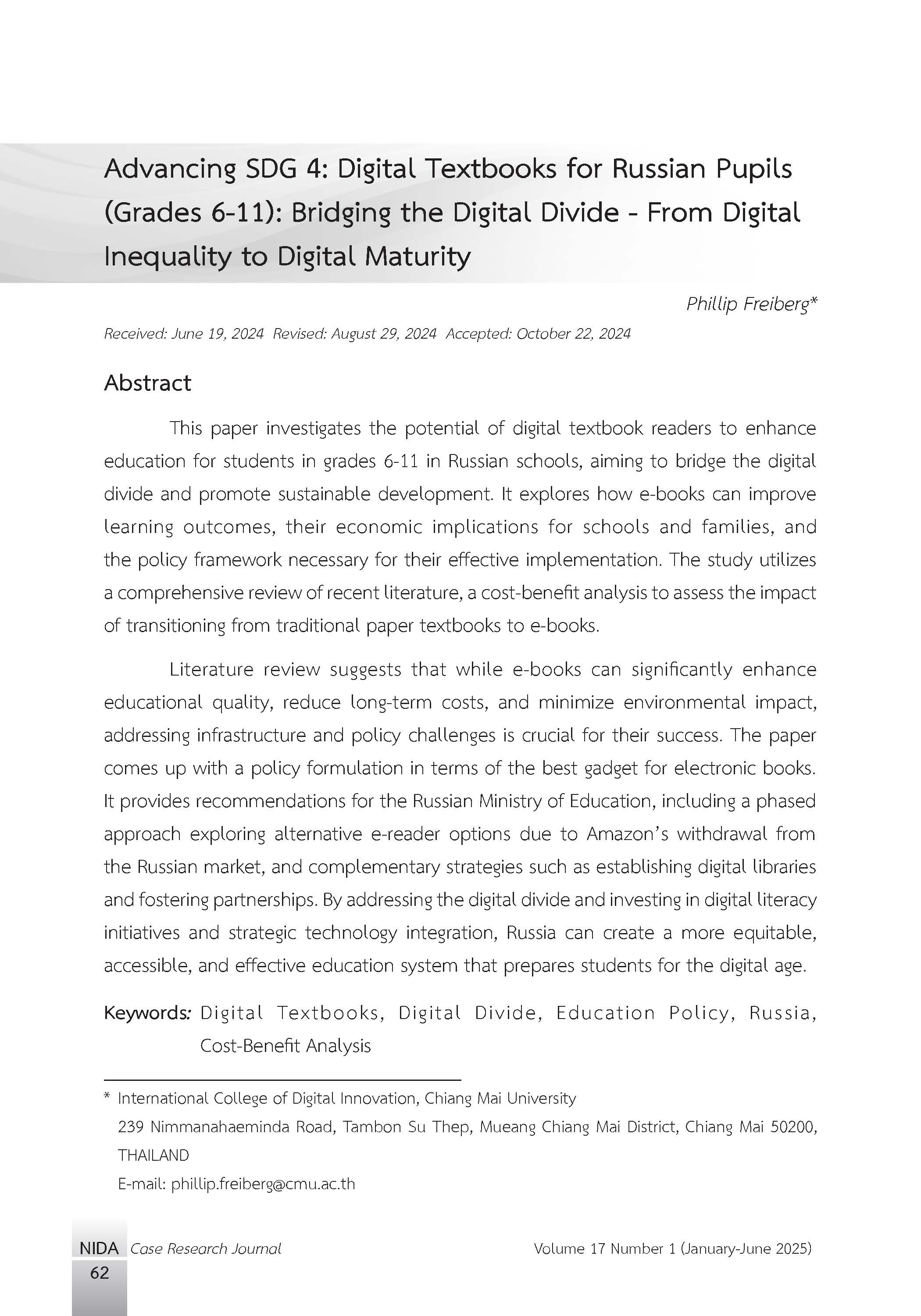
การส่งเสริม SDG 4: ตำราเรียนดิจิทัลสำหรับนักเรียนรัสเซีย (ชั้นประถมศึกษาปีที่ 6-11): การเชื่อมช่องว่างทางดิจิทัลจากความเหลื่อมล้ำทางดิจิทัลสู่ความเป็นผู้ใหญ่ทางดิจิทัล
DOI:
https://doi.org/10.14456/ncrj.2025.3คำสำคัญ:
ตำราเรียนดิจิทัล, ช่องว่างทางดิจิทัล, นโยบายการศึกษา, การวิเคราะห์ต้นทุน-ผลประโยชน์, รัสเซียบทคัดย่อ
บทความนี้สำรวจศักยภาพของตำราเรียนดิจิทัลในการเพิ่มพูนการศึกษาสำหรับนักเรียน ในระดับชั้น 6-11 ใน โรงเรียนรัสเซีย โดยมีเป้าหมายในการเชื่อมช่องว่างทางดิจิทัลและส่งเสริม การพัฒนาที่ยั่งยืน ศึกษาว่าหนังสืออิเล็กทรอนิกส์สามารถปรับปรุงผลการเรียนรู้ได้อย่างไร ผลกระทบ ทางเศรษฐกิจที่มีต่อโรงเรียนและครอบครัว และกรอบนโยบายที่จำเป็นสำหรับการนำไปใช้ที่มี ประสิทธิภาพ การศึกษาใช้การทบทวนวรรณกรรมล่าสุด อย่างครอบคลุม การวิเคราะห์ต้นทุน ผลประโยชน์ และการสร้างแบบจำลองทางการเงินเพื่อประเมินผล กระทบของการเปลี่ยนจากตำราเรียน แบบดั้งเดิมไปสู่หนังสืออิเล็กทรอนิกส์ ผลการศึกษาชี้ให้เห็นว่าแม้ว่า หนังสืออิเล็กทรอนิกส์จะสามารถ เพิ่มคุณภาพการศึกษา ลดต้นทุนระยะยาว และลดผลกระทบต่อสิ่งแวดล้อม ได้อย่างมีนัยสำคัญ แต่การแก้ไขปัญหาโครงสร้างพื้นฐานและความท้าทายด้านนโยบายเป็นสิ่งสำคัญสำหรับความสำเร็จ บทความนี้ให้คำแนะนำโดยละเอียดแก่กระทรวงศึกษาธิการของรัสเซีย ซึ่งรวมถึงการดำเนินการ ตามแนวทางแบบค่อยเป็นค่อยไปพร้อมกับโครงการนำร่อง การสำรวจทางเลือกอื่นสำหรับอีรีดเดอร์ เนื่องจาก การถอนตัวของ Amazon ออกจากตลาดรัสเซีย และกลยุทธ์เสริมอื่น ๆ เช่น การจัดตั้ง ห้องสมุดดิจิทัลและ ส่งเสริมความร่วมมือ โดยการแก้ไขช่องว่างทางดิจิทัลและการลงทุนในโครงการ การรู้หนังสือดิจิทัลและการบูรณาการเทคโนโลยีเชิงกลยุทธ์ รัสเซียสามารถสร้างระบบการศึกษาที่มี ความเสมอภาคเข้าถึงได้ และมีประสิทธิภาพมากขึ้น ซึ่งเตรียมความพร้อมให้นักเรียนสำหรับยุคดิจิทัล
เอกสารอ้างอิง
Aduwa-Ogiegbaen, S. E., & lyamu, E. O. S. (n.d.). Using information and communication technology in secondary schools in Nigeria: Problems and prospects. Department of Educational Psychology & Curriculum Studies, Faculty of Education, University of Benin.
American Academy of Ophthalmology. (n.d.). Screen use in kids: Tips for healthy screen use. https://www.aao.org/eye-health/tips-prevention/screen-use-kids
Birkland, T. A. (2015). An introduction to the policy process: Theories, concepts, and models of public policy making (3rd ed.). M.E. Sharpe.
Cairncross, F., & Pöysti, K. (2003). ICTs for education and building human capital. International Telecommunication Union.
Chandrasekhar, C. P. (2001). ICT in a developing country context: An Indian case study. Centre for Economic Studies & Planning, Jawaharlal Nehru University.
Dahlman, C. (2007). Technology, globalization, and international competitiveness:
Challenges for developing countries. United Nations Department of Economic and Social Affairs. https://sustainabledevelopment.un.org/content/documents/full_report.pdf#page=37
Fisseha, M. (2011). The Roles of information communication technologies in education: Review article with emphasis on the computer and internet.
Freiberg, P. (2011). Education expenditures on ICTs in developing countries. USAID first principles: Designing effective education programs using information and communication technology (ICT).
Freiberg, P. (2012). Putin's Zugzwang: Internet in Russia: The role of the internet in the December 2011 Moscow protests.
Hawkins, R. J. (2002). Ten lessons for ICT and education in the developing world. World links for development program, The World Bank Institute.
Hilbert, M. (2010). When is cheap, cheap enough to bridge the digital divide? Modeling Income related structural challenges of technology diffusion in Latin America. World Development.
Jhurree, V. (2005). Technology integration in education in developing countries: Guidelines to policy makers. International Education Journal, 6(4), 467-483.
Kelley-Salinas, G. (2000). Different educational inequalities: ICT an option to close the gaps. Latin American Institute of Educational Communication (ILCE), Organisation for Economic Co-operation and Development (OECD).
Kozma, R. B. (2010). ICT and educational reform in developed and developing countries. Center for technology in learning, SRI International.
Light, D. (2009). The role of ICT in enhancing education in developing countries: Findings from an evaluation of the intel teach essentials course in India, Turkey, and Chile. EDC/Center for Children and Technology.
Mansell, R. (2010). Information and communication technologies for development: assessing the potential and the risks. Journal of International Affairs, 64(1).
Martinez-Frias, J. (2003). The importance of ICTs for developing countries. Interdisciplinary Science Reviews, 28(1).
Mbodila, M., Jones, T., & Muhandji, K. (2013). Integration of ICT in education: Key challenges. International Journal of Emerging Technology and Advanced Engineering, 3(11).
Mndzebele, N. (2013). Challenges faced by schools when introducing ICT in developing countries. International Journal of Humanities and Social Science Invention, 2(9).
Morozov, E. (2011). The net delusion: The dark side of internet freedom. PublicAffairs.
OECD. (2019). Russia Country Note PISA 2018 Results (Vol. 3, pp. 1-10). OECD Publishing. https://doi.org/10.1787/acd78851-en
OECD. (2023). Shaping digital education: Enabling factors for quality, Equity and efficiency. OECD Publishing. https://doi.org/10.1787/bac4dc9f-en
Peeraer, J., & Van Petegem, P. (2011). ICT in teacher education in an emerging developing country: Vietnam's baseline situation at the start of 'The Year of ICT'. Computers & Education, 56(4).
Rajesh, M. (2003). A study of the problems associated with ICT adaptability in developing countries in the context of distance education. Turkish Online Journal of Distance Education-TOJDE, 4(2).
Reddi, U. R. V. (2011). Primer 1: An introduction to ICT for development. Asian and Pacific Training Centre for Information and Communication Technology for Development (APCICT).
Rosenberger, S. (2014). ICTs and development, What is missing? The Institute for Entwicklungsforschung and Entwicklungspolitik, Bochum.
Rosstat. (2022). Title of the Document. https://rosstat.gov.ru/storage/mediabank/osn-12-2022.pdf
Saidu, A., Tukur, Y., & Adamu, S. H. (2014). Promoting sustainable development through ICT in developing countries. European Journal of Computer Science and Information Technology, 2(2).
Schmidt, E. (2010, August 4). Eric Schmidt: Technology will transform every business [Video]. YouTube. https://www.youtube.com/watch?v=UAcClsrAq70
Setzer, V. W. (2001). A review of arguments for the use of computers in elementary education. Institute of Mathematics and Statistics, University of São Paulo.
Seraw, & Lu, X. (2020). International Journal of Academic Multidisciplinary Research (IJAMR), 4(11), 113-118. ISSN: 2643-9670.
Signé, L. (2017). Policy implementation: A synthesis of the study of policy implementation and the causes of policy failure. OCP Policy Center. http://www.ocppc.ma/sites/default/files/OCPPCPP1703.pdf
Silver, J. (2012, February 24). Classroom disruptor: The proprietary tablet PC that's changing Russian schools. Wired. https://www.wired.com/story/classroom-disruptor/
Susskind, R. (2019). Online courts and the future of justice. Oxford University Press.
UNESCO. (2023). Global education monitoring report 2023: Technology in education. United Nations Educational, Scientific and Cultural Organization. https://doi.org/10.54676/UZQV8501
USAID. (2011). First principles: Designing effective education programs using information and communication technology (ICT).
Warschauer, M. (2010). Journal of international affairs, Fall/Winter 2010, 64(1).
Winthrop, R., & Smith, M. S. (2012). A new face of education: Bringing technology into the classroom in the developing world. Brooke Shearer Working Paper Series, Brookings Institution.
Wong, Y. C., Law, C. K., Fung, J. Y. C., & Lee, V. W. P. (2010). Digital divide and social inclusion: Policy challenge for social development in Hong Kong and South Korea. Journal of Asian Public Policy, 3(1), 27-52.
World Bank. (2023, October 17). Poverty overview: Development news, research, data [Report]. Retrieved from https://www.worldbank.org/poverty/overview
ดาวน์โหลด
เผยแพร่แล้ว
รูปแบบการอ้างอิง
ฉบับ
ประเภทบทความ
สัญญาอนุญาต
ลิขสิทธิ์ (c) 2025 NIDA Case Research Journal

อนุญาตภายใต้เงื่อนไข Creative Commons Attribution-NonCommercial-NoDerivatives 4.0 International License.