
บทบาทของการกำกับดูแลเชิงโครงสร้างและการกำกับดูแลเชิงความสัมพันธ์ต่อการพัฒนาความสัมพันธ์ที่ประสบความสำเร็จระหว่างผู้ซื้อและผู้จัดหา: กรณีศึกษาอุตสาหกรรมก่อสร้างในประเทศเนปาล
DOI:
https://doi.org/10.14456/ncrj.2026.1คำสำคัญ:
การกำกับดูแลเชิงโครงสร้างและเชิงความสัมพันธ์, ความสัมพันธ์ระหว่างองค์กร , ความสัมพันธ์ในการแลกเปลี่ยนระหว่างผู้ซื้อและผู้จัดหา, การทำสัญญาอย่างเป็นทางการ, ความไว้วางใจ, ผลการดำเนินงานของการแลกเปลี่ยนบทคัดย่อ
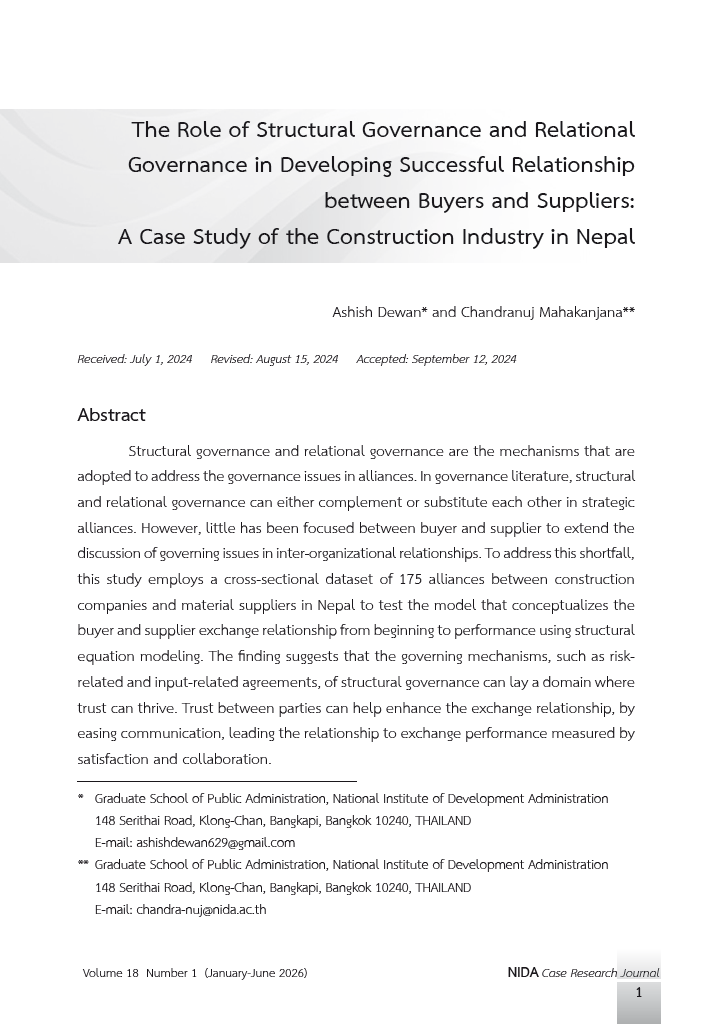
การกำกับดูแลเชิงโครงสร้างและการกำกับดูแลเชิงความสัมพันธ์เป็นกลไกที่ถูกนำมาใช้เพื่อจัดการกับประเด็นด้านการกำกับดูแลในความร่วมมือระหว่างองค์กรในวรรณกรรมด้านการกำกับดูแล พบว่า การกำกับดูแลทั้งสองรูปแบบสามารถทำหน้าที่เสริมกันหรือทดแทนกันได้ในบริบทของพันธมิตร เชิงกลยุทธ์ อย่างไรก็ตาม การศึกษาที่มุ่งเน้นความสัมพันธ์ระหว่างผู้ซื้อและผู้จัดหายังคงมีจำกัดในการ ขยายการอภิปรายเกี่ยวกับประเด็นการกำกับดูแลในความสัมพันธ์ระหว่างองค์กร เพื่อแก้ไขข้อจำกัด ดังกล่าว การศึกษานี้ใช้ชุดข้อมูลแบบภาคตัดขวางจากความร่วมมือจำนวน 175 ความร่วมมือระหว่าง บริษัทก่อสร้างและผู้จัดหาวัสดุก่อสร้างในประเทศเนปาล เพื่อนำมาทดสอบแบบจำลองที่อธิบายความ สัมพันธ์ในการแลกเปลี่ยนระหว่างผู้ซื้อและผู้จัดหา ตั้งแต่ระยะเริ่มต้นของความสัมพันธ์จนถึงผลการ ดำเนินงาน โดยใช้การวิเคราะห์แบบจำลองสมการโครงสร้าง ผลการศึกษาพบว่า กลไกการกำกับดูแล เช่น ข้อตกลงที่เกี่ยวข้องกับความเสี่ยงและปัจจัยนำเข้า ซึ่งเป็นส่วนหนึ่งของการกำกับดูแลเชิงโครงสร้าง สามารถสร้างกรอบที่เอื้อต่อการก่อให้เกิดความไว้วางใจระหว่างคู่สัญญาความไว้วางใจระหว่างคู่สัญญามีส่วนช่วยเสริมสร้างความสัมพันธ์ในการแลกเปลี่ยนโดยเอื้อให้การสื่อสารเป็นไปอย่างราบรื่น และนำ ไปสู่ผลการดำเนินงานของความสัมพันธ์ในการแลกเปลี่ยน ซึ่งวัดจากระดับความพึงพอใจและความร่วม มือระหว่างกัน
เอกสารอ้างอิง
Abdi, M., & Aulakh, P. S. (2017). Locus of uncertainty and the relationship between contractual and relational governance in cross-border interfirm relationships. Journal of Management, 43(3), 771-803. https://doi.org/10.1177/0149206314541152
Baker, G., Gibbons, R., & Murphy, K. J. (2002). Relational contracts and the theory of the firm. The Quarterly Journal of Economics, 117(1), 39-84. https://doi.org/10.1162/003355302753399445
Bonatto, F., de Resende, L. M. M., & Pontes, J. (2020). Relational governance in the supply chain: a systematic literature review. Benchmarking: An International Journal 27(6), 1711-1741. https://doi.org/10.1108/BIJ-01-2019-0033
Cabigiosu, A., & Camuffo, A. (2012). Beyond the “mirroring” hypothesis: Product modularity and inter-organizational relations in the air conditioning industry. Organization Science, 23(3), 686-703. https://www.jstor.org/stable/23252083
Chen, I. J., Paulraj, A., & Lado, A. A. (2004). Strategic purchasing, supply management, and firm performance. Journal of Operations Management, 22(5), 505-523. https://doi.org/10.1016/j.jom.2004.06.002
Cui, A. S., & O’Connor, G. (2012). Alliance portfolio resource diversity and firm innovation. Journal of Marketing, 76(4), 24-43. https://doi.org/10.1509/jm.11.0130
Dekker, H. C. (2004). Control of inter-organizational relationships: Evidence on appropriation concerns and coordination requirements. Accounting, Organizations and Society, 29(1), 27-49. https://doi.org/10.1016/S0361-3682(02)00056-9
De Leeuw, D. (2005). To mix or not to mix data collection modes in surveys. Journal of Official Statistics, 21(2), 233-255 https://api.semanticscholar.org/CorpusID:51995365
Duan, M. (2012). The role of formal contracts with weak legal enforcement: A study in the Chinese context. Strategic Organization, 10(2), 158-186. https://doi.org/10.1177/1476127012444918
Faems, D., Janssens, M., Madhok, A., & Looy, B. V. (2008). Toward an integrative perspective on alliance governance: Connecting contract design, trust dynamics, and contract application. Academy of Management Journal, 51(6), 1053-1078. https://doi.org/10.5465/AMJ.2008.35732527
Ferguson, R. J., Paulin, M., & Bergeron, J. (2005). Contractual governance, relational governance, and the performance of interfirm service exchanges: The influence of boundary-spanner closeness. Journal of the Academy of Marketing Science, 33, 217-234. https://doi.org/10.1177/0092070304270729
Garbade, P., Omta, S., & Fortuin, F. (2016). The interplay of structural and relational governance in innovation alliances. Journal on Chain and Network Science, 16(2), 117-134. https://doi.org/10.3920/jcns2014.x016
Grandori, A., & Furlotti, M. (2010). Flexible formalization: A study on the components of contractual and extra-contractual formal organization. Paper presented at the 14th Annual Conference of The International Society for New Institutional Economics. University of Stirling, Scotland, UK.
Granovetter, M. (1985). Economic action and social structure: The problem of embeddedness. American Journal of Sociology, 91(3), 481-510. https://www.jstor.org/stable/2780199
Gulati, R. (1998). Alliances and networks. Strategic Management Journal, 19(4), 293-317. https://www.jstor.org/stable/3094067
Gulati, R. (2007). Managing network resources: Alliances, affiliations, and other relational assets: Oxford University Press, USA. https://doi.org/10.1093/oso/9780199299355.001.0001
Gulati, R., & Nickerson, J. A. (2008). Interorganizational trust, governance choice, and exchange performance. Organization Science, 19(5), 688-708. https://doi.org/10.1287/orsc.1070.0345
Gulati, R., & Singh, H. J. A. s. q. (1998). The architecture of cooperation: Managing coordination costs and appropriation concerns in strategic alliances. Administrative Science Quarterly 43(4), 781-814. https://www.jstor.org/stable/2393616
Gulati, R., & Sytch, M. (2007). Dependence asymmetry and joint dependence in interorganizational relationships: Effects of embeddedness on a manufacturer’s performance in procurement relationships. Administrative Science Quarterly, 52(1), 32-69. https://doi.org/10.2189/asqu.52.1.32
Heide, J. B. J. J. o. m. (1994). Interorganizational governance in marketing channels. 58(1), 71-85. https://doi.org/10.2307/1252252
Hillman, A. J., Withers, M. C., & Collins, B. J. (2009). Resource dependence theory: A review. Journal of Management, 35(6), 1404-1427. https://doi.org/10.1177/0149206309343469
Hoetker, G., & Mellewigt, T. (2009). Choice and performance of governance mechanisms: Matching alliance governance to asset type. Strategic Management Journal, 30(10), 1025-1044. https://doi.org/10.1002/smj.775
Howard, M., & Squire, B. (2007). Modularization and the impact on supply relationships. International Journal of Operations & Production Management. 27(11): 1192-1212. https://doi.org/10.1108/01443570710830593
Joshi, A. W., & Arnold, S. J. (1998). How relational norms affect compliance in industrial buying. Journal of Business Research. 41(2), 105-114. https://doi.org/10.1016/S0148-2963(97)00017-9
Klein, B. (1980). Transaction cost determinants of “Unfair” contractual arrangements. The American Economic Review, 70(2), 356-362. http://www.jstor.org/stable/1815498
Krishnan, R., Martin, X., & Noorderhaven, N. G. (2006). When does trust matter to alliance performance? Academy of Management Journal, 49(5), 894-917. https://doi.org/10.5465/AMJ.2006.22798171
Lakpetch, P., & Lorsuwannarat, T. (2012). Knowledge transfer effectiveness of university-industry alliances. International Journal of Organizational Analysis, 20(2), 128-186. https://doi.org/10.1108/19348831211227819
Larson, A. (1992). Network dyads in entrepreneurial settings: A study of the governance of exchange relationships. Administrative Science Quarterly, 37(1), 76-104. https://doi.org/10.2307/2393534
Lioukas, C. S., & Reuer, J. J. (2020). Choosing between safeguards: Scope and governance decisions in R&D alliances. Journal of Management, 46(3), 359-384. https://doi.org/10.1177/0149206318795240
Madhok, A. (1995). Opportunism and trust in joint venture relationships: An exploratory study and a model. Scandinavian Journal of Management, 11(1), 57-74. https://doi.org/10.1016/0956-5221(94)00029-H
Manolova, T. S., Manev, I. M., & Gyoshev, B. S. (2014). Friends with money? Owner’s financial network and new venture internationalization in a transition economy. International Small Business Journal, 32(8), 944-966. https://doi.org/10.1177/0266242613482482
Mellewigt, T., Madhok, A., & Weibel, A. (2007). Trust and formal contracts in interorganizational relationships—substitutes and complements. Managerial and Decision Economics, 28(8), 833-847. https://doi.org/10.1002/mde.1321
Moorman, C., Zaltman, G., & Deshpande, R. (1992). Relationships between providers and users of market research: The dynamics of trust within and between organizations. Journal of Marketing Research, 29(3), 314-328. https://doi.org/10.1177/002224379202900303
Murray, J. Y. (2001). Strategic alliance-based global sourcing strategy for competitive advantage: A conceptual framework and research propositions. 9(4), 30-58. https://doi.org/10.1509/jimk.9.4.30.19938
Novak, S., & Stern, S. (2008). How does outsourcing affect performance dynamics? Evidence from the automobile industry. Management Science, 54(12), 1963-1979. https://doi.org/10.1287/mnsc.1080.0922
Paulraj, A., Lado, A. A., & Chen, I. J. (2008). Inter-organizational communication as a relational competency: Antecedents and performance outcomes in collaborative buyer-supplier relationships. Journal of Operations Management, 26(1), 45-64. https://doi.org/10.1016/j.jom.2007.04.001
Pfeffer, J., & Salancik, G. R. (2003). The external control of organizations: A resource dependence perspective. Stanford University Press.
Poppo, L., & Zenger, T. (2002). Do formal contracts and relational governance function as substitutes or complements? Strategic Management Journal, 23(8), 707-725. https://www.jstor.org/stable/3094289
Powell, W. W. (2012). Neither market nor hierarchy: Network forms of organization. In M. Godwyn & J. H. Gittell (Eds.), Sociology of organizations: Structures and relationships (pp. 30–40). Sage. https://uk.sagepub.com/sites/default/files/upm-assets/41370_book_item_41370.pdf
Powell, W. W., & DiMaggio, P. J. (Eds.). (1991). The new institutionalism in organizational analysis. University of Chicago Press. https://press.uchicago.edu/ucp/books/book/chicago/N/bo3684488.html
Reuer, J. J., & Ariño, A. (2007). Strategic alliance contracts: Dimensions and determinants of contractual complexity. Strategic Management Journal, 28(3), 313-330. https://doi.org/10.1002/smj.581
Ring, P. S., & Van de Ven, A. H. (1992). Structuring cooperative relationships between organizations. Strategic Management Journal, 13(7), 483-498. https://doi.org/10.1002/smj.4250130702
Ring, P. S., & Van de Ven, A. H. (1994). Developmental processes of cooperative interorganizational relationships. Academy of Management Review, 19(1), 90-118. https://doi.org/10.2307/258836
Ryall, M. D., & Sampson, R. C. (2003). Do prior alliances influence contract structure? Evidence from technology alliance contracts (Working Paper No. FR 03-11). Simon School of Business, University of Rochester. https://doi.org/10.2139/ssrn.396601
Skinner, S. J., Donnelly, J. H., Jr., & Ivancevich, J. M. (1987). Effects of transactional form on environmental linkages and power-dependence relations. Academy of Management Journal, 30(3), 577-588. https://doi.org/10.2307/256016
Teng, B. S., & Das, T. K. (2008). Governance structure choice in strategic alliances. Management Decision, 46(5), 725-742. https://doi.org/10.1108/00251740810873701
Tepic, M., Omta, O., Trienekens, J., & Fortuin, F. (2011). The role of structural and relational governance in creating stable innovation networks: Insights from sustainability-oriented Dutch innovation networks. Journal on Chain and Network Science, 11(3), 197-211. https://doi.org/10.3920/JCNS2011.x206
Uzzi, B. (1997). Social structure and competition in interfirm networks: The paradox of embeddedness. Administrative Science Quarterly, 42(1), 35-67. https://doi.org/10.2307/2393808
Uzzi, B. (1999). Embeddedness in the making of financial capital: How social relations and networks benefit firms seeking financing. American Sociological Review, 64(4), 481-505. https://doi.org/10.2307/2657252
Vickery, S. K., Jayaram, J., Droge, C., & Calantone, R. (2003). The effects of an integrative supply chain strategy on customer service and financial performance: An analysis of direct versus indirect relationships. Journal of Operations Management, 21(5), 523-539.
Williamson, O. E. (1979). Transaction-cost economics: The governance of contractual relations. The Journal of Law and Economics, 22(2), 233-261. http://dx.doi.org/10.1086/466942
Williamson, O. E. (1985). The economic institutions of capitalism. The Antitrust Bulletin, 31(3), 827-834. https://doi.org/10.1177/0003603X8603100308
Oxley, J. E. (1997). Appropriability hazards and governance in strategic alliances: A transaction cost approach. The Journal of Law, Economics, and Organization, 13(2), 387-409. http://www.jstor.org/stable/765097
Williamson, O. E. (1991). Comparative economic organization: The analysis of discrete structural alternatives. Administrative Science Quarterly, 36, 269-296. https://doi.org/10.2307/2393356
Zenger, T. R., Lazzarini, S. G., & Poppo, L. (2000). Informal and formal organization in new institutional economics. In N. J. Foss (Ed.), The new institutionalism in strategic management. Emerald Group Publishing. https://doi.org/10.1016/S0742-3322(02)19009-7
ดาวน์โหลด
เผยแพร่แล้ว
รูปแบบการอ้างอิง
ฉบับ
ประเภทบทความ
สัญญาอนุญาต
ลิขสิทธิ์ (c) 2026 NIDA Case Research Journal

อนุญาตภายใต้เงื่อนไข Creative Commons Attribution-NonCommercial-NoDerivatives 4.0 International License.